
Bleichroeder Acquisition Corp. III: Ursa Major Deal Defines the Stakes as Liquidity Pressures Mount
With a definitive merger agreement to acquire Ursa Major Technologies, Bleichroeder Acquisition Corp. The structure, size, and required cash minimum of the transaction will determine whether this SPAC can transition from a shell to an operating company—or wind down under mounting financial strain.
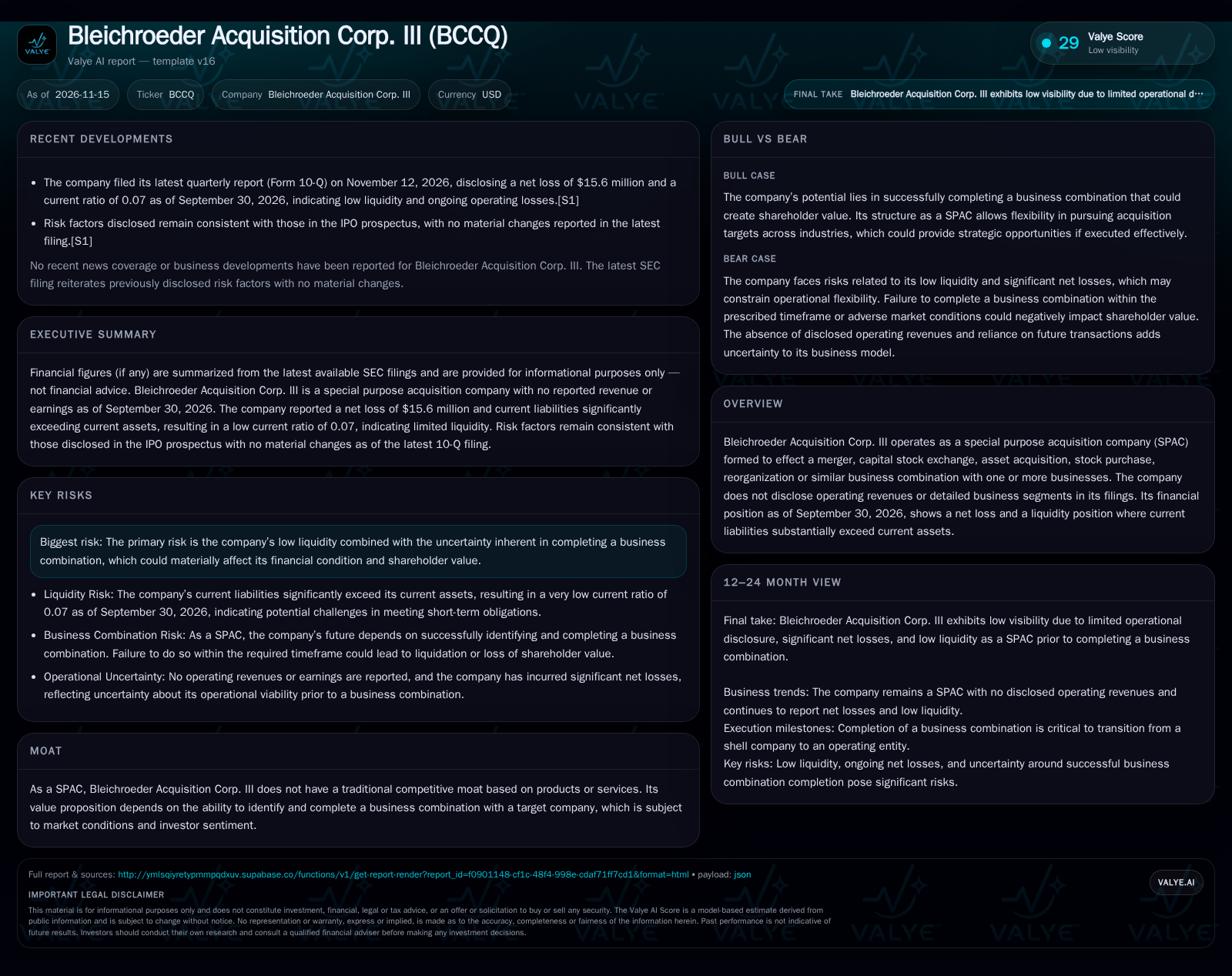
Bleichroeder Acquisition Corp. III, a SPAC, has entered a definitive agreement to acquire Ursa Major Technologies for $1.6 billion in stock, subject to a $150 million minimum cash condition. As of September 30, 2026, the company had just $1.28 million in current assets against $18 million in current liabilities and reported a net loss of $15.6 million. The viability of the business combination, contingent financing, and the SPAC’s ability to satisfy closing conditions will determine whether this entity becomes an operating company or faces liquidation.[S1]
Bleichroeder Acquisition Corp. III’s future now hinges on the successful completion of its proposed $1.6 billion all-stock acquisition of Ursa Major Technologies—a transformative deal for a SPAC that currently has no operating revenues, a net loss of $15.6 million for the last quarter, and a current ratio near zero. The transaction’s closing is far from assured, with a $150 million minimum cash condition and over $242 million in preferred stock financing required to consummate the merger. In this high-stakes moment, the company’s ability to secure funding and finalize the business combination will determine whether it transitions to an operating business or faces dissolution under mounting short-term liabilities.[S1]
Definitive Ursa Major Deal and Liquidity Crunch Set the Stage
The most material current fact is Bleichroeder Acquisition Corp. III’s entry, on August 24, 2026, into a definitive agreement to acquire Ursa Major Technologies for $1.6 billion, entirely in stock. The deal is subject to a $150 million minimum cash condition at closing, and is structured to issue 160 million shares at $10 per share. In parallel, the SPAC has arranged for $242.5 million in Series A preferred stock and warrant investment to support the closing.[S1]
As of September 30, 2026, the company’s balance sheet is strained: just $1.28 million in current assets against $18 million in current liabilities, yielding a current ratio of 0.07. The SPAC has no operating revenues and reported a quarterly net loss of $15.6 million.[S1]
No material changes to disclosed risk factors have been reported since the IPO, meaning the primary risks remain: liquidity, execution of the business combination, and the risk of liquidation if the deal fails.[S1]
How the SPAC Structure Drives Economics and Execution Risk
Bleichroeder Acquisition Corp. III, like all SPACs, has no operating revenues or recurring business model prior to completing a merger. Its economics are binary: either successfully close a business combination, thereby inheriting a target’s operations and potential upside, or liquidate and return remaining funds to shareholders.
The economics of SPAC deals are driven by several levers: the ability to raise and retain sufficient cash (often via PIPE or preferred rounds), the terms of the business combination (valuation, dilution, earnouts), and the capital structure post-merger. The $1.6 billion all-stock deal for Ursa Major is large by recent SPAC standards, but closing is contingent on raising at least $150 million in cash, plus $242 million in preferred investment.[S1]
The company’s current liabilities vastly exceed its assets, suggesting that, absent new capital, it cannot meet near-term obligations. This makes the closing of the business combination not just strategic, but existential. If the deal closes, the economics shift to those of the combined entity; if not, the SPAC faces dissolution costs and sponsor losses.
SPACs also face substantial fixed costs (legal, advisory, administrative) during the deal process, which explains the ongoing net losses in the absence of operating income. The need to maintain a public listing and meet regulatory requirements further adds to the burn rate.
SPACs in a Crowded Market: Competitive Dynamics and Differentiation
Bleichroeder Acquisition Corp. III’s competitive position is defined by its ability to source, negotiate, and close a compelling business combination before its deadline and ahead of rival SPACs. The current environment is highly competitive, with many SPACs chasing a shrinking pool of attractive targets, leading to higher valuations and tighter deal terms.
In theory, the management team’s experience and network can provide differentiation—especially if they have sector expertise or deal-making credibility. The company has indicated a focus on North American and European businesses in disruptive growth sectors, particularly those undergoing technology-driven transformation, where its team believes it can add value.[S1]
However, the absence of a recurring business or product means that the SPAC’s only competitive advantage lies in deal sourcing, capital raising, and execution. The definitive agreement with Ursa Major suggests some success in this regard, but actual differentiation will be determined by the ability to close under challenging market and liquidity conditions.
Peer competition comes not only from other SPACs, but also from private equity and direct listings, which may offer targets more attractive terms or certainty.
If the Ursa Major Combination Closes: Pathways to Value Creation
The most favorable scenario is that Bleichroeder Acquisition Corp. III raises the required $150 million in cash (and secures the $242 million in preferred investment), satisfies all closing conditions, and successfully merges with Ursa Major Technologies. In this case, the combined entity would transition from a shell to an operating business with real assets, operations, and potentially high-growth prospects—depending on Ursa Major’s underlying business.
The upside causal chain: 1) Sufficient capital is raised through PIPE or preferred rounds; 2) Shareholder and regulatory approvals are obtained; 3) The merger is consummated; 4) The new entity leverages public listing for expansion, talent, and future fundraising.
Evidence that would confirm this scenario includes SEC filings reporting satisfaction of closing conditions, funding rounds closing as planned, and public communications from both parties affirming deal momentum. If Ursa Major’s business fundamentals are strong, this could drive post-combination value for shareholders.
Falsification would occur if the company fails to raise the required cash, encounters regulatory or shareholder resistance, or if Ursa Major withdraws from the deal.
Most Plausible Outcome: Execution Challenges and a Narrow Window
Given the company’s liquidity position, the most plausible scenario is a period of intense effort to secure the necessary capital and meet closing conditions—but with significant execution risk. The SPAC may need to renegotiate deal terms, seek alternative or additional financing, or adjust the minimum cash requirement to bring the transaction to completion.
Typical frictions include investor hesitancy in the current SPAC market, redemptions by existing shareholders, and the risk that PIPE or preferred investors require more favorable terms. The base case is that the company either closes the deal with some adjustments to structure or timing, or—if capital cannot be secured in time—faces the risk of liquidation.
Evidence supporting the base scenario would be incremental updates on financing progress, amended deal terms, or regulatory extensions. Evidence against it would be failure to secure investment commitments, missed filing deadlines, or public withdrawal by Ursa Major.
Deal Failure or Funding Shortfall: The Liquidation Route
The primary risk is that Bleichroeder Acquisition Corp. III cannot raise the required cash or fails to meet other closing conditions, leading to the collapse of the Ursa Major deal. In this event, the SPAC would likely enter liquidation, returning any remaining trust proceeds to shareholders after paying creditors, while sponsors and warrant holders typically lose their investment.
The causal chain: 1) Funding efforts are unsuccessful; 2) Redemptions or lack of PIPE/preferred commitments leave the SPAC unable to meet minimum cash condition; 3) Deal is terminated; 4) SPAC dissolves, incurring additional costs and losses.
Evidence confirming this scenario would include 8-K or SEC filings announcing termination of the merger agreement, lack of financing updates, or explicit statements about pursuing liquidation. Falsification would require clear progress toward closing, including cash in escrow or confirmed investor commitments.
Milestones That Will Determine Whether Bleichroeder Becomes an Operating Company or Dissolves
Updates on the $150 million minimum cash commitment: Evidence of PIPE, preferred, or other capital raising would be critical to confirm closing momentum.
Progress toward closing the $242.5 million Series A preferred and warrant investment: Announcements or SEC filings on these tranches would help test the thesis.
Shareholder redemption rates: If disclosed, high redemption levels could jeopardize the minimum cash condition and threaten deal viability.
Ursa Major’s own financial and operational disclosures: Post-announcement updates or S-4 filings would clarify the quality and scalability of the operating target.
Amendments to the merger agreement: Extensions, waivers, or renegotiations could signal either flexibility or distress, depending on context.
Sponsor and insider participation in additional financings: Commitments by insiders can indicate confidence or necessity.
Regulatory and shareholder approval milestones: SEC effectiveness notices, proxy filings, and vote outcomes will determine timeline and feasibility.
Material changes in risk disclosures: New SEC filings noting changes in risk factors or business outlook would be important signals.
Disclaimer: This is research-only, informational analysis and not investment advice. It may include AI-generated interpretation and general industry context. Always verify important details using primary sources.

Comments