
BlackboxStocks: Subscription Trading Analytics, Platform Upgrades, and the Stakes of Sustained Losses
BlackboxStocks offers a hybrid SaaS platform combining real-time analytics, community, and education for retail traders, but its financial trajectory and governance structure raise questions about long-term sustainability and minority shareholder influence.
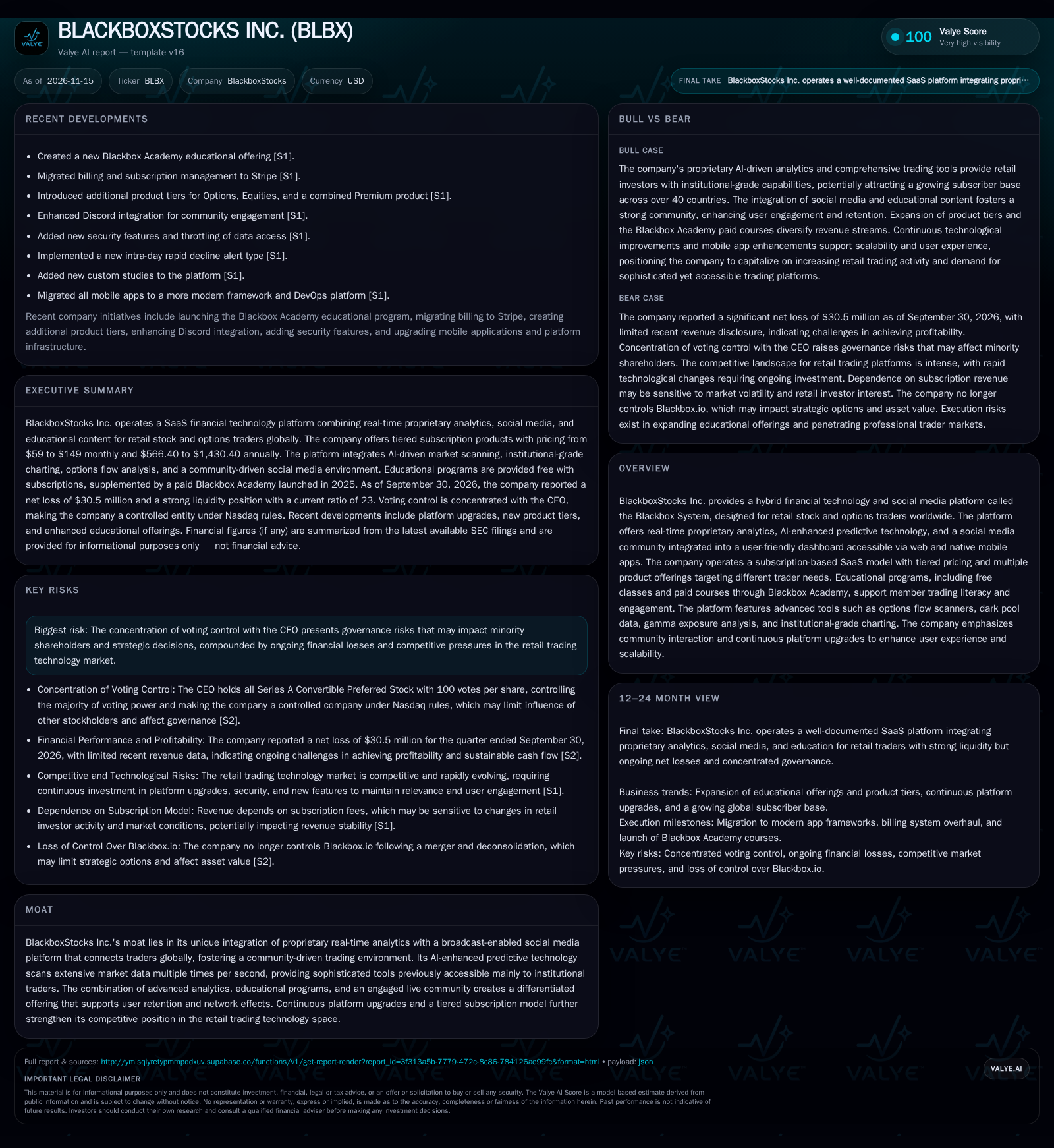
BlackboxStocks delivers proprietary analytics and social features for retail stock and options traders through a tiered SaaS model, recently expanding its educational and product offerings. Despite substantial platform improvements and a global subscriber base, the company reported a significant net loss for the latest quarter and faces ongoing competitive and governance risks. The challenge is whether product innovation and community engagement can drive sustainable revenue growth before capital constraints or market shifts intervene. [S1] [S2]
BlackboxStocks Inc. is positioning itself as a differentiated player in the crowded retail trading technology market by combining real-time analytics, AI-driven tools, and a vibrant social community. With a SaaS model targeting a global base of active traders, the company has invested in platform upgrades, mobile app modernization, and new educational offerings, aiming to deepen engagement and diversify revenue. However, a substantial quarterly net loss and highly concentrated voting control highlight the operational and governance risks facing the firm. The crucial question is whether BlackboxStocks can convert product innovation and community stickiness into a sustainable financial model before competitive pressures or governance constraints become existential.
Recent Losses, Platform Enhancements, and Governance Structure: What’s Changed
The company reported a current ratio of 23 for the period. [S2]
The company has rolled out several platform and product upgrades: new educational offerings under Blackbox Academy, additional product tiers for options and equities, improved mobile app frameworks, and enhanced billing and security systems [S1].
A critical governance fact is the concentration of voting power with CEO Leonard Sternheim, who controls all Series A Convertible Preferred Stock, making BlackboxStocks a controlled company under Nasdaq rules [S2]. This governance structure may influence strategic flexibility and minority shareholder protections.
Subscription Revenue Model and the Scalability Challenge
BlackboxStocks’ core business model is a subscription-based SaaS offering, with monthly plans from $59 to $149 and annual options from $566.40 to $1,430.40, spanning four product tiers for options and equities trading [S1]. This approach provides a recurring revenue base, which, if subscriber growth is strong and churn is low, can support operating leverage and stable cash flows.
The addition of paid educational content through Blackbox Academy (courses priced $197–$497) introduces a higher-margin, potentially less cyclical ancillary revenue stream, though its scale remains unproven [S1].
Fixed costs are likely dominated by data infrastructure, software development, and content creation, while variable costs per additional subscriber are modest—a classic SaaS profile. However, the company’s persistent net losses suggest that either subscriber volume, pricing power, or both are currently insufficient to cover its fixed cost base.
Capital needs in this model are typically front-loaded—heavy investment in technology, customer acquisition, and community-building is essential to reach scale. Without enough revenue growth, ongoing losses could eventually pressure the company’s ability to invest or sustain operations, especially if cash conversion remains weak.
Community Integration vs. Intense Platform Competition
BlackboxStocks competes in a saturated space of retail trading platforms, facing established brokerage apps, analytics providers, and trading communities. Its differentiation hinges on proprietary, AI-driven analytics, real-time alerts, and the tight integration of community features—aiming to deliver institutional-grade tools in a social, accessible format [S1].
The inclusion of educational content and live webinars provides value-add that could enhance engagement and retention, but these features are increasingly common among fintech peers. The company’s ability to foster a sticky community and leverage network effects may be a key moat, but this is not yet proven at scale.
Counterforces include the ease of switching between platforms, aggressive pricing from larger competitors, and rapid technological innovation. Additionally, the company’s loss of control over Blackbox.io could limit its ecosystem ambitions or future product integration [S2].
If Subscriber Growth and Engagement Accelerate, Margins Could Improve Rapidly
A favorable scenario would see BlackboxStocks converting recent product and educational investments into accelerated subscriber growth, higher engagement, and robust upsell into premium tiers and paid courses. With the SaaS model’s operating leverage, incremental subscribers would drive disproportionate margin improvement once fixed costs are covered.
Confirmation would come from disclosed subscriber growth rates, declining churn, rising ARPU (average revenue per user), and evidence that new educational and premium products are gaining traction. A material increase in revenue, paired with narrowing operating losses or a path to breakeven, would validate this scenario.
Falsification would involve stagnant or declining subscriber numbers, weak adoption of paid educational content, or persistent high churn despite platform investments.
Most Likely: Incremental Improvements but Persistent Financial Strain
The most plausible outcome is that BlackboxStocks achieves moderate subscriber growth and engagement improvements thanks to ongoing platform upgrades and expanded offerings, but not at a pace sufficient to rapidly close the gap between revenue and expenses.
This scenario would be confirmed by stable or slightly improving net losses, incremental revenue growth, and evidence that new features are helping to retain users, even if not producing breakout performance. Disclosures showing user base expansion and modest ARPU gains would support this path.
Falsification would be marked by accelerating losses, a shrinking user base, or clear signs that competitive pressures are eroding pricing or engagement.
Subscale Platform and Governance Risks Constrain Strategic Options
In a negative outcome, BlackboxStocks could fail to scale its subscriber base, with competitive and technological pressures driving up customer acquisition costs and limiting pricing power. Persistent net losses would erode available resources for continued platform investment, potentially forcing retrenchment or dilutive financing.
The concentration of voting control with the CEO could compound downside risks by limiting strategic flexibility or deterring outside investment and partnership opportunities. Additionally, loss of control over Blackbox.io might restrict product development or vertical integration.
Early signs would include deteriorating financials, limited disclosure of user metrics, or evidence of increased churn and competitive defections.
Should BlackboxStocks encounter sustained difficulties in scaling its subscriber base, the fixed cost structure of its SaaS platform could exacerbate financial strain, as incremental revenue growth may fail to keep pace with ongoing investments in technology and content. Moreover, the governance concentration might hinder timely strategic pivots or external capital raises, especially if minority shareholders perceive limited influence over corporate direction. This dynamic could reduce investor appetite and limit options for partnerships or acquisitions that might otherwise bolster growth or operational efficiency.
Tracking Sustainable Growth and Governance Outcomes at BlackboxStocks
Subscriber count and net additions, if disclosed, to assess whether platform investments are translating into user growth.
Churn or retention rates, if available, to gauge the stickiness of the community and educational offerings.
Average revenue per user (ARPU), to test whether new tiers and educational products are expanding wallet share.
Revenue disclosure cadence and direction—additional transparency would clarify the pace of monetization.
Progress on narrowing operating losses or achieving breakeven, as a signal of business model viability.
Product adoption metrics for new Blackbox Academy courses and premium tiers, to validate ancillary revenue potential.
Any changes in governance structure, voting rights, or insider transactions, as these could affect investor confidence and strategic flexibility.
Competitive product launches or pricing changes in the retail trading analytics sector, to understand evolving external pressures.
Disclaimer: This is research-only, informational analysis and not investment advice. It may include AI-generated interpretation and general industry context. Always verify important details using primary sources.

Comments