
Nova Minerals: Alaska Gold Ambitions, Redomiciliation, and the Economics of Early-Stage Mining
Nova Minerals’ move to the U.S., seasoned leadership, and a sharpened focus on the Estelle Project reshape its capital access and operational trajectory. But without near-term revenues, the company faces the classic exploration-stage tension between ambitious project advancement and persistent funding needs.
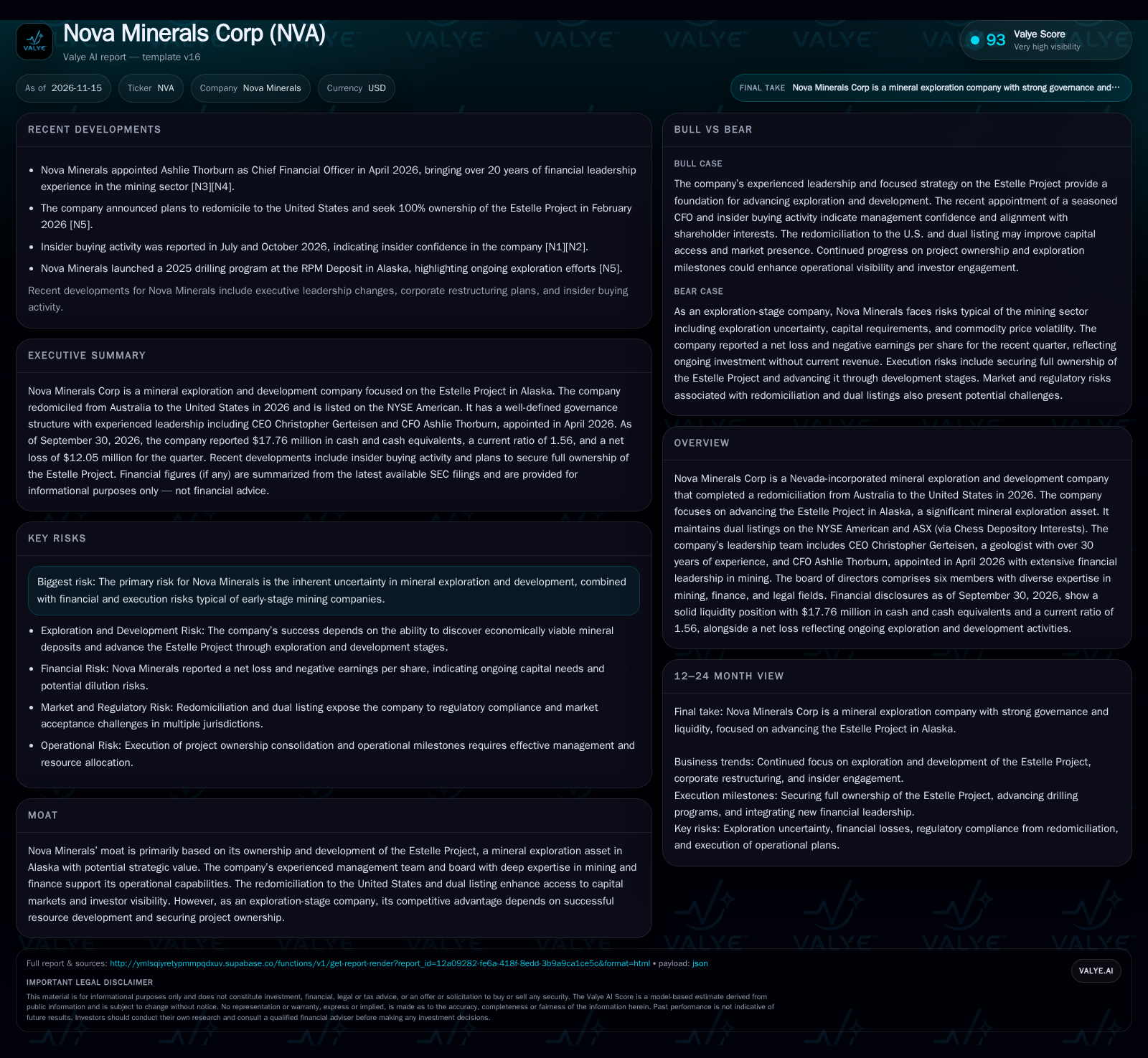
Nova Minerals has redomiciled to the U.S. and is pushing for full control of the Estelle Project in Alaska. Its board and management bring deep mining and financial experience, and the company holds $17.76 million in cash as of late September 2026. Despite insider buying and a new CFO, Nova remains pre-revenue, posting a $12.05 million quarterly loss. The thesis pivots on whether exploration success, ownership consolidation, and U.S. market access can outweigh funding and execution risks typical for early-stage miners.
Nova Minerals Corp’s strategic pivot in 2026—shifting its domicile from Australia to the U.S. and intensifying its commitment to the Estelle Project in Alaska—marks an inflection in its corporate narrative. With a leadership team rich in mining and financial expertise and a dual listing aimed at broadening its capital base, Nova is positioning itself for the next stage of mineral exploration and potential development. Yet, the company’s financials still reflect the realities of early-stage mining: no operating revenue, a substantial quarterly loss, and a dependence on ongoing funding. The critical question is whether Nova’s asset focus, strengthened governance, and U.S. market access can catalyze a transition from exploration to value creation, or whether the familiar risks of the sector—exploration uncertainty, capital needs, and execution complexity—will continue to dominate.
2026 Redomiciliation, Leadership Changes, and Exploration Focus Define the Present
Nova Minerals’ redomiciliation to the U.S. in 2026 and dual listing on the NYSE American and ASX create new avenues for capital raising and investor engagement [S1] [N5]. This move is paired with a sharpened focus on consolidating 100% ownership of the Estelle Project in Alaska, the company’s flagship mineral exploration asset [N5].
The appointment of Ashlie Thorburn as CFO in April 2026 brings over two decades of mining finance experience to the leadership team, reinforcing the company’s operational and financial oversight [N3] [N4].
Financially, Nova reported $17.76 million in cash and equivalents and a current ratio of 1.56 as of September 30, 2026, but remains pre-revenue, posting a net loss of $12.05 million in the most recent quarter [S2]. The company reported cash and liquidity metrics for the period; these figures do not by themselves establish operating runway, investment capacity, financial flexibility, or financing capacity.
How Value Could Be Created: From Exploration Expenditure to Resource Monetization
Nova Minerals’ economic model is typical of early-stage miners: substantial upfront capital outlays for exploration, permitting, and technical studies, with no operating revenue until and unless a viable mineral resource is delineated, permitted, and developed. The Estelle Project’s progression from resource definition to potential development is the company’s primary value lever.
Until then, value creation is driven by incremental resource upgrades, technical de-risking, and potential strategic partnerships or offtake agreements, which can attract external capital or acquirers.
Operating leverage is limited at this stage; fixed costs dominate, and variable costs (drilling, studies) are tied to exploration activity. The absence of revenue means cash burn is persistent, and dilution risk is high unless non-dilutive funding (such as project-level joint ventures or asset sales) can be secured. The economics become more favorable if resource scale or grade improvements meaningfully change project economics, or if gold/copper prices rise substantially.
Asset Location, Team Depth, and Capital Access: Where Nova Might Stand Out—and Where It May Not
Nova’s key potential advantage is the Estelle Project’s location in Alaska, a geopolitically stable, mining-friendly jurisdiction with a history of large-scale gold and copper development. This may help attract institutional investors, strategic partners, or acquirers if the project’s scale and quality are proven.
The board and executive team's mining and financial expertise—especially with the recent CFO hire—should help navigate technical, regulatory, and capital markets challenges. However, these are necessary but not sufficient conditions for success in mineral exploration.
Competitive counterforces are substantial. Nova faces competition from both nearby explorers and global juniors, all seeking capital and technical talent. Substitution risk is less about alternative metals and more about capital allocation: investors and partners can shift focus to projects with superior grades, easier logistics, or more advanced permitting. The dual listing may broaden the investor base, but does not guarantee capital inflows or premium valuation.
Ultimately, until Nova demonstrates meaningful resource upgrades or secures strategic partners, its competitive position remains aspirational rather than established.
What Could Unlock Value: Resource Upgrades, Ownership Consolidation, and Strategic Partnerships
A favorable scenario for Nova would see ongoing exploration at Estelle yield significant increases in resource size, grade, or technical confidence—potentially enough to attract a larger mining company, joint venture partner, or project financier.
Full consolidation of Estelle ownership would simplify the capital structure, making the asset more attractive for external investment or acquisition. The U.S. listing could enhance access to institutional capital, especially if resource upgrades coincide with favorable commodity prices.
Confirmation of this scenario would come from: (1) successful resource upgrades and positive technical studies; (2) disclosure of new strategic partnerships or non-dilutive funding; (3) a meaningful re-rating in market value relative to peers following exploration results; and (4) evidence of progressing toward permitting or pre-feasibility milestones.
Incremental Progress, Ongoing Cash Burn, and the Search for a Catalyst
The most plausible path is one of steady but incremental advancement: Nova continues to invest in drilling and technical work at Estelle, gradually improving its understanding of the resource. The company may secure additional funding through equity raises, potentially at dilutive terms, to sustain operations and exploration.
Partial progress toward project ownership consolidation may occur, but without a major exploration breakthrough or partnership, Nova remains one of many pre-revenue juniors competing for attention and capital. Cash reserves are drawn down steadily, and market value fluctuates with exploration news and broader sector sentiment.
Evidence supporting this scenario would include continued but modest resource upgrades, periodic capital raises, and a lack of transformative transactions or technical breakthroughs. Falsification would require either a major resource upgrade, a significant strategic deal, or, conversely, a material technical or permitting setback.
When Exploration Risk and Funding Constraints Collide
The adverse scenario is driven by a combination of lackluster exploration results, delayed or failed consolidation of Estelle ownership, and tightening capital markets. If drilling fails to materially improve the project's resource base or technical profile, investor interest and capital access could wane.
As cash reserves dwindle, Nova could be forced into highly dilutive financings or asset sales on unfavorable terms. Regulatory or permitting setbacks, or adverse commodity price movements, would further impair value. The company could enter a value-destructive cycle of dilution and asset attrition common to unsuccessful juniors.
Confirmation would come from weak or negative exploration updates, distressed capital raises, or technical/operational delays. Falsification would require either a material positive surprise in resource results or a non-dilutive funding solution.
Milestones and Metrics That Will Shape Nova’s Transition from Exploration to Value Creation
Progress toward 100% ownership of the Estelle Project—including any announced agreements or completed transactions.
Updates on resource definition at Estelle, including new drilling results, resource estimate upgrades, or technical study milestones.
Cash burn rate and updated cash balance disclosures, especially in relation to planned exploration activities and capital needs.
Announcements of new strategic partnerships, joint ventures, or non-dilutive funding arrangements.
Evidence of successful capital raising, including terms and dilution impact if disclosed.
Permitting progress for Estelle, including any regulatory or community engagement milestones.
Commodity price trends for gold and copper, which would affect project economics and investor sentiment.
Disclaimer: This is research-only, informational analysis and not investment advice. It may include AI-generated interpretation and general industry context. Always verify important details using primary sources.

Comments