
Cartesian Growth Corp IV: SPAC Execution Stakes and the Realities of the Blank Check Lifecycle
With no operating business or identified target as of Q3 2026, the company’s trajectory hinges on its ability to source and execute a value-creating business combination amid a shifting capital market landscape.
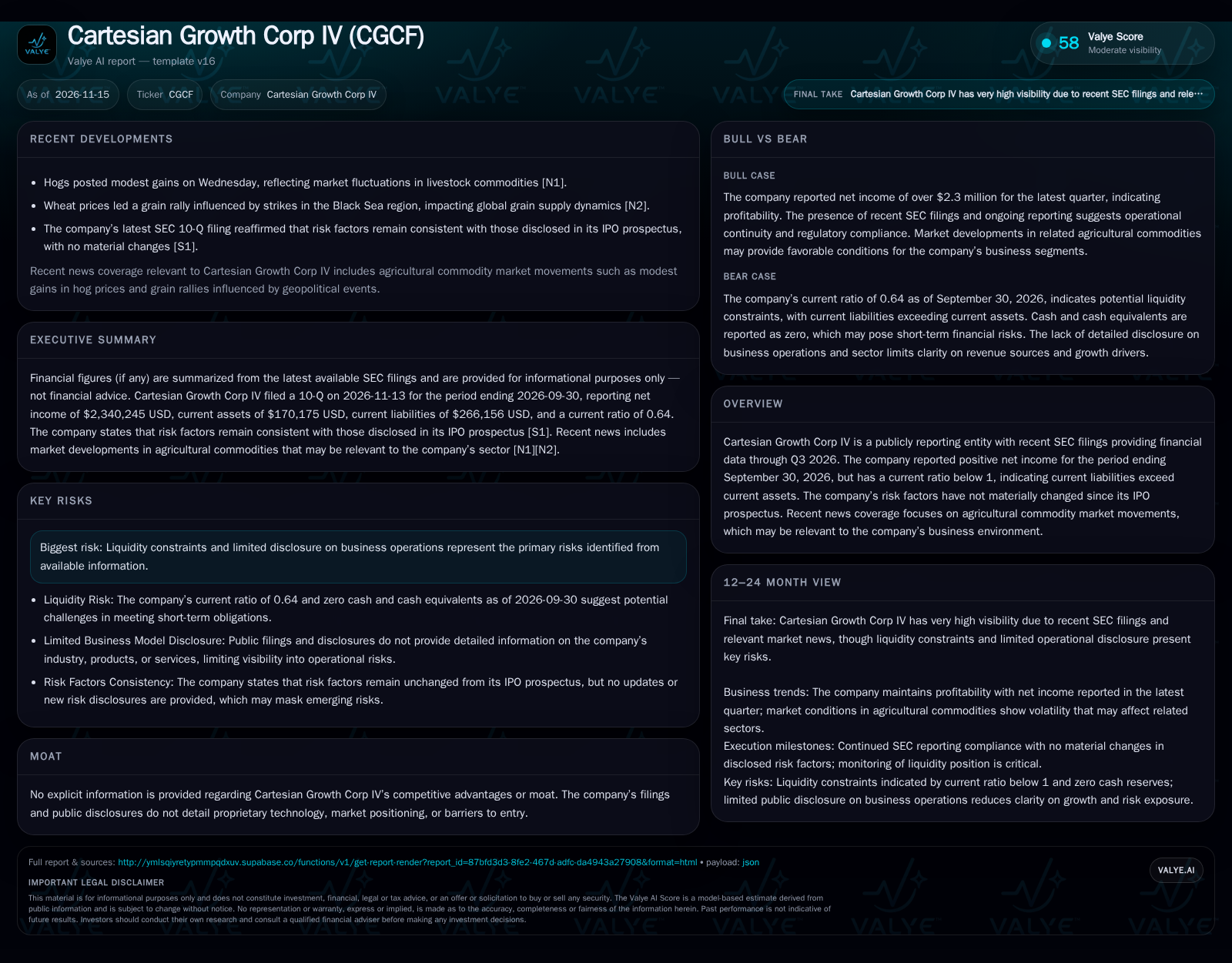
Cartesian Growth Corp IV remains a pre-combination SPAC with zero cash on hand, a current ratio well below 1, and positive net income driven solely by interest from trust assets. The company has not identified a merger target, and its future depends on successfully securing and closing a business combination before time and capital run out. [S1]
As of Q3 2026, CGCF had not identified a merger target, held zero cash outside its trust, and carried current liabilities exceeding its current assets. While regulatory compliance and positive net income from trust interest demonstrate baseline operational discipline, the company’s future is entirely dependent on its ability to secure and close a compelling business combination before its mandate expires. This analysis explores the mechanics, risks, and potential outcomes of CGCF’s blank check structure in the current capital market environment. [S1]
SPAC Structure, Trust Income, and Acute Liquidity Constraints Define the Current State
Cartesian Growth Corp IV is a blank check company, or SPAC, incorporated in February 2026 with the sole purpose of effecting a merger or similar business combination. As of September 30, 2026, the company reported net income of $2.34 million for the quarter, entirely derived from interest on trust account investments—reflecting the absence of any operating business or revenue. The company had zero cash and cash equivalents outside the trust, with current assets of $170,175 and current liabilities of $266,156, resulting in a current ratio of 0.64. This structure presents an acute short-term liquidity risk, as day-to-day expenses must be covered despite the lack of liquid assets outside the trust. No target business had been identified, and the company’s risk disclosures remain unchanged since its IPO. [S1]
How a Pre-Combination SPAC Makes (and Spends) Money
As a pre-combination SPAC, CGCF’s economic model is fundamentally different from an operating company. Its sole cash-generating activity is the accrual of interest income on funds held in the trust account—typically invested in short-term U.S. government securities or equivalent money market instruments. These funds are strictly segregated and cannot be used for general corporate purposes except to pay certain limited expenses (such as taxes or dissolution costs) until a business combination is consummated.
Operating expenses—legal, audit, compliance, and diligence—must be covered by cash raised outside the trust (typically a modest working capital facility or sponsor loans). With zero cash on hand as of Q3 2026, CGCF faces the real risk of being unable to pay operating bills unless additional sponsor support is forthcoming. The company’s ability to generate value for shareholders is entirely contingent on identifying and successfully merging with a target business. If a combination is not completed within the SPAC’s designated timeframe (often 18-24 months post-IPO), the trust funds are returned to public shareholders and the SPAC dissolves, typically leaving sponsors with a total loss on their at-risk capital.
SPAC Market Dynamics, Target Scarcity, and the Challenge of Differentiation
CGCF operates within an increasingly crowded and competitive SPAC landscape. Hundreds of SPACs compete for a finite pool of attractive private companies willing to go public via merger. As the SPAC market matures, target companies have become more selective, often negotiating harder on valuation and deal terms. The recent tightening of capital markets, increased regulatory scrutiny, and a series of underperforming post-merger SPACs have further raised the bar for successful combinations.
Without a proprietary sourcing advantage, differentiated sponsor reputation, or a clear sector focus, a generic SPAC like CGCF may be at a disadvantage relative to peers with deeper industry relationships or a history of successful deal execution. The competitive threat is not just from other SPACs but from direct IPOs, private equity exits, and strategic acquirers. Should capital market conditions improve and quality targets become more accessible, the competitive landscape could shift—but absent a disclosed target or sector angle, CGCF’s positioning remains undifferentiated.
Value Creation if a High-Quality Business Combination Is Secured
The most favorable scenario for CGCF is the identification and successful merger with a high-growth, undervalued private company able to thrive as a public entity. In this scenario, public shareholders could benefit from access to a compelling target at an attractive valuation, while sponsors realize returns on their founder shares and warrants.
Confirmation of this upside would include the announcement of a definitive merger agreement with a credible, growth-oriented target supported by robust financials and a clear rationale for public listing. Additional evidence would include positive market reaction to the deal announcement, strong PIPE (private investment in public equity) participation, and regulatory approvals proceeding without delay. Falsification would occur if no target is identified, if a deal is announced but subsequently terminated, or if the proposed target is met with negative market reception or regulatory barriers.
Absent a Target, Dissolution and Return of Funds Is Most Plausible
In the absence of a timely business combination, the most likely outcome for CGCF is the return of trust funds to public shareholders and the liquidation of the SPAC. This is a common fate for SPACs that fail to secure a deal within their allotted window, particularly in more challenging capital market environments. In this scenario, public shareholders recoup their original investment (plus accrued interest, less permitted expenses), while sponsors and warrant holders typically lose their at-risk capital and upside.
Evidence confirming this scenario would include continued lack of a target announcement as the SPAC’s deadline approaches, increased sponsor loans to cover operating expenses, and formal proxy statements proposing extension or dissolution. This outcome is neither catastrophic nor value-creating for public holders, but it represents the default trajectory for a SPAC without a clear path to combination.
Sponsor and Shareholder Value Is Destroyed by Deal Failure or Adverse Market Shifts
A negative outcome could unfold if CGCF is forced to pursue a suboptimal merger—either due to time pressure, lack of attractive targets, or deteriorating market conditions. In this scenario, the company might announce a business combination with a target that is poorly received by the market, overvalued, or operationally troubled. Such deals can result in mass shareholder redemptions, a collapsed PIPE, and post-merger trading well below trust value, destroying sponsor and public holder value.
Alternatively, acute liquidity constraints could force the SPAC to seek emergency sponsor loans or bridge financing on punitive terms, further eroding economics for all parties. Confirmation would come from a rushed deal announcement, high redemption rates, public filings indicating financial distress, or regulatory complications preventing deal closure. The combination of market headwinds, sponsor fatigue, and lack of operating cushion could accelerate value destruction.
Signals That Will Determine Whether CGCF Can Deliver Shareholder Value
Announcement of a definitive business combination agreement, including details on the target’s industry, financials, and strategic rationale.
Disclosures regarding additional sponsor loans or working capital infusions, which would illuminate the company’s ability to cover operating expenses absent cash outside the trust.
Shareholder redemption rates in connection with any proposed merger, as high redemptions often signal market skepticism and threaten deal viability.
PIPE (private investment in public equity) participation, if disclosed, which would demonstrate external investor confidence in the proposed combination.
Extension proxy filings or amendments to the SPAC’s combination deadline, which could indicate difficulties in securing a target on the original timeline.
Changes in regulatory environment or SEC scrutiny of SPAC transactions, which could alter the feasibility or attractiveness of proposed deals.
A useful metric would be the proportion of trust account funds remaining after permitted withdrawals, as this affects the value available for a merger or liquidation.
Disclaimer: This is research-only, informational analysis and not investment advice. It may include AI-generated interpretation and general industry context. Always verify important details using primary sources.

Comments