
GigCapital9 Corp.: SPAC Structure, Execution Stakes, and the Realities of the 2026 Acquisition Landscape
With $253 million in gross proceeds raised and no target yet identified, GigCapital9 stands at the critical juncture familiar to all newly listed SPACs: its future value depends entirely on executing a timely, well-structured business combination. The interplay of dilution risk, acquisition competition, and regulatory scrutiny will shape both the opportunity and the downside in the months ahead.
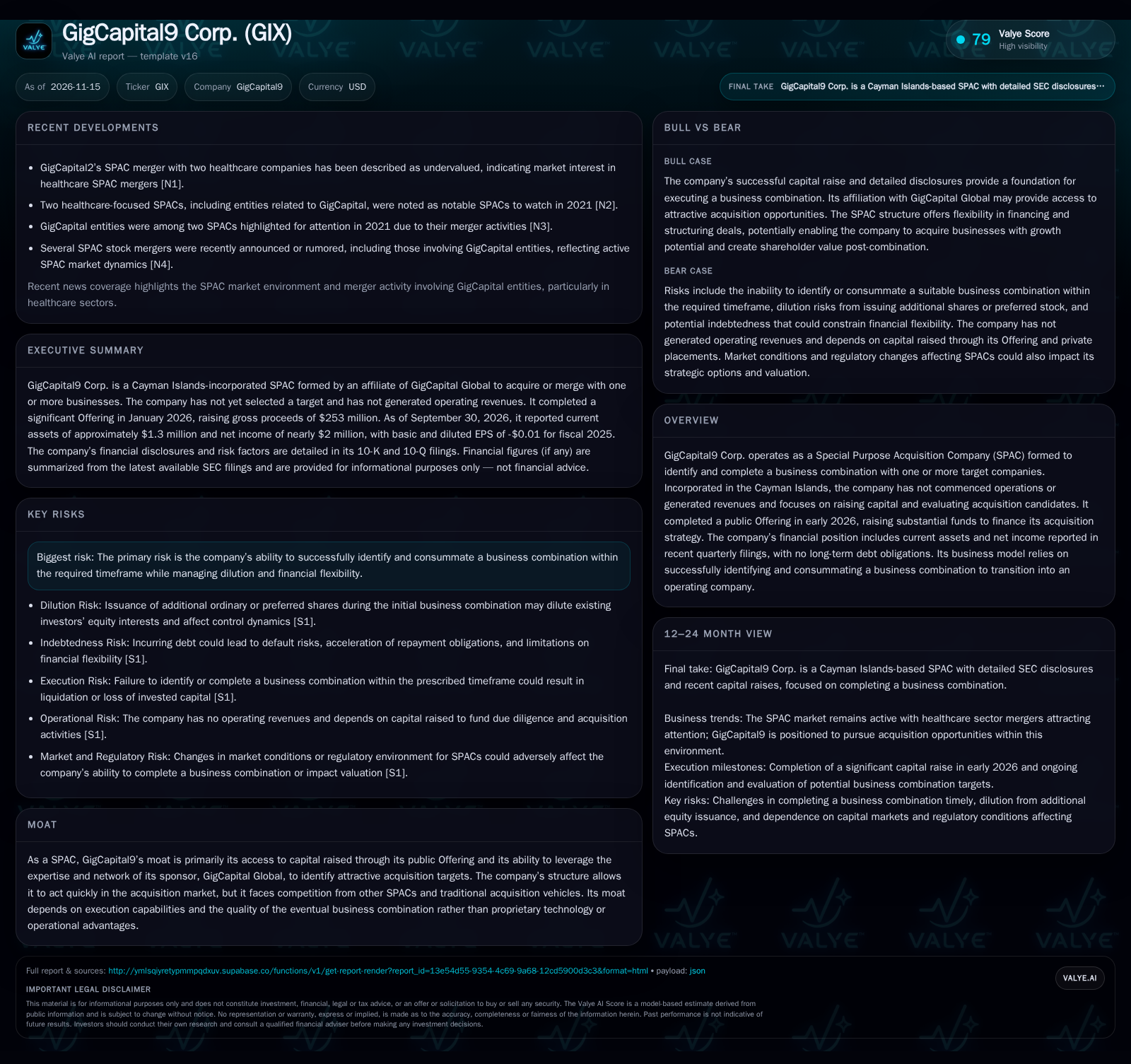
GigCapital9 Corp. is a recently listed SPAC with $253 million in gross proceeds and no announced acquisition target. The company’s economics and future are entirely dependent on executing a successful business combination, with risks centered on dilution, regulatory shifts, and the ability to secure a suitable operating partner within the SPAC’s time constraints. Investors should focus on deal progress, target quality, and evolving market conditions for SPAC transactions. [S1] [S2]
GigCapital9 Corp. exemplifies the high-stakes, binary nature of the SPAC model: flush with $253 million in proceeds and yet to announce a business combination, the company’s fate will be determined by its ability to source, negotiate, and close a transformative deal within a limited window. With no revenue or operations to date, all value is contingent on execution, and the risks of dilution, regulatory headwinds, and market competition loom large. Investors must look beyond the headline capital raise to the mechanics and timing of deal execution for any true insight into likely outcomes.
GigCapital9’s Capital Base and Blank Slate: The Current Reality
The most material facts for GigCapital9 are its $253 million in gross offering proceeds, the absence of any selected acquisition target, and its lack of operating revenue or business operations as of the latest filings [S1] [S2]. The company’s current assets were $1.3 million as of September 30, 2026, with reported net income for the same period reflecting only trust account investment returns rather than business activity [S2]. This positions GigCapital9 as a classic SPAC: a pool of capital with no underlying operating business, wholly dependent on identifying and closing a suitable acquisition.
The lack of any announced target means all forward-looking analysis hinges on unknowns: sector, scale, and quality of the eventual business combination. The capital base is substantial, but the risk of dilution is high, as the company may issue further equity or take on debt to structure a deal [S1]. These facts place urgency on management to execute before SPAC timelines expire, with the risk that failure to do so would trigger liquidation and return of trust funds to investors.
How Value Is Created (or Lost) in the SPAC Lifecycle
GigCapital9’s economics are entirely contingent and transactional: value is created if, and only if, the company can source and consummate an accretive business combination. Until then, the SPAC generates negligible income from money market investments in U.S. Treasuries, which are not material to long-term returns [S1]. The company’s only real asset is the $253 million trust account, which is both its war chest and a liability: if no deal is closed within the SPAC’s typical 18-24 month window, the funds are returned to investors (net of expenses), and the sponsors’ investment is lost.
The economics of the eventual transaction hinge on several levers: acquisition price, deal structure (equity, cash, or debt mix), and post-merger performance. If the target requires more capital than the trust account holds, GigCapital9 may need to raise additional equity (which dilutes existing shareholders) or incur debt (which adds leverage risk) [S1]. The sponsor’s promote—typically 20% of post-combination equity—creates strong incentives for deal completion, but also potential misalignment with public shareholders if target quality is not robust.
Operating leverage, margin profile, and capital needs of the eventual target will determine long-term economics, but none are knowable at this stage. This inherent opacity is a structural feature—and risk—of pre-deal SPACs.
SPACs in a Crowded Field: Competitive and Regulatory Dynamics
GigCapital9 faces a hypercompetitive SPAC landscape where hundreds of similar vehicles are simultaneously seeking high-quality targets. The primary competitors are other recently raised SPACs, private equity funds, and strategic acquirers—all vying for a diminishing pool of attractive, scalable private companies willing to go public via merger.
The company’s only potential advantage lies in the flexibility of its deal structuring and the experience of its sponsor and advisors. However, with no proprietary technology, operating assets, or established customer base, GigCapital9’s differentiation depends on sourcing and negotiating a superior deal—something that cannot be evaluated until a target is announced.
Moreover, the regulatory environment for SPACs has tightened, with increased SEC scrutiny on disclosures, financial projections, and sponsor compensation. This raises the bar for both due diligence and post-merger performance, increasing execution risk and potentially narrowing the field of viable targets.
A Transformative Deal: What Success Would Require
The bull case for GigCapital9 is that it identifies a high-growth, scalable private company at a reasonable valuation, structures a transaction that minimizes dilution, and successfully transitions the target to the public markets with strong post-merger performance. In this scenario, public shareholders participate in meaningful value creation as the combined entity grows revenue, expands margins, and commands a higher multiple.
Evidence that would confirm this scenario includes: announcement of a credible, well-regarded target in a sector with investor appetite; a deal structure that preserves public shareholder value (limited redemptions, minimal sponsor overhang, sensible use of PIPEs or debt); and positive initial trading or operating results post-combination.
Falsification would come from a poorly received target announcement (e.g., low-growth, overvalued, or highly dilutive), significant shareholder redemptions, or post-merger underperformance.
Most Probable Trajectory: Typical SPAC Execution Risks and Outcomes
The most plausible scenario is that GigCapital9 will eventually announce a business combination, but the quality of the target and the terms of the deal will determine whether value is created or eroded for public shareholders. Given the crowded SPAC market and increased regulatory scrutiny, the company is likely to face challenges in securing a top-tier target at an attractive price.
This base case would be confirmed by a target announcement within the typical SPAC timeframe, a deal structure with moderate dilution, and a post-merger company that delivers stable but unremarkable results. If disclosed, metrics such as redemption rates, PIPE participation, and management continuity would help test the strength of the transaction.
If the company fails to secure a target or is forced into a suboptimal deal due to time pressure, this would falsify the middle-path scenario and tilt outcomes toward the downside.
Failure to Close: Liquidation and the Erosion of Sponsor Value
The primary risk is execution failure—either the inability to identify a suitable target or the collapse of deal negotiations. In this scenario, GigCapital9 would be forced to liquidate, returning trust account funds to public shareholders (minus expenses), and sponsors would lose their investment and promote.
Downside risks are exacerbated by competition for targets, the possibility of adverse regulatory developments, and market conditions that make private companies less willing to go public via SPAC. High redemption rates or the need for highly dilutive financing could also undermine deal economics, even if a transaction is completed.
Evidence confirming the downside would include prolonged silence on deal progress, extensions of the SPAC deadline without material updates, or withdrawal of a previously announced deal.
Testing the GigCapital9 Thesis: Deal Progress, Dilution, and Market Conditions
Announcement of a letter of intent or definitive agreement with a target company—timing and quality will be critical.
Deal structure details, including use of PIPE financing, debt, or additional equity issuance, if disclosed.
Redemption rates by public shareholders at the time of business combination vote, as a proxy for deal approval and investor confidence.
Sector and growth profile of the announced target—industry relevance and scalability will affect post-merger valuation.
Regulatory developments affecting SPACs, especially SEC guidance or enforcement actions that could impact timeline or structure.
Sponsor and management team’s alignment with public shareholders, as measured by retained equity, lock-up periods, and post-merger roles if disclosed.
Timing and substance of extensions to the SPAC’s operating window, as repeated extensions may signal difficulties in sourcing a deal.
Post-merger trading and operating performance of the combined entity, if and when a transaction is completed.
Disclaimer: This is research-only, informational analysis and not investment advice. It may include AI-generated interpretation and general industry context. Always verify important details using primary sources.

Comments