
LaFayette Acquisition Corp.: Execution Stakes and Strategic Leverage in the SPAC Lifecycle
With $118.8 million in trust and an experienced SPAC management team, LaFayette Acquisition Corp. stands at a critical juncture: the ability to source, negotiate, and close a high-quality business combination will define its trajectory. The absence of a target amplifies both the opportunity and the execution risk, as industry conditions and regulatory sentiment weigh on SPAC outcomes.
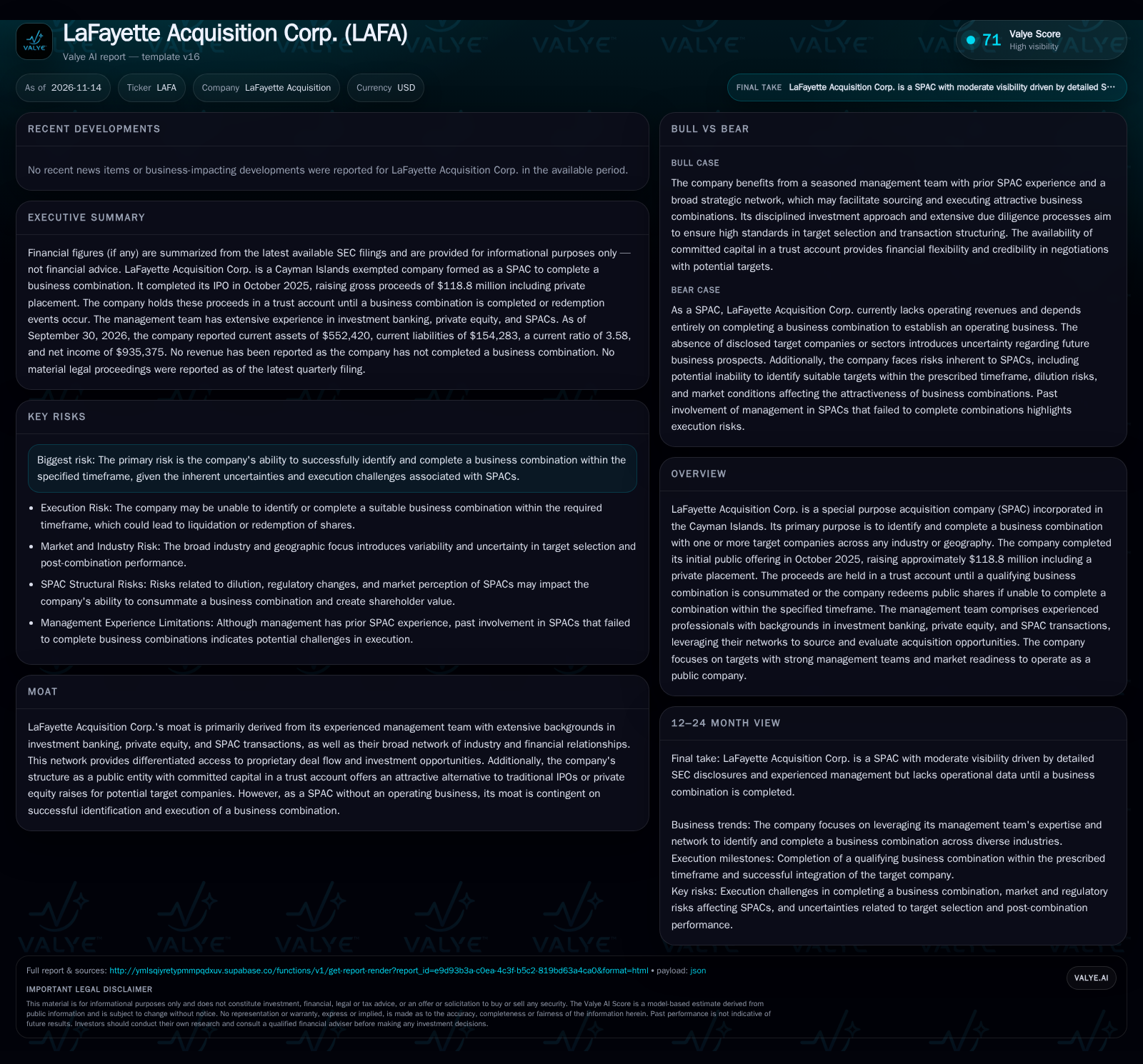
LaFayette Acquisition Corp. is a blank-check SPAC with $118.8 million from its October 2025 IPO and private placement, managed by a team with prior SPAC and deal-making experience. As of September 2026, the company has not announced a business combination or target, and proceeds remain in trust. The primary challenge is the successful identification and completion of a value-accretive combination before regulatory deadlines, amid a market environment that has grown more selective for SPAC transactions. The outcome will hinge on management’s sourcing capabilities, deal structuring, and alignment with shareholder interests. [S2]
LaFayette Acquisition Corp., a Cayman Islands-based SPAC, embodies the classic high-stakes dynamic of blank-check companies: a substantial pool of capital in trust, experienced dealmakers at the helm, but no operating business or disclosed acquisition target as of late 2026. With $118.8 million raised and a ticking regulatory clock, the next twelve months are likely to determine whether the team can source and close a value-creating combination, or if the company will join the growing cohort of SPACs facing redemption and liquidation. The uncertain outcome underscores the importance of both management acumen and evolving market conditions in the current SPAC landscape. [S2]
Where LaFayette Stands: Capital Position, Management, and the Absence of a Target
LaFayette Acquisition Corp. completed its IPO in October 2025, raising $115 million from the public issuance of 11.5 million units at $10 each, plus $3.8 million from a concurrent private placement. All proceeds are held in a trust account, available only for a business combination or redemption. As of September 30, 2026, the company reports current assets of $552,420 and current liabilities of $154,283, reflecting minimal operational spend and a current ratio of 3.58. Critically, no business combination or target has been identified, and the company has not generated revenue. The management team, led by Christophe Charlier and Jennifer Calabrese, brings prior SPAC and deal-making experience, but the window for executing a transaction is closing. [S2]
How Value Is Created—or Lost—in the SPAC Structure
LaFayette’s economics are binary at this stage: either a business combination is completed, unlocking the capital in trust and creating an operating company, or the SPAC is liquidated, returning funds to shareholders (less expenses). Until a deal is struck, the only income is interest from trust assets, with operating expenses kept low. Upon a successful merger, value creation depends on the terms negotiated—purchase price, capital structure, potential earn-outs, and dilution from sponsor shares or warrants. The SPAC model incentivizes sponsors to complete a deal, as their promote (founder shares, rights) typically vests only if a combination closes. However, this can create tension between sponsor economics and public shareholder interests, especially if the chosen target is marginal. Operating leverage post-merger depends entirely on the acquired company’s business model, which is currently unknown. Capital needs will be transaction-specific: some targets require additional PIPE financing, others may need to deleverage or invest for growth.
Further complexity arises in SPAC economics from the timing and structure of PIPE investments, which can significantly influence post-merger capitalization and shareholder dilution. PIPE investors typically seek discounted entry points or preferential terms to compensate for the risk of investing in a nascent public entity, potentially impacting the perceived fairness of the deal by retail shareholders. Additionally, the alignment of incentives between sponsors and PIPE investors can either mitigate or exacerbate conflicts of interest, particularly if PIPE commitments are contingent on specific deal terms or target performance milestones. Understanding these dynamics is crucial, as misaligned incentives can lead to suboptimal deal structures that erode long-term shareholder value rather than enhance it.
Deal Sourcing Edge or Commodity Capital? Assessing LaFayette’s Differentiation
LaFayette’s main potential advantage lies in its management team’s prior SPAC experience and industry networks, which could provide access to proprietary deal flow that less-connected SPACs might not see. The credibility of the sponsor and their ability to vet targets matters in a crowded SPAC market, where many vehicles chase a finite pool of attractive private companies. However, the current SPAC environment is highly competitive, with increased regulatory scrutiny, more selective investor sentiment, and a backlog of SPACs seeking deals. Many targets now have alternative routes to public capital, such as direct listings or traditional IPOs, and may demand aggressive terms from SPACs. Unless LaFayette can leverage its network to uncover a differentiated, high-quality target—and structure a deal that aligns sponsor and public shareholder interests—it risks being perceived as undifferentiated, with capital that is effectively a commodity.
The competitive landscape for SPAC deal sourcing is also influenced by sector-specific cycles and capital availability, which condition the attractiveness of potential targets. For example, SPACs targeting technology or healthcare sectors may face different valuation expectations and regulatory scrutiny compared to those focused on industrial or consumer sectors. LaFayette’s ability to tailor its search and negotiation strategy to sectors where it holds domain expertise could serve as a buffer against commoditization of capital. However, this specialization also narrows the target universe, potentially increasing the risk of protracted search periods or compromised deal terms if suitable candidates are scarce. Thus, the interplay between sector focus and capital competition is a critical factor shaping deal sourcing efficacy.
Unlocking Value: What Would a Successful SPAC Outcome Require?
The most favorable scenario is that LaFayette leverages its management network to identify a target with strong fundamentals, credible growth prospects, and readiness for public markets—potentially in a sector where the team’s expertise provides insight or access. The deal would be structured to minimize dilution, attract PIPE or other outside investment if needed, and win broad shareholder support. Confirmation of this scenario would include the announcement of a credible, well-regarded target with transparent financials, clear growth drivers, and a business model that can withstand public market scrutiny. Additional PIPE commitments and positive reactions from research analysts or institutional investors would further validate the outcome. Falsification would occur if the announced target is outside management’s core competence, lacks scale or visibility, or if the deal structure is heavily dilutive without a compelling growth story.
Most Likely Trajectory: Deal Pursuit, Market Headwinds, and Execution Friction
The most plausible outcome is that LaFayette continues to evaluate targets, with mounting time pressure as the SPAC’s window to complete a transaction narrows. The team may announce a deal with a middle-market company in a sector adjacent to their stated expertise, but the transaction could face challenges: valuation pushback, increased redemption rates, or the need for additional financing. Confirmation would come through a definitive agreement with a target that passes regulatory and shareholder muster, with manageable dilution and some PIPE participation. If the team cannot secure a high-quality target or if market conditions deteriorate further, the deal may be delayed, restructured, or ultimately fail to close. High redemption rates or tepid PIPE interest would signal investor skepticism about the transaction’s value proposition.
Failure to Launch: What Could Derail LaFayette’s SPAC Thesis?
LaFayette’s downside is the classic SPAC risk: inability to identify or close a suitable business combination within the required timeframe, leading to liquidation and return of trust proceeds to shareholders. This could result from a lack of attractive targets, overvaluation by potential candidates, or inability to secure shareholder approval due to perceived deal quality or excessive dilution. Regulatory shifts or negative sentiment toward SPACs could compound the challenge, as could management’s history with failed SPACs. Evidence of this scenario would include repeated delays, target withdrawals, high redemption rates, or failure to announce a transaction before the deadline. If disclosed, extension votes and sponsor capital infusions could signal a last-ditch effort to avoid liquidation, but also highlight execution strain.
Milestones That Will Determine Whether LaFayette Delivers—or Liquidates
Announcement of a definitive agreement with a target company, including industry, size, and management’s rationale for the selection.
Disclosure of PIPE financing or other committed capital to support the transaction, which would indicate market validation and reduce dilution risk.
Actual or projected redemption rates at the time of combination vote—high redemptions would signal shareholder skepticism and could jeopardize deal economics.
Transaction terms, especially the treatment of sponsor promotes, warrants, and dilution for public shareholders.
Sector and geographic alignment of the target with management’s stated expertise and network, as this may impact integration and post-merger performance.
Regulatory or legal developments affecting SPAC structure, redemption rights, or disclosure requirements, which could alter deal feasibility.
If disclosed, communication from the sponsor regarding potential extension votes, additional capital contributions, or willingness to forfeit promote shares if a deal is not completed.
Disclaimer: This is research-only, informational analysis and not investment advice. It may include AI-generated interpretation and general industry context. Always verify important details using primary sources.

Comments