
Bitwise Dogecoin ETF: Single-Asset Crypto Exposure Meets Fee Discipline and Volatility Realities
The Bitwise Dogecoin ETF delivers regulated, exchange-traded access to Dogecoin with a low headline fee and initial waivers, but its fortunes are inextricably linked to the meme coin’s price swings, regulatory flux, and the evolving appetite for niche crypto products among U.S. investors.
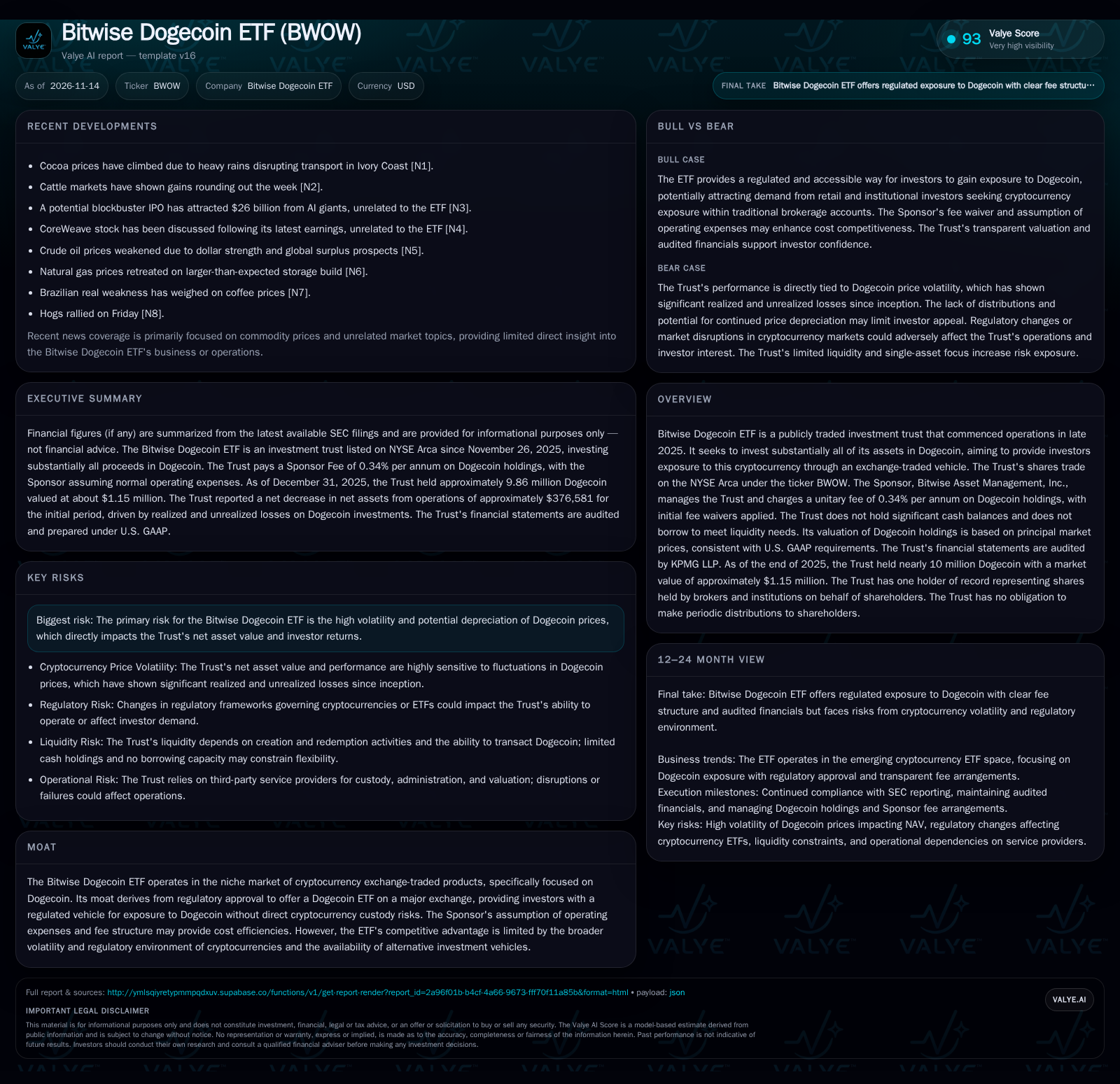
Bitwise Dogecoin ETF (NYSE: BWOW) offers investors a regulated, audited, and cost-conscious way to gain exposure to Dogecoin, but its performance is dictated by the asset’s inherent volatility and the uncertain regulatory and competitive landscape for crypto ETFs. With a 23% NAV decline since inception and net income in the latest quarter, the ETF’s economics hinge on both Dogecoin’s price trajectory and the durability of sponsor fee waivers and expense assumptions. Regulatory or market shifts could rapidly alter its risk/reward profile. [S1] [S2]
The Bitwise Dogecoin ETF (NYSE: BWOW) brings one of crypto’s most notorious meme coins into the world of regulated, exchange-traded investment vehicles. With nearly all assets deployed in Dogecoin and a lean, sponsor-absorbed expense structure, BWOW targets both retail and institutional investors seeking crypto exposure without the operational headaches of custody, wallets, or direct trading. However, the ETF’s fate is tightly tethered to Dogecoin’s unpredictable price action and the evolving regulatory climate for digital asset products. The result is a product with clear cost transparency and auditability, but also with concentrated risk and a performance profile that can swing dramatically with the underlying asset.
Recent Performance and Structural Decisions Shape Investor Experience
The Bitwise Dogecoin ETF began trading on NYSE Arca in late 2025, with the Sponsor investing nearly all proceeds into Dogecoin and charging a unitary 0.34% annual fee, initially waived for the first $500 million in assets through December 25, 2025 [S1]. As of December 31, 2025, the Trust held approximately 9.86 million Dogecoin valued at about $1.15 million, but experienced a 23.16% decline in NAV per share since inception, driven by realized and unrealized losses on Dogecoin [S1]. Notably, the Trust reported net income of $150,399 for the quarter ended September 30, 2026, showing sensitivity to recent Dogecoin price moves [S2]. The Sponsor’s policy of assuming most operating expenses up to $500,000 per year, coupled with the temporary fee waiver, is intended to drive cost competitiveness but is time-limited [S1].
Fee Structure, Asset Volatility, and Operating Leverage Define Economics
The Trust’s economics are unusually simple for an ETF: nearly all assets are held as Dogecoin, with no borrowing and minimal cash retention outside of creation/redemption settlements [S1]. The primary revenue stream for the Sponsor is the 0.34% annual fee on Dogecoin holdings, though this is waived for initial assets—an explicit customer acquisition tactic that compresses near-term profitability for the Sponsor but boosts net returns for shareholders. In the absence of leverage, the ETF’s NAV changes almost one-for-one with Dogecoin’s price, making asset growth and investor inflows directly contingent on market sentiment toward Dogecoin.
The ETF model leverages fixed Sponsor expenses—capped at $500,000 per year for core operations—against variable asset levels. As AUM grows, the fee structure could deliver operating leverage for the Sponsor once waivers expire, but with such a narrow asset focus, scale is entirely dependent on sustained investor interest and Dogecoin’s price appreciation. The absence of cash drag or lending activities means the ETF cannot generate ancillary yield, so all returns are a direct function of Dogecoin performance, less the sponsor fee.
Differentiation Hinges on Regulatory First-Mover Status and Cost Discipline
BWOW’s primary competitive advantage is its regulatory approval to offer Dogecoin exposure in a familiar ETF wrapper on a major U.S. exchange [S1]. For investors wary of direct crypto custody or unfamiliar with digital wallets, this structure removes significant friction. The sponsor’s initial fee waivers and assumption of operating expenses further sharpen its competitive positioning during the launch period.
However, these advantages are not structural moats. Competing crypto ETPs could emerge if regulatory attitudes toward meme coins soften or if other sponsors pursue similar products with even lower fees. Substitution risk is high: investors can already access cryptocurrencies through direct trading platforms, crypto-native funds, or derivatives. Moreover, BWOW’s single-asset focus leaves it vulnerable to investor rotation if Dogecoin falls out of favor or if broader crypto sentiment sours. The ETF’s ability to retain assets will depend on both the stability of its cost structure post-waiver and Dogecoin’s appeal relative to other digital assets.
Dogecoin Price Resurgence and ETF Asset Growth Reinforce Economics
A sustained rally in Dogecoin prices could drive sharp increases in BWOW’s NAV and attract additional inflows from both retail and institutional investors seeking compliant, audited crypto exposure. As AUM expands, the Sponsor’s fee income would rise, especially after initial waivers expire, generating operating leverage and potentially enabling further fee reductions or marketing investments to defend market share.
Confirmation of this scenario would include: a marked increase in Dogecoin price and trading volumes, rising ETF share creation activity, and public disclosures of expanding AUM and net inflows. Additional evidence would be the emergence of new institutional holders or analyst coverage indicating increased mainstream adoption of meme-coin-themed products.
Volatility and Fee Expiry Keep Returns Unpredictable Despite Structural Simplicity
The most plausible trajectory is one in which BWOW’s AUM and investor base fluctuate in tandem with Dogecoin’s price cycles and broader crypto sentiment. The expiration of sponsor fee waivers could modestly increase all-in costs for shareholders, potentially dampening net returns unless offset by further AUM growth or sustained price appreciation in Dogecoin.
In this scenario, the ETF remains a niche product—attractive to investors seeking regulated Dogecoin exposure but lacking the scale or stability of more diversified crypto ETPs. AUM would likely rise and fall with crypto cycles, and the ETF’s economics would remain tightly coupled to the underlying asset, with little ability to diversify revenue sources or mitigate drawdowns.
This scenario would be confirmed if AUM remains modest, with periodic net inflows and outflows corresponding to Dogecoin’s price action, and if sponsor fees revert to the stated 0.34% without further waivers.
Dogecoin Weakness, Fee Pressure, or Regulatory Shocks Undermine Sustainability
A sharp decline in Dogecoin’s price, combined with waning retail interest or negative regulatory developments, could drive both NAV erosion and investor redemptions. If operating expenses rise or competitive fee pressure intensifies after the waiver period, the ETF could struggle to maintain AUM, with fixed costs becoming a higher percentage of assets.
Potential triggers for this scenario include a material drop in Dogecoin’s market cap, public regulatory warnings or restrictions targeting meme-coin products, or the launch of lower-fee competitors cannibalizing demand. Confirmation would be sustained NAV declines, shrinking AUM, and potentially a widening discount to NAV if redemption channels are stressed or market makers withdraw.
Factors That Will Shape the Bitwise Dogecoin ETF’s Long-Term Appeal
Monthly and quarterly changes in AUM and net inflows/outflows, which would reveal investor sentiment and market traction.
The actual expiration of sponsor fee waivers and any subsequent fee structure changes, as these will affect net returns and cost competitiveness.
NAV per share volatility relative to Dogecoin spot prices, which would confirm tracking efficiency and the absence of significant slippage or operational drag.
Regulatory developments affecting the permissibility, marketing, or structure of single-asset crypto ETFs in the U.S., especially any actions targeting meme-coin products.
Emergence of competing Dogecoin or meme-coin ETFs, or major fee reductions by rival sponsors, which could shift market share.
Public disclosures regarding the ETF’s creation/redemption activity and liquidity, as persistent discounts or premiums to NAV could signal market structure issues.
If disclosed, the number and profile of institutional holders, which would indicate whether the product is gaining traction beyond retail investors.
Disclaimer: This is research-only, informational analysis and not investment advice. It may include AI-generated interpretation and general industry context. Always verify important details using primary sources.

Comments