
York Space Systems: Expanding Defense Constellations While Managing Financial and Government Dependencies
York Space Systems is leveraging vertical integration and proprietary technology to address the growing needs of national security and commercial space, but persistent net losses and heavy dependence on government contracts test the resilience of its business model.
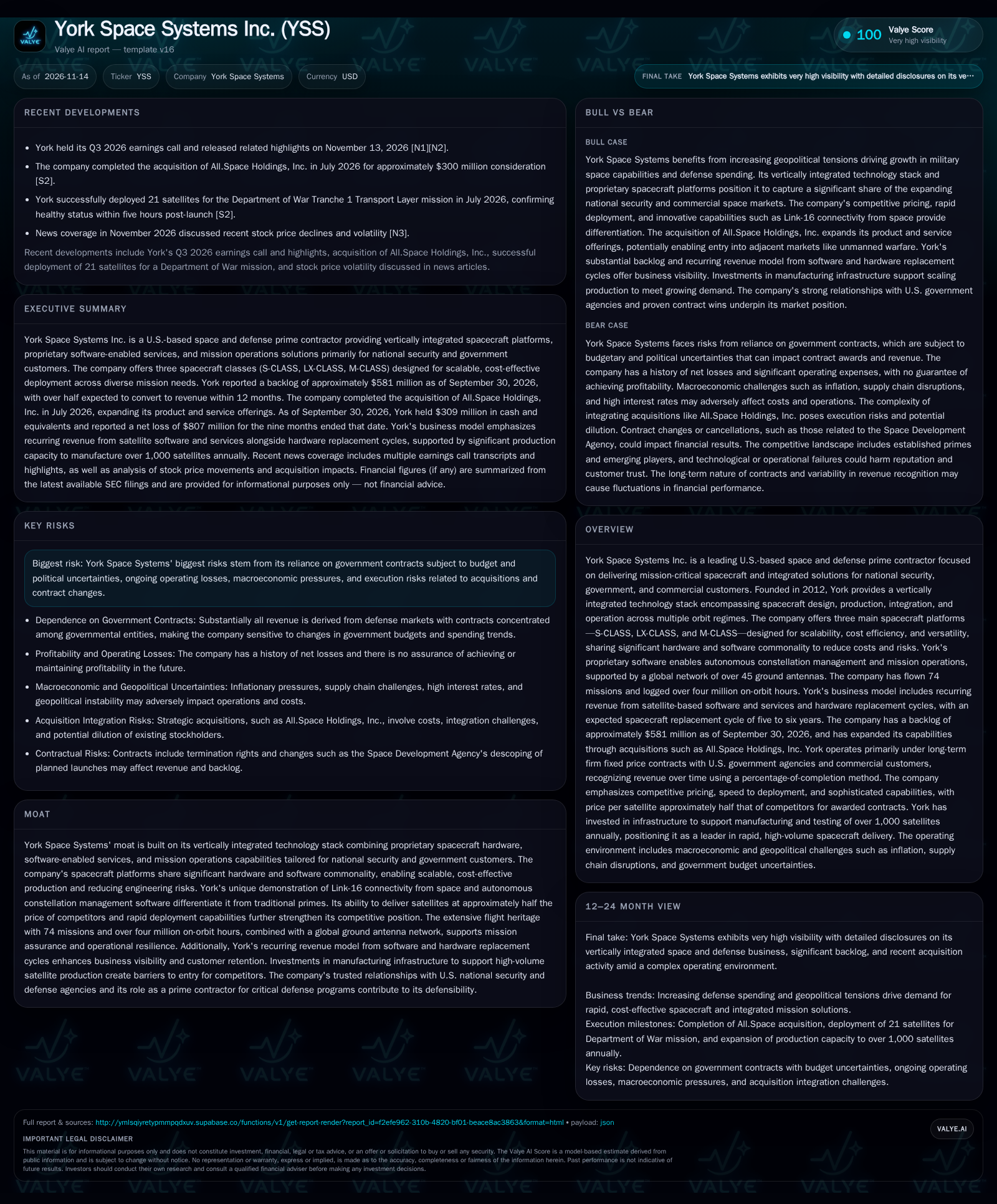
York Space Systems has built a significant backlog, expanded through acquisition, and demonstrated unique technical capabilities in national security space. However, sustained net losses and exposure to government budget cycles raise questions about the path to profitability and the durability of growth.
York Space Systems is attempting to redefine the economics and speed of satellite deployment for national security and commercial space missions through vertical integration, proprietary spacecraft platforms, and autonomous operations software. Its backlog has expanded despite a challenging macroeconomic backdrop and government budget volatility, and the company has completed a transformative acquisition to further diversify its offerings. However, persistent operating losses and the inherent risks of government contract concentration continue to pressure the investment thesis. The question is whether York’s technological differentiation and production scale can overcome structural barriers to profitability and market expansion.
Recent Milestones and Financial Realities Shape York's Strategic Posture
York Space Systems reported a backlog of approximately $581 million as of September 30, 2026—up from $543 million at the end of 2025—with over 57% of this backlog expected to turn into revenue within 12 months [S2]. This signals continued contract momentum and near-term revenue visibility, a critical factor given the company’s dependence on long-lead government projects. In July 2026, York completed the $300 million acquisition of All.Space Holdings, marking a meaningful expansion of its product and service capabilities [S2]. Yet, despite these operational wins, York posted a net loss of $807 million for the first nine months of 2026 [S2], reflecting the heavy upfront investment and margin pressures of the current growth phase. The company reported cash and liquidity metrics for the period; these figures do not by themselves establish operating runway, investment capacity, financial flexibility, or financing capacity. [S2]
The interplay between York's backlog growth and its liquidity position warrants closer examination, especially given the capital-intensive nature of satellite manufacturing and the long lead times inherent in government contracting. While backlog expansion signals demand strength, the timing and recognition of this revenue depend heavily on contract milestones and government budget approvals, which can be unpredictable. Moreover, the upfront costs associated with scaling production capacity and integrating acquisitions can strain cash flow, potentially necessitating external financing or operational adjustments. Understanding the cadence of cash inflows relative to outflows is thus critical to assessing York's financial resilience during this growth phase.
Recurring Revenue Ambitions Meet the Realities of Fixed-Price Contracts
York’s business model blends hardware sales, recurring software-enabled services, and hardware replacement cycles, with the latter expected to recur on a five-to-six-year cadence [S1]. Revenue is recognized over time, primarily under long-term firm fixed price contracts with government and select commercial customers [S2]. This structure offers revenue predictability but also exposes York to cost overrun risk: if project delivery costs exceed expectations, York bears the loss. The company touts price-per-satellite advantages—claiming contract wins at roughly half the competitor price—and significant hardware/software commonality across its three satellite classes (S-CLASS, LX-CLASS, M-CLASS), which should, in theory, drive manufacturing efficiencies [S1]. Operating leverage could materialize if York can sustain high production volumes (over 1,000 satellites annually in capacity), but persistent net losses suggest that scale benefits have not yet offset upfront engineering, infrastructure, and integration costs [S2]. The acquisition of All.Space Holdings may provide additional recurring service opportunities, but integration costs and potential dilution could weigh on near-term margins.
The fixed-price contract model, while offering revenue visibility, inherently transfers execution risk to York, especially in a sector where technological complexity and supply chain volatility are common. If cost overruns or schedule delays occur, the company must absorb these expenses, which can erode margins or exacerbate losses. This risk profile necessitates rigorous cost management, precise engineering estimates, and robust program controls. Additionally, the anticipated recurring revenue from software and services depends on successful customer adoption and retention, which may be influenced by evolving mission requirements and competitive offerings. The balance between hardware sales and service-based revenue streams will be pivotal in shaping York’s margin trajectory and financial stability.
Can Vertical Integration and Heritage Counter Defense Prime Competition?
York positions itself as a vertically integrated prime, combining proprietary spacecraft, autonomous constellation management software, and global ground operations [S1]. Its unique demonstration of Link-16 connectivity from space is a key technical differentiator for missile defense applications [S1]. The company claims faster deployment and lower costs relative to traditional defense primes and emerging commercial satellite firms—an important consideration as government buyers seek both capability and value. However, the space and satellite sector remains intensely competitive, with established primes offering deep incumbency, regulatory expertise, and robust supply chains. Emerging players may also leverage new architectures or business models. Switching frictions for major government contracts are high due to mission risk, but commercial buyers may be more price- and flexibility-sensitive. York’s extensive flight heritage (74 missions, 17 flight-proven products) and growing backlog enhance credibility, but sustained differentiation will require ongoing innovation and flawless execution.
Vertical integration can provide York with tighter control over product development cycles and supply chain coordination, potentially enabling faster iteration and responsiveness to customer needs. However, this approach also demands significant investment in diverse capabilities and exposes the company to operational complexities that pure-play hardware or software firms may avoid. The competitive landscape includes defense primes with entrenched relationships and comprehensive service portfolios, which can leverage scale and regulatory familiarity to maintain market share. York’s ability to sustain its technical edge, particularly in autonomous constellation management and secure communications, must be complemented by effective program execution and customer engagement strategies to overcome these barriers and capture incremental market share.
Winning the Volume Game: How Scale and Software Could Unlock Profitable Growth
A favorable scenario for York sees defense and national security spending on space accelerating further, driving large, multi-year constellation contract awards. If York can leverage its manufacturing scale and common platform architecture to deliver satellites at superior speed and materially lower cost, while layering on recurring software and services, the company could achieve positive operating leverage. The successful integration of All.Space Holdings might broaden its addressable market—particularly in adjacent domains like unmanned warfare—and diversify revenue streams. Confirmation of this scenario would come from a sustained increase in backlog, improving gross margins, and a narrowing or reversal of operating losses. Additional evidence would include new multi-year contract wins, expansion into commercial and allied government markets, and demonstrable growth in recurring software/service revenues.
Balancing Growth with Profitability in a Budget-Constrained Environment
The most plausible near-term outcome is continued growth in contracted backlog and deployment activity, supported by York’s cost and speed advantages, but offset by ongoing margin pressure and integration challenges. Government spending on space remains robust, yet subject to political and budgetary volatility. York is likely to capture additional contracts—particularly for U.S. defense and intelligence—but may struggle to convert scale into profits until cost discipline, integration of acquisitions, and higher-margin software/service revenues mature. Confirmation of this scenario would include steady backlog growth, incremental gross margin improvement, and narrowing net losses. Falsification would be indicated by a meaningful contraction in backlog, major contract cancellations, or a deepening of losses despite revenue growth.
When Government Reliance Meets Execution and Budget Risk
A negative scenario unfolds if U.S. government budgets tighten, leading to delayed, descoped, or canceled contracts. York’s concentration in defense clients and dependence on firm fixed price contracts would magnify the impact of any such shifts. Cost overruns, supply chain shocks, or operational missteps—especially in the wake of the All.Space acquisition—could erode margins and further extend net losses. The company’s liquidity position, while currently solid, could deteriorate quickly if losses persist and backlog fails to replenish. Confirmation would come in the form of contract terminations, missed delivery milestones, or a sudden drop in backlog. Widening operating losses and negative operating cash flow, coupled with a need to raise additional capital, would further validate this downside.
Testing York’s Thesis: What Will Validate Scale, Diversification, and Margin Progress?
Backlog growth and composition by customer and contract type—acceleration, concentration, or attrition would help test demand durability [S2].
Gross margin trends, especially as production scales and new services are integrated—improvement would signal operating leverage realization (if disclosed).
Integration milestones and synergy capture from the All.Space Holdings acquisition—delays or cost overruns would signal execution risk [S2].
Progress in recurring software/service revenue as a share of total sales—growth here would validate the move toward higher-margin business (if disclosed).
Major contract wins, renewals, or cancellations—especially with U.S. defense and intelligence agencies—would directly affect visibility and market share [S2].
Net loss and cash burn trajectory—persistent or worsening losses would challenge the scalability thesis [S2].
Any supply chain disruptions or inflationary impacts on input costs—could pressure both delivery timelines and margins (if disclosed).
Disclaimer: This is research-only, informational analysis and not investment advice. It may include AI-generated interpretation and general industry context. Always verify important details using primary sources.

Comments