
OneIM Acquisition Corp.: Capital Structure, Execution Risks, and Outlook for Business Combination
With $287.5 million held in trust and no operating business until a merger is completed, OneIM Acquisition Corp. exemplifies the SPAC model’s binary risk/reward: capital and sponsor experience are in place, but execution risk remains paramount as the deadline for a deal approaches.
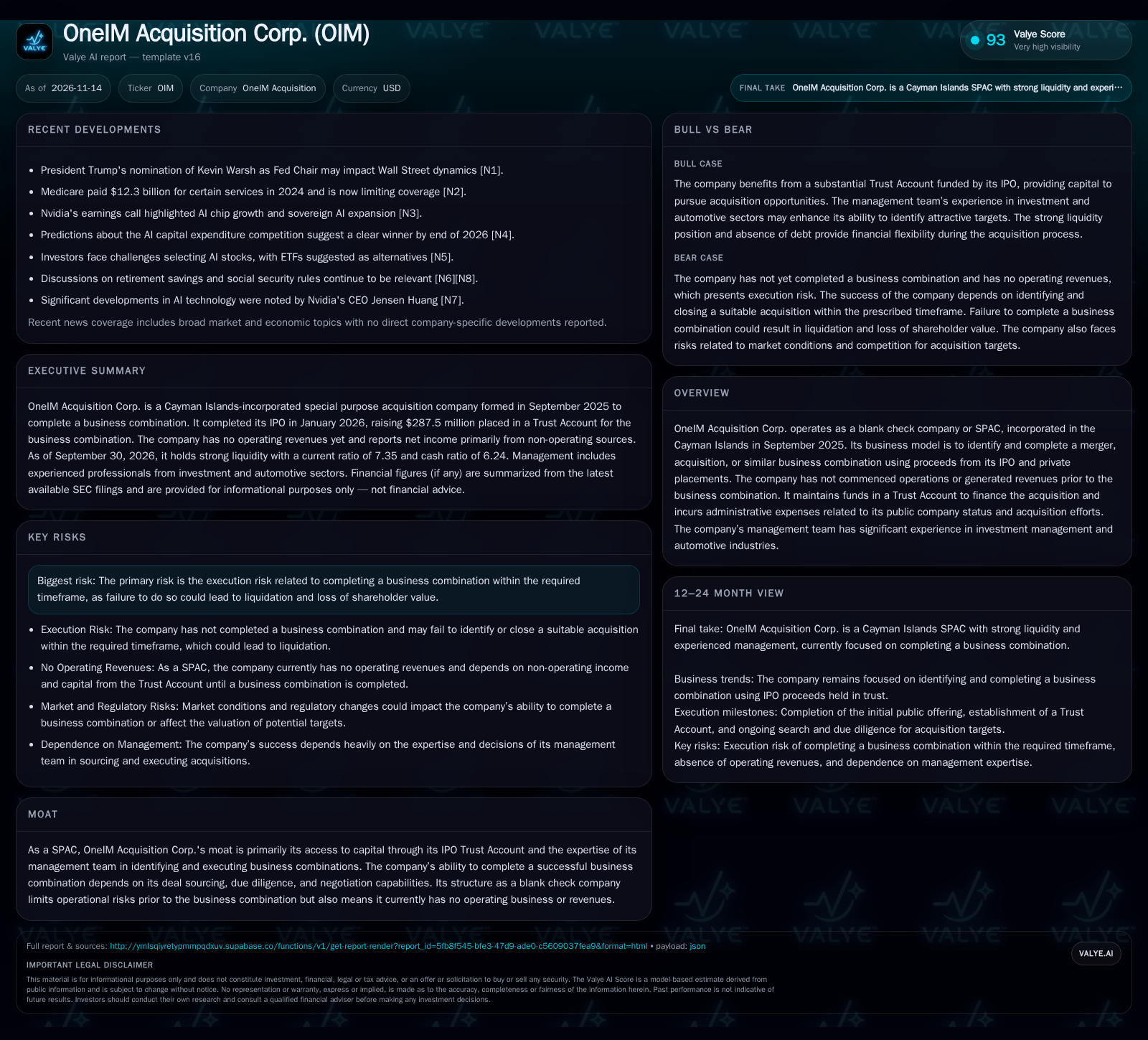
OneIM Acquisition Corp. is a Cayman Islands-incorporated SPAC holding $287.5 million in trust from its January 2026 IPO, with no operating revenues until it completes a business combination. The company’s entire future depends on its ability to identify and close a suitable acquisition before its deadline, leveraging sponsor experience in investment management and automotive sectors. Its financial position is strong, but there is no operating business yet—making execution risk and market conditions the central variables for investors. [S1] [S2]
OneIM Acquisition Corp. stands at the classic crossroads of the SPAC lifecycle: flush with $287.5 million in trust from its January 2026 IPO, but with no operating business or revenue until it successfully merges with a target. Its experienced management team brings credibility, but the clock is ticking to deploy capital before the SPAC’s mandated window closes. This binary setup—ample capital and sponsor know-how against a hard execution deadline—defines both the opportunity and risk for investors, with the entire thesis riding on management’s ability to identify, negotiate, and close a compelling business combination in a crowded and competitive market. [S1] [S2]
Current Position: OneIM’s Capital Status and SPAC Timeline
As of November 2026, OneIM Acquisition Corp. is a Cayman Islands-based SPAC with $287.5 million in a Trust Account, raised via its January 2026 IPO and private placement. The company has not begun operations or generated operating revenues; all reported income is non-operating, primarily interest from trust assets. Its balance sheet is clean, with no long-term debt or off-balance sheet liabilities, and reported liquidity position as shown by a current ratio of 7.35 and cash ratio of 6.24. However, OneIM has not yet announced or closed a business combination, and its existence as a SPAC is fundamentally time-limited: failure to complete a deal within its prescribed timeframe will trigger liquidation and the return of trust funds to shareholders. [S1] [S2]
The temporal constraints inherent in the SPAC structure impose a strict discipline on the management team to balance thorough due diligence with the urgency of deal closure. This dynamic can create a tension between pursuing ideal targets that require extended negotiation or complex structuring and the necessity to consummate a transaction before the deadline. Additionally, the absence of operating revenues until a combination is completed means that the SPAC’s financial sustainability during this period depends heavily on the trust account’s interest income and the management of operating expenses. Effective cost control and strategic prioritization of deal-related activities are therefore essential to preserve capital and maintain investor confidence throughout the search phase.
Understanding SPAC Economics: Value Creation and Erosion
A SPAC like OneIM does not generate revenue from operations until it merges with a target. Instead, its economics are shaped by the terms of its IPO, the interest income earned on funds in the Trust Account, and the costs of being a public company. The primary sources of value creation are: (1) identifying and merging with a private company at an attractive valuation, (2) providing that target with access to public capital markets, and (3) potential upside from sponsor-promoted equity and warrants. The cost base is modest pre-deal—mainly administrative, legal, and due diligence expenses, plus a $10,000/month fee to the Sponsor for administrative services. The largest fixed expense is typically the underwriting and advisory fees, which are only paid if a deal closes. If the SPAC fails to close a deal, the only value returned to public shareholders is the pro rata trust balance (minus permitted expenses), and the sponsor’s investment is typically lost. The business model is thus binary: economic upside is only realized if a compelling acquisition is completed and the market rewards the combination.
The economics of SPACs also depend critically on the alignment of incentives between sponsors and public shareholders, which is often mediated through the structure of founder shares and warrants. Sponsor-promoted equity typically represents a significant portion of the post-merger capital structure, creating potential dilution that can erode shareholder value if the target company’s performance does not meet expectations. Furthermore, the timing and pricing of PIPE investments can influence the valuation and capital structure of the combined entity, affecting the ultimate returns to investors. Understanding these interrelated financial mechanisms is crucial for assessing the potential for value creation or erosion in the SPAC lifecycle.
Sourcing Deals Amid SPAC Competition: OneIM’s Differentiators
In the current environment, SPACs are competing not only against each other but also against traditional private equity, direct listings, and IPO routes for attractive targets. OneIM’s potential competitive edge lies in its management team, which brings experience from investment management and automotive sectors—a possible advantage if targeting mobility, industrial, or related technology businesses. However, this edge is conditional: without a proprietary sourcing network, differentiated deal terms, or a clear thematic focus, OneIM risks being just one of many SPACs chasing a shrinking pool of high-quality targets. The company reported cash and liquidity metrics for the period; these figures do not by themselves establish operating runway, investment capacity, financial flexibility, or financing capacity.
Potential Value from a Successful Acquisition
If OneIM’s management leverages its capital and sector expertise to source and successfully close a business combination with a high-growth, undervalued private company, several positive outcomes could follow. The new entity could access public capital, accelerate growth, and deliver returns to shareholders through share price appreciation. Confirmation of this scenario would come from (a) announcement of a definitive agreement with a credible, growing target; (b) positive market reaction to deal terms and target fundamentals; and (c) successful completion of the merger with minimal redemptions and strong post-deal performance. Evidence that would falsify this upside includes failure to identify a target or a negative market response to a proposed deal (e.g., mass redemptions or a drop in share price upon deal announcement).
Expected Trajectory: Typical SPAC Lifecycle Developments
The most probable path is that OneIM identifies a target and announces a deal within its allotted timeframe, but faces a typical set of SPAC market dynamics: moderate to high shareholder redemptions, extensive regulatory and shareholder scrutiny, and the need for supplemental financing or PIPE (private investment in public equity) commitments to close the transaction. Deal terms may need to be adjusted to ensure completion, with value creation for public shareholders depending on the perceived quality and growth prospects of the target. Confirmation of this scenario would include the timely announcement of a business combination, a manageable redemption rate, and the closing of the transaction within the SPAC’s window. Falsification would occur if the deal falls through, regulatory or shareholder approval is not obtained, or the SPAC fails to find a target before liquidation.
Consequences of Expiration: Liquidation and Sponsor Impact
The principal risk is execution failure—if OneIM cannot identify and close a suitable business combination within its deadline, it must liquidate, returning the trust balance to public shareholders and forfeiting the sponsor’s investment. This scenario would be confirmed by a lack of deal announcement as the deadline nears, or by the public disclosure of failed negotiations or target withdrawals. Other downside triggers include regulatory intervention, macroeconomic shocks dampening deal appetite, or an inability to secure sufficient PIPE financing if redemptions are high. The result is a return of capital to shareholders, but no upside for sponsors or public investors beyond trust value, and the effective loss of the sponsor’s out-of-pocket investment.
Key Developments Influencing OneIM’s Investment Case
Announcement of a definitive business combination agreement, which would mark a transition from capital search to deal execution.
Redemption rates upon deal announcement and closing—a high rate would suggest weak target appeal or market skepticism.
PIPE (private investment in public equity) commitments or additional financing secured to backstop redemptions, if disclosed.
Regulatory or shareholder approval timelines and any material conditions or delays in the closing process.
Sponsor and management alignment with public shareholders, as evidenced by any additional capital commitments or lock-up arrangements, if disclosed.
Any changes in the competitive landscape for SPAC targets (e.g., major deals by peer SPACs in similar sectors).
Updates on trust account value, including interest income and permitted withdrawals for expenses.
If disclosed, specifics on the sector focus or target profiles under active consideration, which would clarify the likelihood of sourcing a differentiated deal.
Disclaimer: This is research-only, informational analysis and not investment advice. It may include AI-generated interpretation and general industry context. Always verify important details using primary sources.

Comments