
Gemini Space Station: U.S. Crypto Platform Navigates Profitability Pressures Amid Strategic Refocus
Gemini Space Station, Inc. is doubling down on its regulated, vertically integrated crypto platform in the United States, expanding into derivatives and prediction markets while contending with persistent net losses, mixed product economics, and intensifying competition. The company’s operational and regulatory choices will determine whether its model can scale profitably in a volatile digital asset landscape.
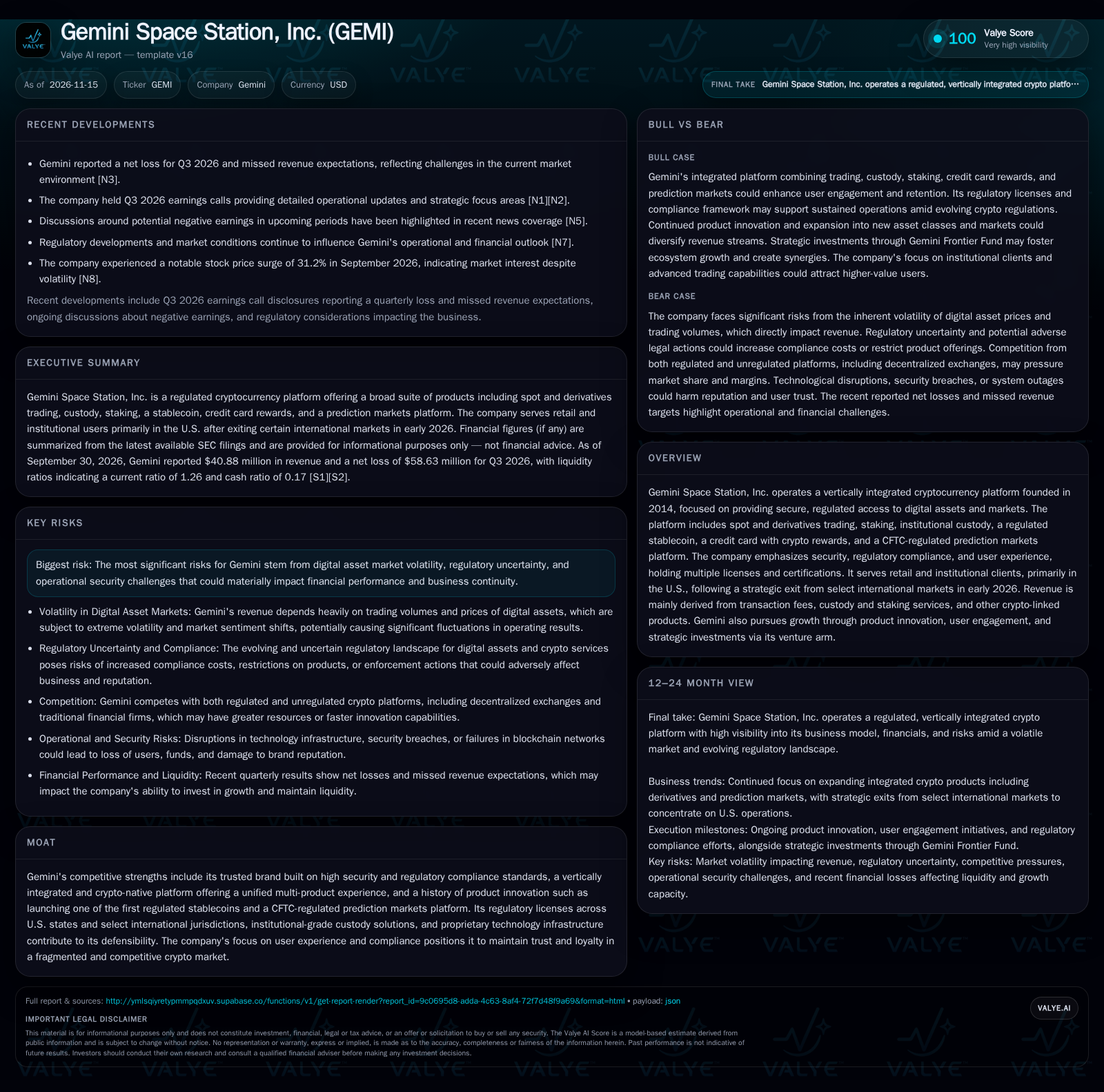
Gemini Space Station, Inc. is a U.S.-focused crypto platform with offerings spanning spot and derivatives trading, custody, staking, and a regulated stablecoin. Despite a $40.88M revenue quarter ending September 2026, the company reported a net loss of $58.63M and continues to face earnings pressure. Strategic exits from certain international markets and the discontinuation of its NFT marketplace reflect a shift toward core exchange and prediction markets. The path to sustainable profitability hinges on deepening user engagement, scaling high-value products, and navigating regulatory and market volatility. [S1] [S2] [N3]
Gemini Space Station, Inc. stands at a pivotal point in its evolution as a U.S.-centric cryptocurrency platform. Recent operational decisions—such as withdrawing from certain international markets and shuttering its NFT marketplace—signal a sharpened focus on regulated core businesses, including spot and derivatives trading, custody, and a newly launched prediction markets platform. However, this strategic refocus comes amid persistent net losses and missed revenue expectations, underscoring the challenge of scaling a compliant, multi-product crypto exchange in a turbulent sector. The company's ability to convert its regulatory credentials and product innovation into profitable growth will be tested as it seeks to deepen user engagement and weather the next phase of digital asset market volatility. [S1] [S2] [N3]
Strategic U.S. Refocus and Persistent Losses Define the Current Landscape
Gemini Space Station, Inc. reported $40.88 million in revenue and a net loss of $58.63 million for Q3 2026, with basic and diluted EPS of -$0.46. The company reported cash and liquidity metrics for the period; these figures do not by themselves establish operating runway, investment capacity, financial flexibility, or financing capacity. [S2]
Operationally, Gemini has exited select international markets to concentrate on the U.S., simultaneously discontinuing its NFT marketplace in January 2026 to prioritize its core exchange, custody, and CFTC-regulated prediction markets platform. [S1]
These decisions are set against a backdrop of missed revenue targets and ongoing net losses, as highlighted in recent earnings reports and news coverage. This combination of strategic narrowing and financial pressure underscores the company’s need to achieve scale and operational efficiency within its chosen U.S. regulatory perimeter. [S2] [N3]
Revenue Mix, Fee Structures, and the Search for Operating Leverage
Gemini’s top line is primarily driven by transaction fees on spot and derivatives trading, with additional contributions from custody and staking fees, stablecoin float, and crypto-linked credit card rewards. In the current crypto exchange landscape, transaction-based revenue is highly sensitive to underlying asset price volatility and trading volumes—factors largely outside the company’s direct control. [S1]
Custody and staking offer higher-margin, recurring-fee potential, especially among institutional clients, but require ongoing investment in compliance, security, and technology. Gemini’s institutional-grade custody, featuring cold storage and advanced cryptographic controls, could support premium pricing if the company can maintain its reputation for security and regulatory trustworthiness.
The launch of a CFTC-regulated prediction markets platform in December 2025 may diversify revenue streams and help smooth revenue cyclicality if user adoption grows. However, prediction markets are still a nascent segment in the U.S. and face their own regulatory and liquidity hurdles.
On the cost side, Gemini’s vertically integrated platform model means significant fixed costs for compliance, technology infrastructure, and regulatory licensing. The path to operating leverage depends on scaling transaction volume and asset base faster than fixed cost growth. The company’s Q3 2026 net loss suggests that current volumes and product mix have not yet achieved this break-even threshold. [S2]
Compliance as Differentiator—But Market Share Remains Under Pressure
Gemini’s competitive positioning relies on its regulatory credentials, security certifications, and an integrated product suite spanning trading, custody, staking, and stablecoins. In the U.S., this compliance-first approach is a differentiator compared to less-regulated platforms, potentially attracting risk-averse institutions and retail users wary of counterparty risk.
However, Gemini faces intense competition from both regulated crypto exchanges (such as Coinbase and Kraken) and global unregulated or decentralized exchanges that may offer broader asset access, lower fees, or innovative products. The company’s recent exit from certain international markets and the discontinuation of its NFT marketplace may cede ground to competitors with a broader or more agile product set.
Switching frictions in crypto are relatively low for sophisticated users, especially as on-chain interoperability and wallet portability improve. Gemini’s focus on user experience, compliance, and security may foster trust-based retention, but true pricing power or network effects are not guaranteed unless the platform can create unique value or lock-in mechanisms—such as proprietary staking pools, integrated financial products, or exclusive institutional services.
Pathways to Profitable Scale: Institutional Growth and Product Depth
A favorable scenario for Gemini would unfold if U.S. regulatory clarity increases, supporting greater institutional participation in digital assets and derivatives. In this environment, Gemini’s compliance infrastructure and custody reputation could attract high-value clients seeking a trusted, regulated partner.
If the company’s prediction markets platform gains traction—either through unique product design or regulatory first-mover advantage—it could open a new, less cyclical revenue stream, especially if institutional and retail users adopt these markets for hedging or speculation.
Sustained growth in transaction volume, diversification of revenue via staking and custody, and successful cross-selling of credit card and stablecoin services could drive operating leverage and move Gemini toward break-even or profitability.
Confirmation of this scenario would come from a sustained increase in institutional user growth (if disclosed), rising share of revenue from custody and staking, narrowing net losses, and evidence of positive user adoption trends in new product lines such as prediction markets.
Scaling Within Constraints: Incremental Progress Amid Cyclical Headwinds
The most plausible near-term trajectory involves Gemini maintaining its U.S.-centric, compliance-led positioning while gradually growing its user base and product adoption. Transaction-based revenue will likely remain volatile and tied to broader crypto market cycles, limiting near-term earnings visibility.
Incremental improvements in operating efficiency, coupled with selective product innovation (such as targeted derivatives expansion and prediction markets), may help offset some cost pressure, but fixed compliance and infrastructure expenses will continue to weigh on margins until the company achieves greater scale.
Evidence supporting this scenario would include stable or slowly rising revenue despite market fluctuations, a steady pace of product launches or enhancements, and narrowing—though still negative—net income. Conversely, a sudden drop in trading volumes, legal setbacks, or continued cost escalation would challenge this outlook.
Adverse Market Cycles and Regulatory Setbacks Could Prolong Losses
A negative scenario would see digital asset prices and trading volumes contract further, compressing Gemini’s transaction fee revenue and exacerbating net losses. If regulatory burdens intensify—through new restrictions, higher compliance costs, or adverse enforcement actions—the company could face product limitations or escalating operational outlays.
Loss of user trust from a technology or security incident, or an inability to differentiate in an increasingly commoditized trading environment, could drive user attrition and further erode revenue.
This scenario would be confirmed by declining active user metrics (if disclosed), further widening of net losses, evidence of regulatory penalties or forced product withdrawals, or negative trends in cash and liquidity ratios suggesting financial strain.
Testing Gemini’s Model: What Will Determine Scalable Profitability?
Quarterly trends in trading volume and transaction fee revenue, with particular focus on derivatives and prediction markets’ contribution to the mix.
Growth rates for institutional custody assets under management and associated fee income (if disclosed).
Adoption metrics for the CFTC-regulated prediction markets platform, such as active users, contract volume, or revenue share (if disclosed).
Progress toward break-even or profitability, as measured by narrowing net losses and operating margin improvement.
Any new or escalated regulatory actions, product restrictions, or compliance costs that could impact product scope or cost structure.
User retention or churn rates, especially among high-value clients and institutional users (if disclosed).
Disclaimer: This is research-only, informational analysis and not investment advice. It may include AI-generated interpretation and general industry context. Always verify important details using primary sources.

Comments