
Silence Therapeutics: RNAi Platform Progress, Liquidity, and the Stakes of Clinical Execution
Silence Therapeutics has demonstrated clinical progress with Divesiran, its lead RNAi candidate, and maintains significant liquidity.
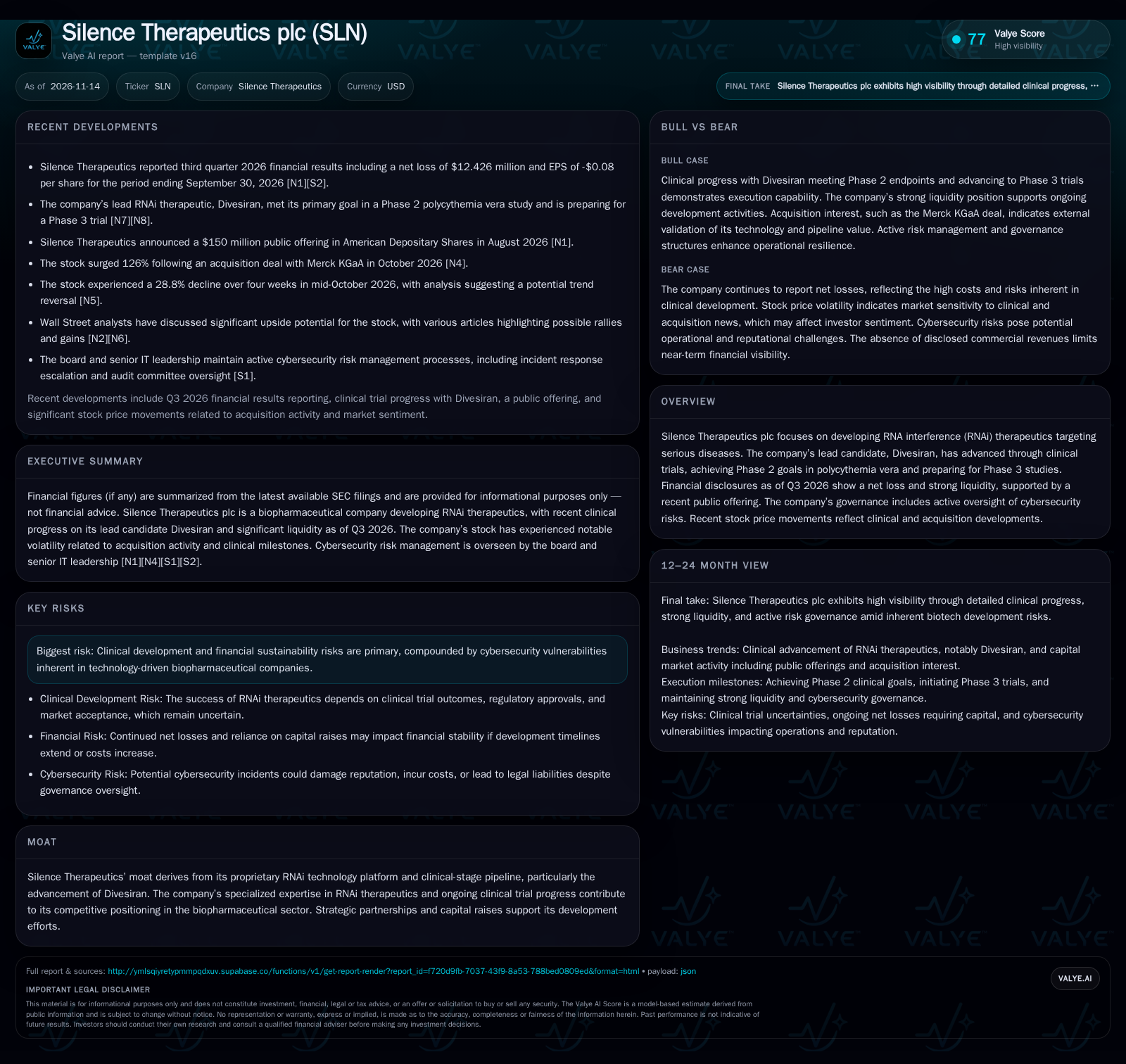
Silence Therapeutics has demonstrated clinical progress with Divesiran, its lead RNAi candidate, and maintains significant liquidity. The company’s visibility is heightened by a recent acquisition deal with Merck KGaA, but ongoing net losses and the absence of commercial revenue keep execution and funding risks front and center. The next 12–24 months hinge on clinical milestones and capital market dynamics as the company seeks to convert scientific promise into durable value. [N1] [N4] [N7] [S2]
Silence Therapeutics stands at a strategic crossroads in late 2026. With its lead RNAi asset, Divesiran, achieving a Phase 2 endpoint in polycythemia vera and the company preparing for Phase 3, Silence has drawn significant investor and strategic attention—including a major acquisition announcement by Merck KGaA. As Silence advances its RNAi pipeline, the next year will test its ability to convert clinical progress and external validation into sustainable value.
Divesiran’s Phase 2 Success and Acquisition Interest Reshape the Strategic Landscape
The most material recent developments for Silence Therapeutics are the achievement of Phase 2 primary goals by its lead RNAi therapeutic, Divesiran, in polycythemia vera (PV), and the announcement of an acquisition deal with Merck KGaA, which triggered a 126% surge in the company’s stock price. As of September 30, 2026, Silence reported $247.659 million in cash and cash equivalents, a net loss of $12.426 million for Q3 2026, and no disclosed commercial product revenue. This combination of clinical progress, strategic interest, and significant liquidity positions Silence for a pivotal transition, but underscores the execution risk and market sensitivity inherent in pre-commercial biotechs. [N1] [N4] [N7] [S2]
RNAi Platform Economics: Development Costs, Capital Needs, and Commercialization Potential
Silence Therapeutics’ business model is fundamentally R&D-intensive, with ongoing net losses reflecting the high fixed costs of clinical development, regulatory submissions, and platform advancement.
If Divesiran or other candidates achieve regulatory approval, the economics could shift dramatically. RNAi therapies, particularly those leveraging infrequent dosing and durable effects, may command premium pricing in rare indications like PV. However, commercial success also depends on payer acceptance, competitive positioning, and the ability to scale manufacturing and distribution. Operating leverage could materialize if a product launch occurs, but development costs will likely remain significant until such a transition. Without disclosed details on commercial terms or pricing, the magnitude of future margins and cash flows remains highly uncertain.
A critical factor influencing the economic outlook for Silence Therapeutics is the scalability of its RNAi manufacturing processes. RNAi therapeutics often require complex lipid nanoparticle formulations and precise delivery mechanisms, which can elevate production costs and impact gross margins. If Silence successfully optimizes manufacturing efficiency and achieves economies of scale, the cost per dose could decrease substantially, improving profitability prospects. Conversely, persistent manufacturing challenges or supply chain constraints could limit margin expansion and delay commercial viability. Additionally, the timing and magnitude of capital expenditures for commercial-scale manufacturing facilities or partnerships will materially affect the company’s cash flow profile and financing needs.
Another dimension shaping the platform economics is the reimbursement environment for RNAi therapies targeting rare diseases like polycythemia vera. Payers typically scrutinize novel modalities with high price points, demanding robust evidence of clinical benefit and cost-effectiveness compared to existing treatments. Silence’s ability to generate compelling health economics and outcomes research data will be pivotal in securing favorable coverage and reimbursement terms. Failure to do so could constrain market access and revenue potential, even if regulatory approval is obtained. Furthermore, the company’s commercial strategy, including patient support programs and pricing models, will influence uptake and long-term revenue sustainability.
RNAi Innovation, Clinical Differentiation, and the Challenge of Incumbent Therapies
Silence Therapeutics’ core competitive asset is its proprietary RNAi platform, supported by clinical progress with Divesiran. The company’s approach—targeting the TMPRSS6 gene to regulate iron metabolism and reduce red blood cell overproduction in PV—offers a novel mechanism relative to traditional cytoreductive therapies and phlebotomy. RNAi’s potential for infrequent dosing and durable effects could be a differentiator in patient convenience and outcomes.
However, the competitive environment is intense. Numerous established and emerging biopharma companies are pursuing RNA-targeted therapies and other disease-modifying approaches for hematologic and rare diseases. Larger incumbents may have greater resources for development, commercialization, and payer negotiations. Additionally, Silence must contend with the clinical and regulatory risks inherent in novel modalities, as well as the possibility that other RNAi or gene-silencing platforms achieve faster or more compelling results. Strategic partnerships, such as the Merck KGaA deal, can provide validation and scale but may also subject Silence to integration or execution risks.
The competitive landscape’s evolution will also depend on the pace of innovation in RNAi delivery technologies and alternative gene-silencing approaches, such as antisense oligonucleotides or CRISPR-based therapies. If competitors develop platforms that offer improved tissue targeting, reduced immunogenicity, or simplified dosing regimens, Silence may face pressure to enhance its own technology or risk obsolescence. Strategic partnerships and licensing agreements could provide access to complementary technologies, but also introduce dependencies and potential dilution of control over development priorities. Additionally, regulatory authorities’ evolving standards for novel RNA-based therapies will influence the risk profile and time-to-market relative to competitors.
Clinical Milestones Drive Value Inflection and Strategic Leverage
In the favorable scenario, Silence successfully initiates and completes enrollment for the Phase 3 Divesiran PV trial, achieving positive topline results that confirm efficacy, safety, and durability of response. This would set the stage for regulatory submission and potentially accelerate commercial or strategic partnerships, leveraging the current liquidity to advance additional pipeline assets.
External validation—such as a consummated acquisition by Merck KGaA or another strategic—could deliver immediate value and provide resources for platform expansion. Confirmation would come from regulatory milestones (e.g., Phase 3 trial initiation and successful interim analyses), partnership announcements, or completed M&A transactions. Falsification would involve clinical setbacks, regulatory delays, or breakdowns in strategic negotiations.
Execution on Phase 3 and Capital Stewardship Define the Next Chapter
The company may pursue additional partnerships or non-dilutive funding to extend runway and diversify risk, while maintaining a focus on operational discipline.
Shareholder value in this scenario will hinge on sustained clinical progress, prudent cash management, and the ability to weather volatility as key milestones approach. Confirmation would come from on-time trial enrollment, manageable burn rate, and continued external interest (e.g., analyst coverage, partnership discussions).
Clinical Setbacks and Capital Constraints Expose Structural Vulnerabilities
In the adverse scenario, Silence encounters clinical setbacks in the Divesiran Phase 3 program—such as safety signals, lack of efficacy, or enrollment challenges—leading to regulatory delays or trial discontinuation. Without commercial revenue, the company’s burn rate could rapidly erode its cash reserves, forcing difficult decisions around pipeline prioritization, cost reductions, or dilutive financings.
Additionally, if the Merck KGaA acquisition fails to close or strategic interest wanes, Silence may lose a key source of external validation and capital. Confirmation would include negative trial results, material cash burn without offsetting capital inflows, or the announcement of workforce reductions and halted programs. Falsification would require evidence of clinical progress, new funding, or alternative strategic options.
Milestones and External Factors That Will Shape Silence’s Value Trajectory
Progress and updates on the initiation, enrollment, and interim results of the Phase 3 Divesiran PV trial.
Cash burn rate and updated forecasts for operational runway, particularly in relation to clinical trial timelines.
Status updates and terms regarding the proposed acquisition by Merck KGaA or alternative strategic transactions.
Pipeline development beyond Divesiran—announcements of new candidates, partnerships, or IND submissions.
If disclosed, metrics on patient retention, dosing adherence, and real-world outcomes in ongoing or expanded trials.
Regulatory interactions and feedback, including special designations (e.g., fast track, orphan drug) that could accelerate timelines.
Cybersecurity incidents or governance updates, given the heightened risk profile as operations scale.
Disclaimer: This is research-only, informational analysis and not investment advice. It may include AI-generated interpretation and general industry context. Always verify important details using primary sources.

Comments