
Bitwise Chainlink ETF: Structure, Exposure, and the Mechanics of Crypto-Linked ETP Economics
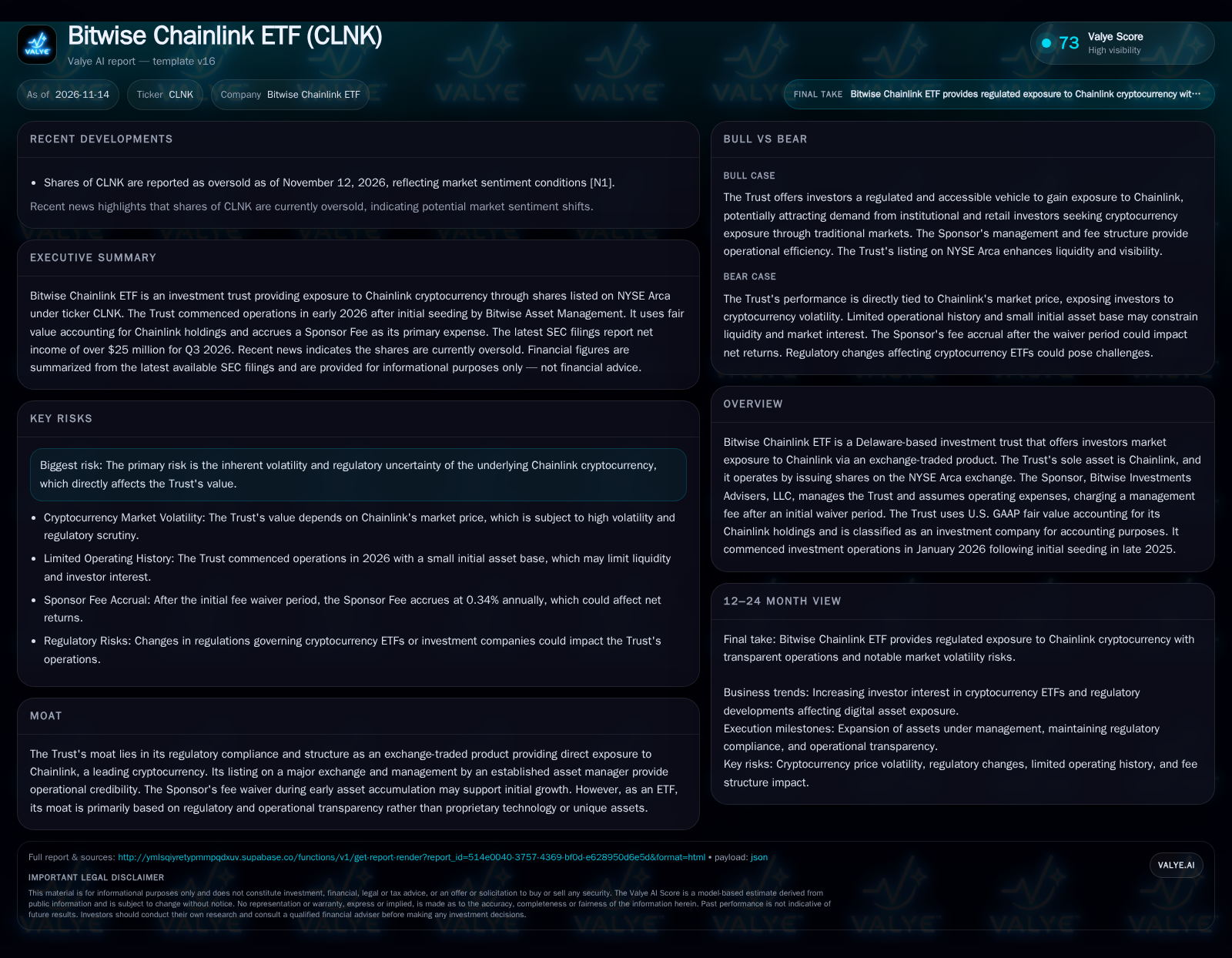
Bitwise Chainlink ETF (CLNK) offers investors a regulated, exchange-traded vehicle for direct exposure to Chainlink’s price movements. While the Trust’s operations are lean and transparent, its fortunes are inextricably tied to the volatility and adoption trajectory of Chainlink itself, layered with unique regulatory and fee structure considerations.
Bitwise Chainlink ETF (CLNK) provides public market access to Chainlink's price, leveraging a transparent trust structure, a major exchange listing, and a sponsor fee waiver for initial growth. Its primary risk is direct dependence on Chainlink’s volatility and regulatory shifts. The ETF’s economics, competitive positioning, and future asset growth hinge on investor demand for listed crypto exposure and the evolution of crypto ETF regulation and pricing competition.
Bitwise Chainlink ETF (CLNK) sits at the intersection of digital asset innovation and traditional financial markets, offering a simple, regulated wrapper for Chainlink exposure. With a lean structure, a sponsor fee waiver for its early growth phase, and direct linkage to Chainlink’s price, CLNK is both an accessible entry point for crypto-curious investors and a pure play on the fortunes of one of blockchain’s most prominent oracle networks. However, the ETF’s value proposition, growth trajectory, and risk profile are all fundamentally shaped by external factors: the price and adoption of Chainlink itself, evolving regulatory frameworks, and the competitive dynamics of the crypto-linked ETF space.
Recent Performance and Structural Features Set the Tone for CLNK
As of the quarter ended September 30, 2026, Bitwise Chainlink ETF reported net income of $25,114,865, demonstrating the sensitivity of trust income to Chainlink’s market performance [S2]. The Trust commenced investment operations in January 2026 following a modest seeding by Bitwise Asset Management, and as of December 31, 2025, had net assets of $200 with 8 shares outstanding, highlighting its nascent stage [S1]. The Sponsor waives all fees up to $500 million in assets until April 2025, after which a 0.34% annual fee is charged on Chainlink holdings [S1]. Recent news coverage notes CLNK shares as oversold as of November 12, 2026, reflecting current market sentiment [N1]. These facts together establish both the early operational phase of the Trust and its direct exposure to Chainlink’s price volatility and investor sentiment.
How CLNK’s Economics Are Driven by Asset Flows, Crypto Prices, and Fee Structures
The business model of Bitwise Chainlink ETF is fundamentally simple: the Trust holds Chainlink as its sole asset, and investors purchase shares that represent a pro-rata interest in these holdings. The Trust’s only ordinary expense is the Sponsor Fee, set at 0.34% annually on Chainlink holdings after the fee waiver period ends in April 2025 [S1]. During the waiver, the Sponsor absorbs all normal operating expenses, which enables the Trust to maximize NAV growth and potentially attract early flows. Once the waiver expires, the expense ratio becomes a direct drag on net returns relative to spot Chainlink.
Revenue for the Trust is not generated in the traditional sense; rather, investor returns are determined by the appreciation or depreciation of Chainlink held and the relative efficiency of the trust structure. The sponsor, Bitwise, receives its compensation via the accrued fee post-waiver. The ETF’s asset base is likely to scale in step with investor demand for listed Chainlink exposure and with Chainlink’s own price. The Trust’s lean structure means fixed costs are minimal, and operational leverage is less relevant than in typical operating businesses. However, the economics become more attractive for the Sponsor as AUM grows, since the cost to administer additional assets is marginal, while fees scale linearly with AUM after the waiver period.
Capital needs for the Trust itself are minimal, as it does not invest in infrastructure, R&D, or marketing in the way an operating company might. However, persistent inflows are necessary for the ETF to reach scale, improve liquidity, and justify continued sponsor support, especially after the fee waiver expires.
Regulatory Structure, Exchange Listing, and Fee Policy Shape CLNK’s Place in the Crypto ETF Landscape
CLNK’s competitive positioning is anchored in its regulatory compliance, transparent structure, and listing on NYSE Arca, which provides broad investor access and operational credibility [S1]. Its primary competitors are other crypto-linked exchange-traded products (ETPs), including both single-asset crypto trusts and diversified digital asset funds. The moat for CLNK is not technological but structural: regulatory clarity, a major exchange listing, and the operational reputation of Bitwise as Sponsor.
However, the competitive landscape for crypto ETPs is rapidly evolving. New entrants could compete on lower fees, tighter tracking error, or enhanced product features (such as staking yield pass-through, if permitted). Substitution risk is high: investors seeking Chainlink exposure could also buy the token directly, use rival ETPs, or gain exposure through broader crypto index products. The Sponsor’s temporary fee waiver may help attract early assets, but long-term differentiation will depend on liquidity, tracking efficiency, and brand trust.
In the absence of proprietary technology or unique distribution rights, switching frictions are minimal for sophisticated investors. However, operational transparency, regulatory compliance, and ease of trading via the NYSE Arca listing may support some degree of stickiness among traditional investors wary of direct crypto custody.
Institutional Adoption and Favorable Regulation Could Drive Rapid AUM Growth
If institutional and retail demand for listed Chainlink exposure accelerates—driven by broader adoption of Chainlink in decentralized finance, positive cryptocurrency market cycles, or regulatory green lights for crypto ETPs—CLNK could see rapid asset inflows and increased trading volume. The fee waiver through April 2025 could catalyze early growth, as investors seek low-cost, regulated access.
A favorable upside scenario would see Chainlink’s price appreciate significantly, attracting further flows, which in turn improve liquidity and visibility for the Trust. Regulatory stability around crypto ETFs would reinforce investor confidence, while Bitwise’s brand and operational track record could help CLNK capture outsized share of new AUM. Confirmation of this scenario would include sustained net inflows, growing trading volumes, narrowing bid-ask spreads, and a rising NAV per share, outpacing competitors. AUM milestones—such as surpassing $100 million or $500 million before the fee waiver expires—would strongly support this thesis.
Falsification would be evidenced by persistent outflows, little growth in AUM, or regulatory developments that stall or reverse crypto ETP adoption.
CLNK Tracks Chainlink Price, with Gradual AUM Growth and Modest Fee Drag
The most plausible middle path is that CLNK’s AUM and trading volumes grow gradually, largely mirroring investor interest in Chainlink and the broader digital asset market. The ETF tracks Chainlink’s price closely, with net returns modestly lagging due to the Sponsor Fee (after the waiver ends). The Trust’s structure and NYSE Arca listing provide a familiar, regulated wrapper, making it an attractive option for investors who prefer not to hold crypto directly.
In this scenario, the Trust does not achieve runaway growth but establishes itself as a niche product with stable, if modest, AUM. The fee waiver period helps seed initial interest, but long-term AUM growth is contingent on Chainlink’s price appreciation and the ability of the ETF to retain assets against competitive fee pressure and potential new product launches.
Confirmation would come from steady, if unspectacular, inflows and moderate improvements in secondary market liquidity. Falsification would be visible in stagnant or declining AUM, persistent discounts to NAV, or regulatory headwinds that limit product marketing or investor access.
Crypto Volatility or Regulatory Shocks Erode Trust Value and Investor Demand
A negative scenario for CLNK would occur if Chainlink’s price declines sharply or remains volatile, eroding NAV and deterring new inflows. Regulatory uncertainty or adverse rulings affecting crypto ETFs could further dampen demand or force operational changes. In this environment, CLNK could see declining AUM, widening discounts to NAV, and reduced liquidity, which might in turn create a negative feedback loop of further outflows.
The expiration of the fee waiver could exacerbate outflows if investors perceive the Sponsor Fee as uncompetitive versus rival products or direct token purchases. Confirmation of the downside scenario would include sustained net redemptions, persistent discounts to NAV, and negative press around crypto ETF regulation or Chainlink fundamentals. Falsification would require evidence of resilient inflows or stable AUM despite adverse crypto market conditions.
Milestones That Will Shape the Bitwise Chainlink ETF Thesis in 2026 and Beyond
Net asset value (NAV) per share growth relative to underlying Chainlink price movements—tracking error would help test product efficiency if disclosed.
Assets under management (AUM) progression, especially during and after the Sponsor Fee waiver period, as a gauge of market adoption and fee sensitivity.
Primary and secondary market trading volumes, which reflect investor interest and liquidity quality.
Bid-ask spread trends on NYSE Arca—narrowing spreads would indicate increasing liquidity and market confidence.
Fee competitiveness relative to other Chainlink or crypto-linked ETPs, especially after the waiver period ends.
Regulatory developments or communications from the SEC and NYSE Arca regarding crypto ETF listing and operational requirements.
Chainlink network adoption metrics or major blockchain integrations, as these may influence underlying token demand and, by extension, ETF flows.
Discount or premium to NAV in secondary trading, as persistent deviations could signal market structure or demand issues.
Disclaimer: This is research-only, informational analysis and not investment advice. It may include AI-generated interpretation and general industry context. Always verify important details using primary sources.

Comments