
Birchtech Corp.: Regulatory Tailwinds, Innovation Bets, and the Next Phase in Environmental Controls
Birchtech stands at the intersection of tightening environmental regulation and technology-driven purification markets, leveraging its patented mercury emissions solutions while betting on water treatment expansion and carbon rejuvenation. The company’s near-term trajectory hinges on patent monetization, execution in emerging segments, and the durability of regulatory demand.
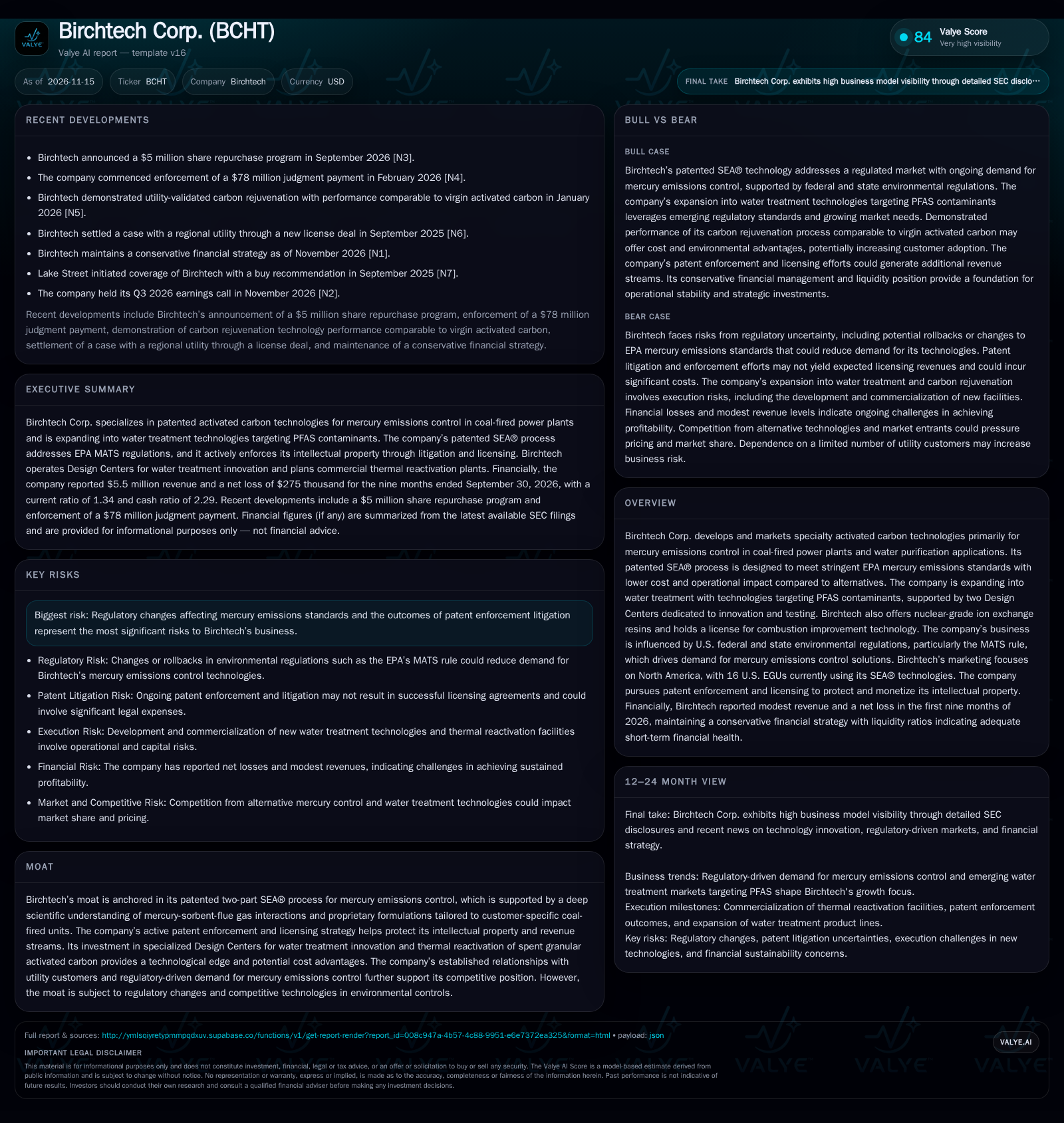
Birchtech’s business is underpinned by patented activated carbon technologies for coal-fired power plants and expanding water treatment offerings. Regulatory-driven demand and successful patent enforcement provide near-term revenue visibility, but the company’s scale, profitability, and future growth are contingent on the pace of water treatment adoption, execution of commercial carbon rejuvenation, and resilience to regulatory or competitive shifts. [S1] [S2] [N4] [N5]
Birchtech Corp. is navigating a critical period as it leverages regulatory-driven demand for its patented mercury emissions technologies while pushing into the fast-evolving water treatment market. With a core business anchored in EPA compliance solutions for coal-fired utilities and a pipeline of innovation targeting PFAS remediation and activated carbon rejuvenation, Birchtech’s fortunes are tied to the durability of environmental mandates and the company’s ability to translate technical validation into commercial scale. Recent patent enforcement wins and a disciplined financial strategy provide a buffer, but sustainable growth will depend on market adoption of next-generation offerings and the company’s ability to manage execution and regulatory risks.
Recent Patent Enforcement, Financial Discipline, and Technology Validation
Three developments shape Birchtech’s current outlook. First, the company commenced enforcement of a $78 million judgment payment related to its patented mercury removal technologies, signaling the tangible value of its IP portfolio and its willingness to convert infringement into licensing revenue. Second, Birchtech demonstrated utility-validated carbon rejuvenation with performance comparable to virgin activated carbon, suggesting technical progress in reducing both cost and environmental impact for water treatment customers. The company reported a current ratio of 1.34 for the period. [S2] [N3] [N4] [N5]
Revenue Streams, Cost Structure, and the Pursuit of Operating Leverage
Birchtech’s core revenue is anchored in specialty activated carbon sales and licensing for mercury emissions control, primarily serving coal-fired power plants subject to EPA’s MATS rule. The company’s SEA® process offers a value proposition of regulatory compliance at lower operational costs, positioning Birchtech as a preferred supplier where cost and reliability matter. Revenue from IP enforcement—evidenced by the $78 million judgment—adds a non-linear, episodic layer to the business model, but is inherently unpredictable and costly to pursue. [S1] [N4]
Expansion into water treatment and PFAS remediation introduces a new revenue frontier. Here, Birchtech is piloting next-generation sorbents and thermal reactivation of spent granular activated carbon (GAC), which, if commercialized, could reduce customers’ lifecycle costs and environmental footprint. The economics of carbon rejuvenation may be attractive if operating costs and capital intensity are managed, but will depend on customer adoption, pricing, and the ability to scale beyond the Design Center pilot phase. The addition of nuclear-grade ion exchange resins broadens the addressable market but likely requires a distinct sales cycle and technical validation.
Birchtech’s cost structure likely features a mix of fixed R&D and patent enforcement expenses, variable manufacturing and distribution costs, and episodic legal outlays. Achieving operating leverage will depend on growing the installed base, increasing recurring supply contracts, and converting technical pilots into repeatable commercial deployments. The company’s modest revenue and near-breakeven loss profile suggest early-stage operating leverage, but scale is not yet evident. [S2]
Patents, Process Differentiation, and the Regulatory Moat—But for How Long?
Birchtech’s competitive edge rests on its patented two-part SEA® mercury removal process, which is tailored to meet or exceed EPA standards at lower cost and operational burden than generic activated carbon solutions. The moat is reinforced by ongoing IP enforcement, as recent legal outcomes demonstrate, and by the technical depth of its process and customer-specific formulations. However, the company’s position is exposed to two major counterforces: the risk of regulatory rollback (which could shrink the addressable market for mercury controls) and the threat of substitute technologies, including alternative sorbents or process innovations from both incumbents and new entrants. [S1] [N4] [N6]
In water treatment, particularly PFAS remediation, the landscape is more fragmented and competitive, with established chemical companies and emerging startups all vying for share. The demonstrated performance of rejuvenated carbon may provide a cost and sustainability edge, but Birchtech must prove that its approach can scale, deliver recurring revenue, and fend off commoditization. Customer switching costs in utilities are historically high due to the criticality of compliance and process integration, but new regulatory or technological shifts could erode this advantage over time.
From Patent Monetization to Water Treatment Scale: The Case for Acceleration
A favorable scenario for Birchtech hinges on three reinforcing mechanisms. First, continued success in enforcing and licensing its patented mercury removal technologies could generate substantial high-margin, non-dilutive revenue, especially if additional infringers are converted into licensees or direct customers. Second, commercial deployment of thermal carbon rejuvenation—validated by utility pilots—could catalyze adoption among water treatment operators seeking cost savings and environmental benefits, paving the way for a recurring revenue stream from both equipment and ongoing sorbent supply. Third, regulatory tightening around PFAS and other emerging contaminants could accelerate demand for advanced water treatment solutions, expanding Birchtech’s addressable market and increasing pricing power.
Evidence that would confirm this scenario includes new multi-site commercial contracts for rejuvenated carbon, additional successful patent settlements or licensing deals, and a step-change in revenue and margin growth from water treatment lines. A sustained, above-peer growth rate and rising gross margins would also validate operating leverage and a transition from episodic to recurring revenue. [N4] [N5]
Regulatory-Driven Stability, Gradual Water Entry, and Episodic IP Revenue
The most plausible trajectory is for Birchtech to maintain its core position as a regulated supplier to U.S. coal-fired utilities, with incremental revenue from new utility contracts and continued, albeit sporadic, IP enforcement outcomes. Expansion into water treatment is likely to proceed cautiously, with pilot projects and gradual uptake as customers validate the performance and economics of rejuvenated carbon. Revenue remains modest, with profitability hinging on cost management and the pace of commercial adoption in new segments.
Confirmation of this scenario would include a stable or slightly growing installed base of SEA®-enabled EGUs, periodic but not transformative patent settlements, and measured progress in water treatment commercialization. Stagnation in revenue growth, slow margin expansion, and continued reliance on regulatory mandates would suggest that Birchtech is not yet breaking out of its niche. [S1] [S2] [N5]
Regulatory Rollback, Execution Missteps, and Competitive Erosion
The adverse case arises if EPA or state-level mercury emissions standards are weakened or enforcement is deprioritized, leading to reduced demand from coal-fired utilities. Simultaneously, if Birchtech’s patent litigation efforts stall or fail to generate further licensing revenue, the episodic IP income evaporates. In water treatment, commercialization could falter if technical pilots fail to translate into cost-effective, scalable solutions, or if larger competitors outpace Birchtech in winning municipal and industrial contracts. Revenue stagnates or declines, fixed costs remain, and losses widen, potentially pressuring liquidity and forcing retrenchment.
This scenario would be confirmed by regulatory changes reducing compliance requirements, a shrinking customer base in coal-fired utilities, failed or delayed water treatment commercialization, and absence of new patent-related revenue. Margin compression or a material increase in net losses would signal deteriorating economics. [S1]
Milestones That Could Shift Birchtech’s Trajectory in Environmental Solutions
Number of new commercial contracts or site deployments for carbon rejuvenation technology—would signal customer adoption beyond the pilot phase.
Additional patent enforcement outcomes, including new settlements, licensing agreements, or judgments—evidence of further monetization of Birchtech’s IP portfolio.
Revenue and gross margin breakdown by segment (mercury control vs. water treatment, if disclosed)—to gauge the transition from legacy to growth segments.
Updates on capital allocation to commercial thermal reactivation facilities—would clarify execution progress and capital intensity.
Regulatory developments affecting EPA MATS or emerging PFAS standards—potentially expanding or contracting Birchtech’s addressable market.
Churn or retention rates among existing utility customers (if disclosed)—to assess the durability of the core business.
Evidence of customer adoption of SEA-IX™ nuclear-grade ion exchange resins—would test expansion into new verticals.
Progress on scaling Design Center innovations to commercial facilities—an indicator of R&D-to-revenue conversion.
Disclaimer: This is research-only, informational analysis and not investment advice. It may include AI-generated interpretation and general industry context. Always verify important details using primary sources.

Comments