
Longeveron’s Stem Cell Ambitions: Clinical Setbacks, Capital Discipline, and the Search for Strategic Leverage
Longeveron’s drive to commercialize stem cell therapies faces renewed uncertainty after its lead candidate missed a pivotal clinical endpoint, but observed safety signals, active patent licensing, and partnership outreach offer alternative routes for value creation. The company’s ability to convert scientific progress into sustainable business outcomes now hinges on pipeline execution, financial runway management, and its approach to external collaboration.
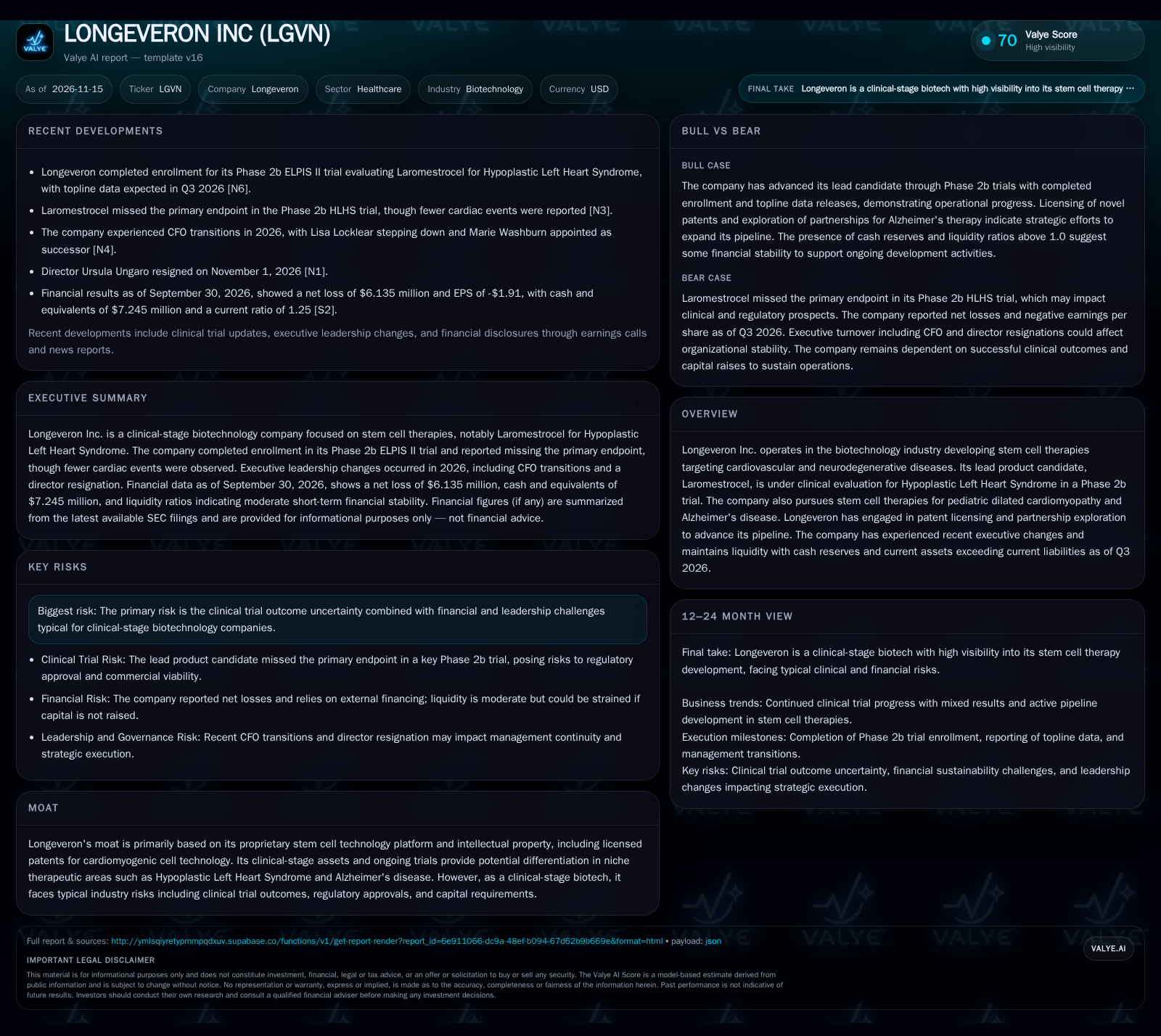
Longeveron’s lead stem cell therapy for pediatric heart disease missed its Phase 2b primary endpoint, raising questions about regulatory and commercial prospects. However, observed reductions in cardiac events, ongoing patent licensing, and partnership efforts in Alzheimer’s research provide potential alternative value levers.
Longeveron Inc. stands at a strategic crossroads after its lead stem cell therapy for Hypoplastic Left Heart Syndrome failed to meet its primary Phase 2b endpoint, despite showing favorable safety signals. This setback puts heightened emphasis on the company’s ability to extract value from its remaining pipeline, patent portfolio, and partnership initiatives—especially as near-term financial losses continue and executive turnover raises questions about operational continuity. The next 12 months will test whether Longeveron can pivot from clinical disappointment to commercial relevance, leveraging its intellectual property and ongoing trials in new therapeutic areas.
Clinical Trial Results Shift the Strategic Focus
The most consequential recent development for Longeveron is the failure of Laromestrocel, its lead candidate for Hypoplastic Left Heart Syndrome (HLHS), to meet the primary endpoint in the Phase 2b ELPIS II trial as of September 2026. While the topline data did reveal a reduction in cardiac events, missing the primary efficacy goal is a setback for regulatory approval and commercial prospects in this rare pediatric indication. At the same time, the company continues to report net operating losses, with a $6.135 million loss and $7.245 million in cash and equivalents as of September 30, 2026. Executive turnover—specifically a CFO transition and a director resignation—further clouds the near-term outlook. The company remains active in patent licensing and partnership outreach, especially in Alzheimer’s research, suggesting a potential pivot or diversification of its commercial focus. [N3] [S2] [N4] [N1]
Stem Cell Therapy Economics: High Risk, High Leverage, and Uncertain Payouts
Longeveron’s business model relies on the successful clinical development and eventual commercialization of its proprietary stem cell therapies. In the HLHS program, the commercial opportunity is constrained by the rarity of the indication, meaning pricing power would need to be high to justify ongoing investment. However, missing the primary endpoint in Phase 2b undermines the probability of regulatory approval, likely reducing the asset’s risk-adjusted net present value and making future capital allocation to this program less compelling.
The company’s economics are characterized by high fixed R&D costs, with clinical trial expenses dominating the cost structure until (and if) a product is approved. Variable costs, such as manufacturing and distribution, become relevant only at or after commercialization. The company reported cash and liquidity metrics for the period; these figures do not by themselves establish operating runway, investment capacity, financial flexibility, or financing capacity. [S2]
Longeveron’s patent licensing activity and exploration of partnerships—particularly in larger markets like Alzheimer’s—could provide alternative revenue streams, either through upfront payments, milestones, or royalties. However, these economics are highly contingent on the perceived clinical promise of the technology and the company’s negotiating leverage, both of which may be impaired following the HLHS trial outcome.
Intellectual Property and Clinical Pipeline: Differentiation Versus Industry Headwinds
Longeveron’s moat is rooted in its proprietary stem cell technology and associated patents, including licensed IP for cardiomyogenic cell applications. This provides some defensibility, but the company operates in a field crowded with both large pharmaceutical companies and emerging biotechs pursuing cell and gene therapies across cardiovascular and neurodegenerative indications.
The HLHS setback puts pressure on Longeveron to demonstrate differentiation in its remaining pipeline, particularly in pediatric dilated cardiomyopathy and Alzheimer’s. In these areas, the company faces indirect competition from established therapies and next-generation modalities (such as gene editing and monoclonal antibodies), which may offer different efficacy or safety profiles. Switching costs for clinicians and health systems are generally low in the absence of clear clinical superiority or reimbursement incentives.
Longeveron’s partnership and licensing efforts are a rational response to the capital intensity and risk of late-stage development. However, the company’s ability to command favorable terms is linked to the strength of its clinical data and perceived platform potential—both of which are now under greater scrutiny.
Pivoting to Value: How Partnerships and Pipeline Expansion Could Revitalize Prospects
A favorable outcome for Longeveron would involve successfully leveraging observed safety signals and secondary endpoints (such as reduced cardiac events) from the HLHS trial to support further development or regulatory dialogue, possibly as part of a redefined clinical strategy. Simultaneously, the company could secure non-dilutive funding or collaboration agreements—particularly in Alzheimer’s or pediatric cardiomyopathy—by convincing partners of the platform’s broader potential.
Upside would be confirmed by announcements of new partnerships, licensing deals, or grant funding that extend the company’s runway and validate its science. Additional positive data from other pipeline programs, or regulatory feedback that supports alternative approval pathways for Laromestrocel, would also bolster the narrative. A meaningful revenue contribution from out-licensing or milestone payments would further demonstrate the company’s ability to monetize its technology, even in the absence of near-term product launches.
Pipeline Progress and Capital Discipline Define the Next Chapter
The most plausible trajectory for Longeveron is a period of operational recalibration: continued development of earlier-stage programs, active pursuit of licensing and partnership opportunities, and disciplined capital management to extend financial runway. The company’s existing liquidity may support ongoing operations in the short term, but further capital raises—either dilutive or non-dilutive—are likely necessary unless substantial business development progress is made.
Confirmation of this scenario would come from incremental updates on pipeline progress, measured expense management, and at least partial success in partnership discussions. Conversely, a lack of business development milestones, further clinical disappointments, or rapid cash burn would suggest a drift toward more acute financial risk.
Clinical Failures and Funding Gaps: The Road to Value Erosion
The adverse scenario for Longeveron is driven by a combination of persistent clinical setbacks, inability to secure new partnerships or licensing deals, and accelerating financial losses leading to a constrained runway. If follow-on studies in pediatric cardiomyopathy or Alzheimer’s fail to produce compelling data, the company’s negotiating leverage and prospects for non-dilutive funding could deteriorate sharply.
Evidence for downside would include delays or negative updates in pipeline programs, unsuccessful capital-raising efforts, or further executive turnover signaling instability. Diminishing liquidity without offsetting business development progress would heighten the risk of value-destructive financing or forced asset sales.
Testing the Longeveron Thesis: What Will Reveal True Strategic Traction?
Progress or setbacks in ongoing and planned clinical trials for pediatric dilated cardiomyopathy and Alzheimer’s indications.
Announcements of new partnerships, licensing agreements, or grant funding, particularly those providing non-dilutive capital or validating the platform’s broader relevance.
Quarterly cash burn and updated liquidity disclosures to gauge the pace of financial runway depletion or extension.
Evidence of regulatory engagement or alternative approval pathways for Laromestrocel, especially if safety signals are leveraged.
Management stability, including the impact of recent executive changes and any further turnover at the executive or board level.
Updates on intellectual property portfolio expansion, out-licensing activity, or patent litigation (if disclosed).
Operational milestones or commercial traction in out-licensed programs, which would provide external validation of Longeveron’s technology.
Disclaimer: This is research-only, informational analysis and not investment advice. It may include AI-generated interpretation and general industry context. Always verify important details using primary sources.

Comments