
Holistic Asset Finance Group: Specialization in Short-Form Video Marketing Amid Liquidity Constraints and Competitive Pressures
Holistic Asset Finance Group’s pivot to short video digital marketing in Asian markets has driven a sharp revenue shift, but tight liquidity and a lack of scale highlight both the promise and fragility of its current model. Can focused execution and regional expertise carve out sustainable differentiation as larger rivals crowd the space?
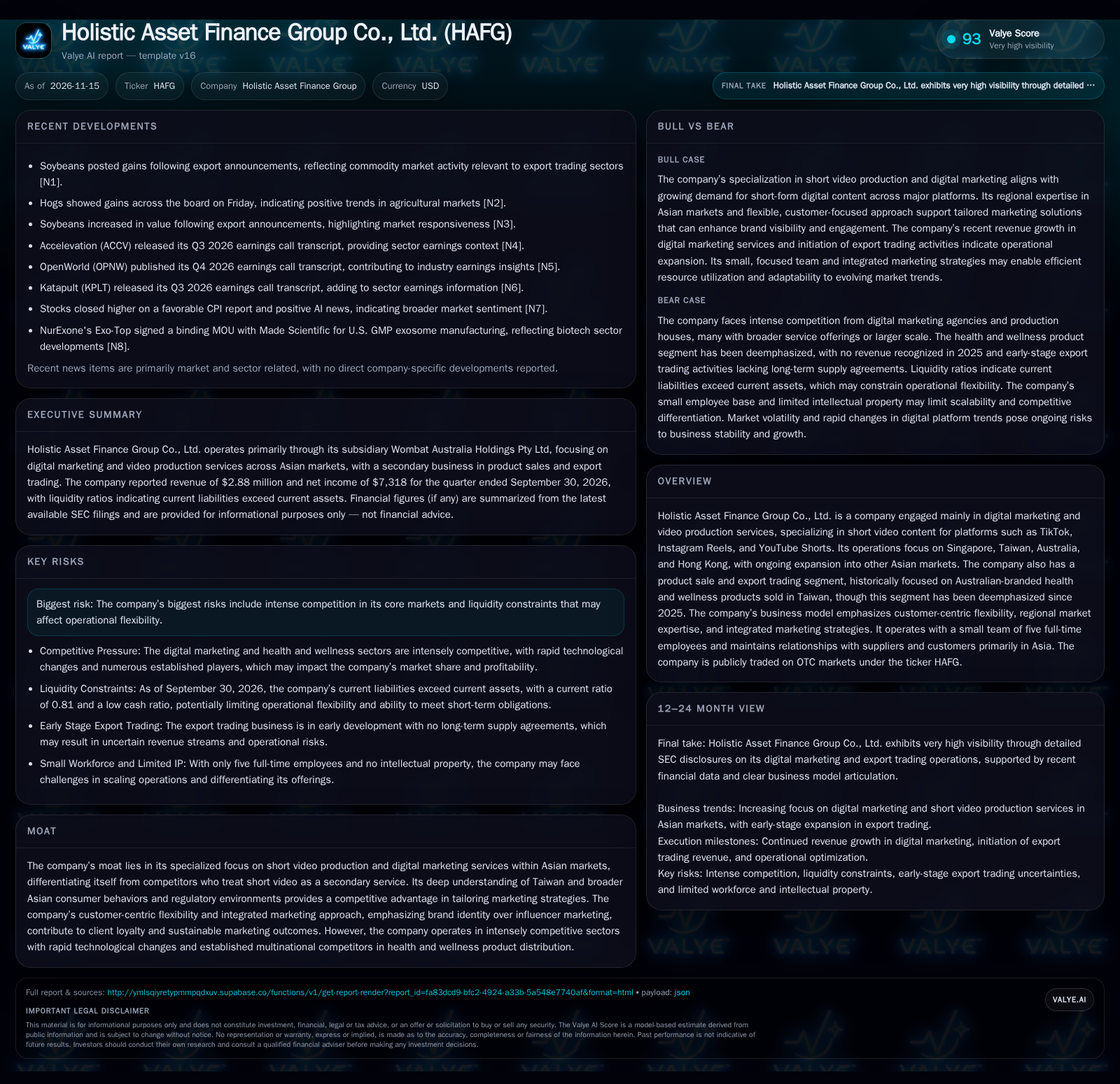
Holistic Asset Finance Group has transitioned decisively from product sales to digital marketing, with short-form video now driving nearly all revenues. While 2026 quarterly revenue exceeded $2.8 million, liquidity metrics remain tight and the company’s workforce is lean. The next phase hinges on whether its project-based, regionally attuned approach can secure repeat business and margin expansion, or whether scale and capital constraints will limit long-term competitiveness.[S2]
Holistic Asset Finance Group’s evolution from an Australian-branded product exporter to a specialist in short video digital marketing has produced a dramatic revenue transformation. By focusing on customized, data-driven campaigns for Asian markets, the company has surfed the global wave of short-form content adoption—yet this growth comes with a stark liquidity profile and operational vulnerabilities. The firm’s ability to sustain momentum will likely depend on converting project wins into recurring business, deepening its niche expertise, and managing the capital pressures inherent in its small-scale, competitive sector.[S1] [S2]
Recent Financial Results Spotlight a Business Model in Transition
The most material developments for Holistic Asset Finance Group are its near-total revenue reliance on digital marketing and video production, a sharp pivot from its previous focus on health and wellness product exports. Digital marketing accounted for 100% of 2025 revenue, and for the quarter ended September 30, 2026, the company reported $2,879,711 in revenue and net income of $7,318.[S2] This topline demonstrates the commercial traction of its short video offerings in Asian markets. The company reported cash and liquidity metrics for the period; these figures do not by themselves establish operating runway, investment capacity, financial flexibility, or financing capacity. [S2] [S1]
Short Video Campaigns: Project-Based Revenue, Thin Margins, and High Operating Leverage
Holistic Asset Finance Group generates revenue primarily through project-based digital marketing services, focusing on short video content for platforms such as TikTok, Instagram Reels, and YouTube Shorts. The economics of this business are typically characterized by high revenue volatility, as project pipelines can be lumpy and client concentration is high—three customers accounted for 70% of 2025 revenues.[S1] The service model leverages a lean workforce (five full-time employees) and outsources key components such as advertising placement to third-party vendors, which can keep fixed costs low but may limit the company’s ability to capture higher margins or control delivery quality.
Operating leverage is likely moderate: while the company can scale output with relatively modest additional fixed costs, the absence of intellectual property or proprietary technology limits opportunities for significant margin expansion. Capital requirements are modest for the core marketing business, but ongoing liquidity constraints could restrict the company’s ability to invest in business development, technology upgrades, or talent acquisition. The early-stage export trading segment may involve higher working capital needs if it grows, but as of 2025–2026, it remains an immaterial contributor.[S1] [S2]
Specialization Versus Scale: Can Niche Focus Outpace Larger Agencies?
In the intensely competitive digital marketing sector, Holistic Asset Finance Group’s differentiation rests on its specialization in short-form video and its deep understanding of Asian consumer behavior—particularly in Taiwan, Singapore, and Hong Kong. This focus contrasts with larger agencies that treat short video production as an add-on rather than a core service.[S1] The company’s customer-centric, data-driven approach and regional expertise may resonate with brands seeking tailored, culturally attuned campaigns.
However, barriers to entry in digital marketing remain low, and larger agencies can quickly ramp up their own short-form content offerings. The lack of proprietary tools, platforms, or intellectual property weakens defensibility, while the company’s limited scale and resources may constrain its ability to win larger campaigns or support clients with integrated, multi-channel strategies. Intense price competition and rapid shifts in platform algorithms further challenge sustainable differentiation. In export trading, the company faces established distributors and lacks long-term supplier relationships, making this a high-risk, low-visibility growth avenue.
If Project-Based Wins Convert to Recurring Engagements, Margin Expansion Could Follow
A favorable scenario would see Holistic Asset Finance Group leveraging its initial project wins to secure repeat business and multi-campaign contracts, particularly with regional brands expanding their digital presence in Asia. This could manifest as increased client retention, a rising share of recurring revenue, and improved margins as the company builds scale and operational efficiencies.
Confirmation would come from disclosures of expanded client rosters, multi-project or retainer-based contracts, and a reduction in customer concentration. Evidence of margin improvement—such as higher gross or operating margins in subsequent quarters—would suggest that the company is successfully moving beyond project-based volatility. Additionally, any announcement of technology partnerships, proprietary content tools, or data analytics capabilities would indicate a push toward defensible differentiation.
Sustained Revenue but Persistent Volatility and Margin Pressure Define the Near Term
The most plausible path is continued revenue generation from project-based digital marketing, with quarter-to-quarter volatility reflecting client concentration and the seasonal nature of marketing spend (notably around holidays and major promotional events in Asia). While the company may secure additional clients or expand into new Asian markets, its small team and lack of proprietary assets are likely to keep margins thin and limit bargaining power with both clients and suppliers.
This scenario would be confirmed by steady but uneven revenue growth, persistent low net income, and ongoing liquidity tightness. Customer concentration and absence of long-term contracts would persist, and there would be limited evidence of recurring revenue or significant margin expansion. The export trading segment may remain a minor contributor unless the company secures reliable supply channels and demonstrates traction outside digital marketing.
Liquidity Constraints and Client Losses Could Trigger a Downward Spiral
In an adverse scenario, the combination of tight liquidity and high client concentration exposes Holistic Asset Finance Group to significant risk if one or more major clients reduce or terminate their projects.
Confirmation of this scenario would include declining revenue, mounting payables or overdue obligations, staff attrition, or the need to raise emergency financing on unfavorable terms. A deterioration in customer relationships or failure to win new contracts during key seasonal periods would further amplify downward pressure. In export trading, the inability to secure supply or generate sales would reinforce reliance on the volatile services business.
Milestones That Will Shape Holistic Asset Finance Group’s Strategic Trajectory
Quarterly revenue growth in digital marketing—especially the proportion attributable to repeat versus new clients—would help test whether the business is building durable customer relationships.
Gross and operating margin trends, if disclosed, would indicate whether the company is achieving efficiencies or succumbing to price competition.
Changes in customer concentration (for example, the top three clients’ share of revenue) would reveal dependency risk and diversification progress.
The conversion rate from project-based engagements to retainer contracts or recurring revenue arrangements would be critical for stabilizing cash flow.
Liquidity and working capital movements—such as current and cash ratio trends—should be monitored for signs of operational stress or improvement.
Expansion of the employee base or investment in proprietary content or analytics tools would signal a commitment to scaling and differentiation.
Progress or setbacks in the export trading segment—especially the establishment of long-term supplier relationships and initial revenue traction—would clarify the viability of this diversification effort.
Disclaimer: This is research-only, informational analysis and not investment advice. It may include AI-generated interpretation and general industry context. Always verify important details using primary sources.

Comments