
ProCap Acquisition Corp: Sector Focus and Social Capital Shape SPAC Timeline
ProCap Acquisition Corp has raised substantial capital and assembled an experienced team to pursue a business combination in financial services. With the SPAC structure’s inherent time constraint and no operating revenues to date, the company’s ultimate value will hinge on target selection, deal execution, and market conditions at the time of the merger.
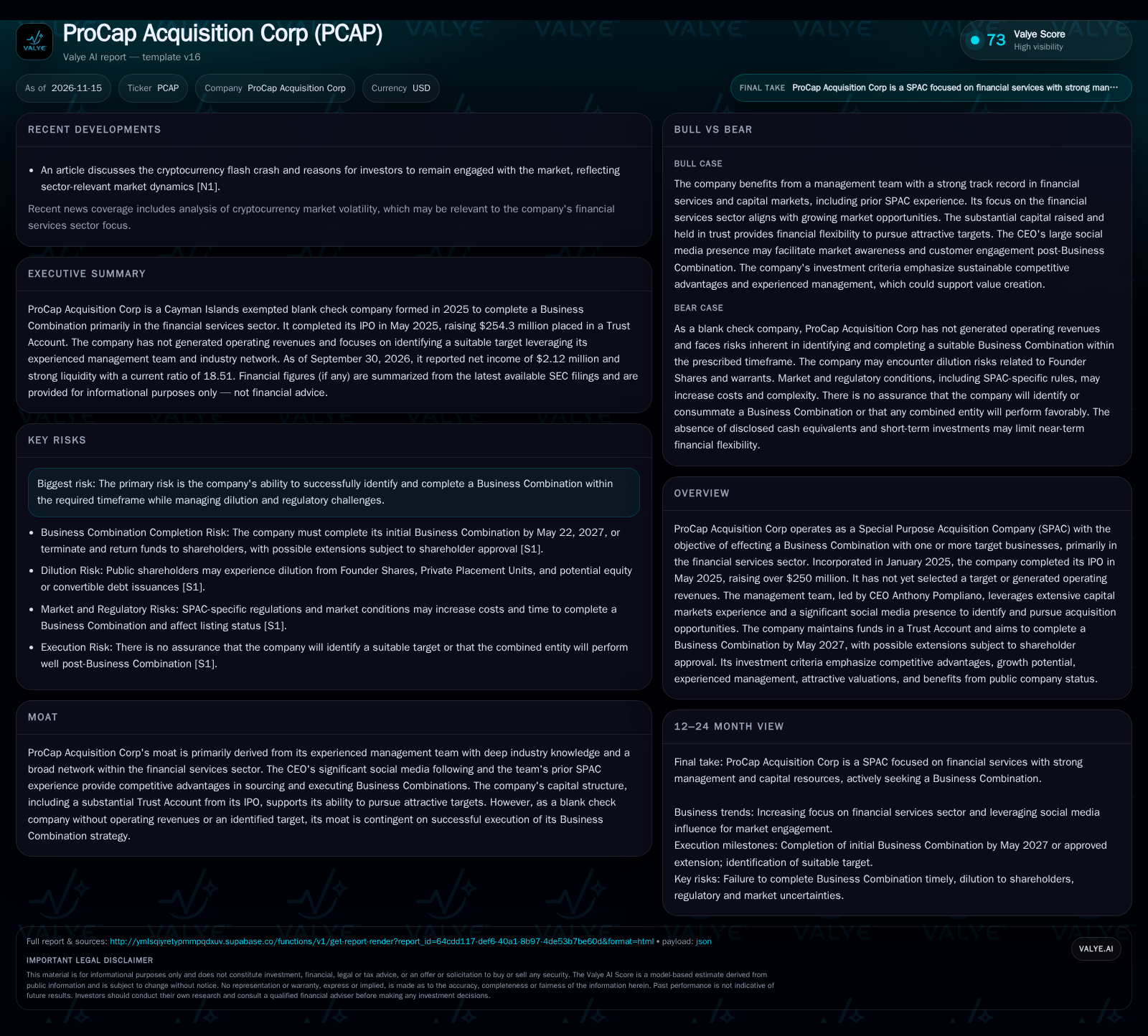
ProCap Acquisition Corp is a financial-services-focused SPAC with $254.3 million in trust and a management team leveraging industry expertise and a large social media presence. The firm faces a May 2027 deadline to complete a business combination, has not yet selected a target, and currently generates only interest income. Success will depend on the quality of the eventual deal and post-merger execution in an evolving regulatory and capital markets landscape. [S1] [S2]
ProCap Acquisition Corp is a blank check company formed in early 2025 to identify and merge with a business in the financial services sector.Having raised over $250 million and maintained a reported current ratio as of late 2026, the company’s immediate prospects hinge not on its own operations—since it has yet to generate operating revenue—but on its ability to source, negotiate, and execute a value-accretive merger before its May 2027 deadline. The next 18 months will test the management team’s network, sector insight, and dealmaking capability amid heightened scrutiny and competition in the SPAC arena.
SPAC Structure and Deadline Constraints in Target Identification
ProCap Acquisition Corp operates as a Special Purpose Acquisition Company (SPAC) incorporated in the Cayman Islands in January 2025. The company raised $250 million through its IPO in May 2025, supplemented by a $4.3 million private placement, with all proceeds held in trust for a future business combination. As of September 30, 2026, ProCap had not identified a target and reported no operating revenues, with net income derived solely from interest on trust assets. The SPAC structure mandates that ProCap must consummate a business combination by May 22, 2027, or return the trust funds to shareholders, though an extension is possible with shareholder approval. This timeline creates a defined window in which management must execute, introducing both urgency and risk. [S1] [S2]
Understanding SPAC Economics: Fees, Dilution, and Value Prospects
ProCap’s current business model is typical for SPACs: it generates no operating revenue and instead relies on interest income from its trust account until a deal is completed. The eventual economics depend on several factors: the size and terms of the business combination, the valuation at which a target is acquired, and the performance of the merged entity post-transaction. The IPO structure includes public shares and warrants, with each unit granting the holder the right to purchase additional shares at $11.50, introducing potential dilution for shareholders upon deal completion. Founder shares and private placement units further complicate the dilution picture. SPAC sponsors often benefit from a promote—typically 20% of post-business combination equity—creating strong incentives to close a deal, but this can misalign sponsor and public shareholder interests if deal quality is compromised.
Operating leverage and capital needs will only become relevant after a target is acquired. Until then, expenses are limited to deal sourcing, due diligence, and public company compliance costs, funded from a small working capital pool outside the trust. After a merger, the combined entity’s economics will depend on the target’s business model—whether capital-light (e.g., fintech software) or capital-intensive (e.g., specialty finance)—and its ability to scale and generate cash flow.
Management’s Network and Sector Expertise as Competitive Advantages
With CEO Anthony Pompliano and a team experienced in financial services and capital markets, ProCap is positioned to leverage industry relationships and a broad network for deal sourcing. The CEO’s large social media following could enhance visibility and attract potential targets or post-merger investor interest. However, the SPAC market remains crowded, especially in financial services, where many sponsors are competing for a finite pool of high-quality, public-ready targets. Structural advantages may be limited unless ProCap can secure proprietary deal flow or offer unique value to a target, such as capital markets expertise, public company readiness, or access to a differentiated investor base.
Counterforces include SPAC fatigue among targets, increased regulatory scrutiny, and a market environment where private valuations may not align with public market realities. The existence of warrants and founder shares may also make ProCap’s offer less attractive to sophisticated targets wary of dilution and post-merger volatility. Substitutes for the SPAC route—such as traditional IPOs or direct listings—remain viable for some financial services companies, particularly as capital markets normalize post-2025.
Potential Upside from Securing a High-Growth Financial Services Target
The most favorable scenario for ProCap would involve identifying a financial services target with strong growth prospects, sustainable margins, and a compelling rationale for going public. If the management team leverages its network to source a proprietary deal—perhaps an emerging fintech with proven product-market fit but limited access to traditional IPO channels—ProCap could create value for shareholders through both the initial transaction and subsequent market re-rating.
Confirmation of this scenario would come from a definitive merger agreement with a target exhibiting robust historical growth, clear competitive advantage, and positive cash flow projections. Favorable deal terms—such as a modest valuation relative to public comps and limited sponsor dilution—would further validate the upside. Additional evidence would include post-announcement investor enthusiasm, limited redemptions, and the ability to raise a concurrent PIPE (private investment in public equity) at or above the trust’s per-share value.
Expected Outcome: Conventional Deal with Moderate Dilution and Market Response
The most plausible outcome is that ProCap identifies a credible, but not ground-breaking, financial services target within the next year. The deal may occur at a valuation close to the trust value, with moderate dilution from public warrants and founder shares. While the management team’s network and sector focus may help secure a transaction, the market’s cautious stance toward SPACs—driven by recent underperformance and regulatory tightening—means that investor enthusiasm and post-merger trading could be muted.
Evidence supporting this scenario would include a merger with a mid-sized, cash-generative target, but with moderate redemptions from public shareholders at closing. PIPE participation might be limited or priced at a discount. If disclosed, the combined entity’s financial projections would likely show steady, but not explosive, growth. Falsification would require either a highly accretive deal with strong investor demand or, conversely, failure to secure a target at all.
Risks from Deal Failure, Elevated Redemptions, or Value-Reducing Merger
In the adverse scenario, ProCap is unable to secure an attractive target before its May 2027 deadline, resulting in the return of trust funds to shareholders and a loss of deal-related costs for the sponsor. Alternatively, the company could complete a merger with a suboptimal target—perhaps due to time pressure or limited options—leading to a value-destructive transaction. High redemptions, excessive dilution, or a weak post-merger trading environment could erode public shareholder value.
Confirmation of this downside would be the announcement of liquidation or a last-minute deal with a thin business case, substantial dilution, and poor market reception. High redemption rates at deal closing, minimal or no PIPE support, or post-merger share price trading below trust value would further substantiate the negative scenario.
Key Milestones Influencing ProCap’s SPAC Success and Investor Returns
Announcement of a definitive merger agreement, including target identity, business model, and rationale for public listing.
Terms of the transaction: valuation, sponsor promote structure, warrant coverage, and dilution estimates.
Level of redemptions at the time of shareholder vote and whether the trust account is materially depleted.
Size, pricing, and investor composition of any PIPE financing, if disclosed.
Financial profile of the target: historical growth, profitability trajectory, and post-merger projections.
Regulatory or market developments that could affect SPAC deal execution or sector attractiveness.
If disclosed, post-deal trading performance, analyst coverage, and institutional investor participation.
Disclaimer: This is research-only, informational analysis and not investment advice. It may include AI-generated interpretation and general industry context. Always verify important details using primary sources.

Comments