
Horizon Kinetics: Contrarian Value Investing Amid Industry Headwinds and Profitability Pressure
The company's future may hinge on its ability to grow assets under management, defend its differentiated research model, and translate investment philosophy into profitable growth.
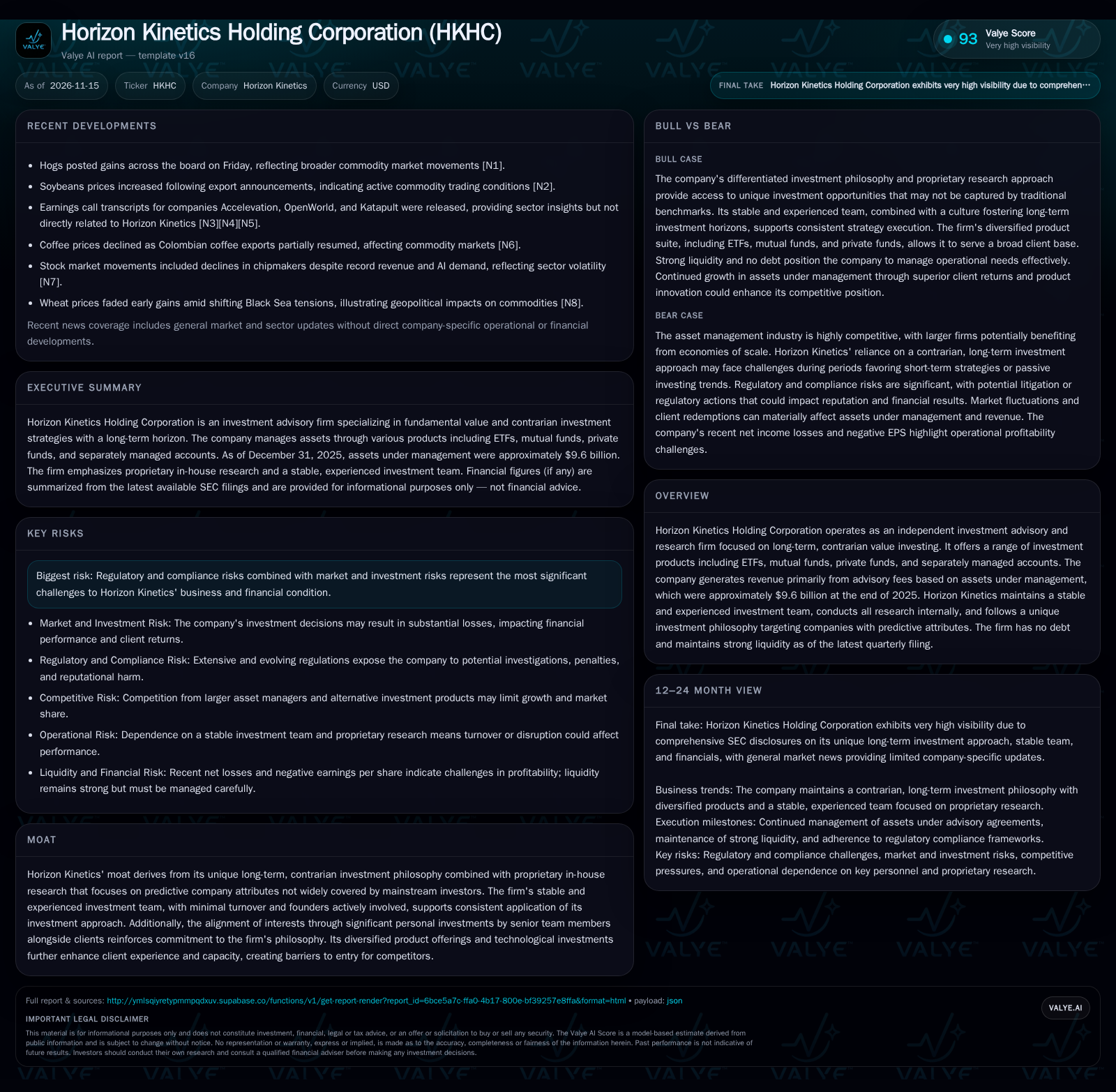
Horizon Kinetics operates as a fundamental value and contrarian-oriented investment adviser, managing $9.6 billion in AUM as of year-end 2025. Its moat rests on proprietary research, a stable investment team, and long-term strategy, but competitive and regulatory risks remain material. The company's ability to attract and retain clients, innovate products, and deliver differentiated returns will determine its long-term trajectory. [S2]
Horizon Kinetics Holding Corp. stands out in the asset management industry for its deep commitment to contrarian, long-term value investing and its proprietary, in-house research model. While the firm boasts $9.6 billion in assets under management and a reported liquidity position with no debt, it reported a significant net loss in Q3 2026, raising questions about the sustainability of its operating model amid industry headwinds. As competition intensifies and regulatory demands grow, Horizon Kinetics’ future will be shaped by its ability to attract client assets, maintain its research-driven edge, and translate its investment philosophy into consistent, profitable growth. [S2]
Recent Financial Performance and Strategic Foundations
Horizon Kinetics reported assets under management (AUM) of approximately $9.6 billion at the end of 2025, marking a modest decline from $9.8 billion the previous year. This stability suggests a loyal client base, but also reflects the challenges of asset retention and growth in a competitive landscape. The company reported a net loss of $18.35 million and basic and diluted EPS of -$0.98 for Q3 2026, indicating operational profitability issues despite its reported cash position of $36.4 million and lack of debt. Liquidity ratios as of September 30, 2026—current ratio of 4.92 and cash ratio of 45.58—underscore the company’s conservative balance sheet. The firm’s value proposition remains rooted in a proprietary, contrarian investment philosophy and a stable, founder-led investment team. [S1] [S2]
How Horizon Kinetics Earns: Fee Models, Cost Structure, and Operating Leverage
The core revenue engine for Horizon Kinetics is advisory and performance fees generated from managing client assets across mutual funds, ETFs, private funds, and separately managed accounts. Fee income is typically a function of AUM and, in some products, investment performance. This model offers operating leverage: as AUM grows, incremental revenue outpaces fixed costs, provided expenses are contained. However, the industry is characterized by fee compression, rising regulatory and technology costs, and shifting investor preferences toward passive products, all of which can pressure margins.
Fixed costs include in-house research, compensation for a stable and experienced investment team, compliance infrastructure, and technology investments aimed at enhancing client service and operational efficiency. Variable costs rise with AUM and product complexity, but the absence of debt reduces financial risk. The company’s negative net income in Q3 2026 highlights the pressure to scale AUM and control costs in order to achieve sustainable profitability. Without significant asset growth or higher-margin products, the firm may struggle to translate its distinct investment philosophy into consistent earnings.
The interplay between fee models and cost structure in asset management firms like Horizon Kinetics is critical, especially under fee compression trends. A useful metric would be the firm’s average fee per asset dollar under management, segmented by product type, to understand revenue sensitivity to asset shifts. Moreover, the fixed nature of research and investment team compensation means that without sufficient scale, incremental revenue gains may be offset by rising variable costs such as compliance and technology expenses. This dynamic creates a delicate balance where operational leverage can quickly turn negative if AUM growth stalls or client preferences shift toward lower-fee passive alternatives. Hence, the firm’s ability to innovate fee structures or introduce higher-margin products could be pivotal in sustaining profitability.
Defending the Contrarian Edge: Differentiation and Market Pressures
Horizon Kinetics’ moat is built on its proprietary, in-house research targeting overlooked opportunities such as spin-offs, owner-operators, and companies with dormant assets. This approach diverges from benchmark-centric, large-scale asset managers and index providers. The long tenure of its investment team and direct founder involvement reinforce cultural consistency and client trust—factors that can drive client retention and referrals.
However, the firm faces formidable competition from larger asset managers, wealth management firms, banks, and index providers, many of whom benefit from economies of scale, brand recognition, and technological resources. The continued shift toward passive and low-fee strategies could erode the appeal of differentiated active management. Furthermore, regulatory complexity and the need for ongoing investment in compliance and technology create barriers for smaller players. The question is whether Horizon Kinetics’ research-driven, contrarian approach can continue to deliver returns that offset these structural disadvantages and justify premium fees.
Beyond direct competition, regulatory changes can disproportionately affect smaller, research-intensive asset managers by increasing compliance costs relative to their revenue base. This could erode the firm’s ability to invest in its differentiated research process or talent retention. Furthermore, the rise of data-driven investment platforms and AI-assisted analytics among larger competitors may challenge Horizon Kinetics’ proprietary research moat unless it continuously evolves its methodologies. The firm’s contrarian approach also requires a client base willing to tolerate periods of underperformance, which may shrink if market environments favor passive or momentum-driven strategies. Therefore, maintaining client education and demonstrating the long-term value of its approach remain essential to defend its market position.
Outperformance Drives Asset Growth and Margin Recovery
If Horizon Kinetics’ differentiated strategies deliver strong, uncorrelated returns—particularly during periods of market stress or when mainstream benchmarks underperform—the firm could attract inflows from clients seeking true diversification. Outperformance would likely lead to higher AUM, boosting advisory and performance fee income and restoring margin leverage. The company’s investments in technology and client service could facilitate scalable growth without a commensurate rise in fixed costs, further enhancing profitability.
Evidence confirming this scenario would include a meaningful uptick in AUM, positive net flows into proprietary funds and ETFs, improved net income and EPS, and external recognition of investment performance. Additionally, new product launches that resonate with institutional or retail clients—especially in niche or inflation-protected segments—could signal continued innovation and differentiation.
Steady-State: Navigating Fee Pressure and Modest Growth
The most plausible outcome is that Horizon Kinetics maintains a relatively stable AUM base, with modest growth or attrition offset by market movements and client activity. Fee compression and rising compliance costs may continue to weigh on margins, limiting earnings recovery despite operational discipline. The firm’s unique philosophy and team stability should support retention of core clients, but outsized asset growth may prove elusive absent sustained outperformance.
This scenario would be confirmed by AUM tracking in a narrow band, muted net flows, persistent but manageable losses or breakeven earnings, and limited expansion in product offerings. Any improvement in profitability would likely come from incremental efficiency gains or selective product innovation, rather than transformative growth.
Market Outflows and Competitive Attrition Undermine the Model
A less favorable scenario would see Horizon Kinetics’ contrarian strategies underperform mainstream benchmarks during extended bull markets or periods favoring passive investing. This could trigger client redemptions, leading to a decline in AUM and, consequently, revenue. Ongoing net losses could erode the company’s ability to invest in talent and technology, further weakening its competitive position.
This outcome would be evidenced by a sustained drop in AUM, negative net flows, further deterioration in net income and EPS, and possible staff turnover or reduction in research capacity. Regulatory or reputational events could accelerate outflows and deepen operational challenges.
Company-Specific Developments That Could Reshape the Horizon Kinetics Thesis
Quarterly trends in assets under management (AUM), including net client flows and the impact of market performance on AUM. [S2]
Fee rate trends across different product lines—disclosure of average advisory fee rates would help test margin resilience.
Net income and EPS progression, particularly signs of narrowing losses or a return to profitability. [S2]
Product innovation and launch of new funds or strategies, especially those targeting inflation protection, alternatives, or niche themes.
Retention and turnover among senior investment professionals—if disclosed, this would indicate the stability of the investment process.
Client concentration metrics or major account wins/losses, which could affect revenue visibility and business risk.
Changes in the regulatory environment or notable compliance costs that could impact profitability or operational flexibility.
Expense discipline and scalability of recent technology investments—evidence of improved operating leverage would support the bull thesis.
Disclaimer: This is research-only, informational analysis and not investment advice. It may include AI-generated interpretation and general industry context. Always verify important details using primary sources.

Comments