
Beeline Holdings: AI Mortgage Platform, Non-QM Growth, and the Stakes of Digital-First Lending
Beeline Holdings, Inc. is leaning into an AI-centric mortgage origination and title ecosystem, with a strategic emphasis on Non-QM lending, digital lead generation, and an experimental crypto-fractional equity product. Recent revenue recovery and platform expansion highlight both the scale opportunity and persistent risks from regulation, funding dependencies, and economic cycles.
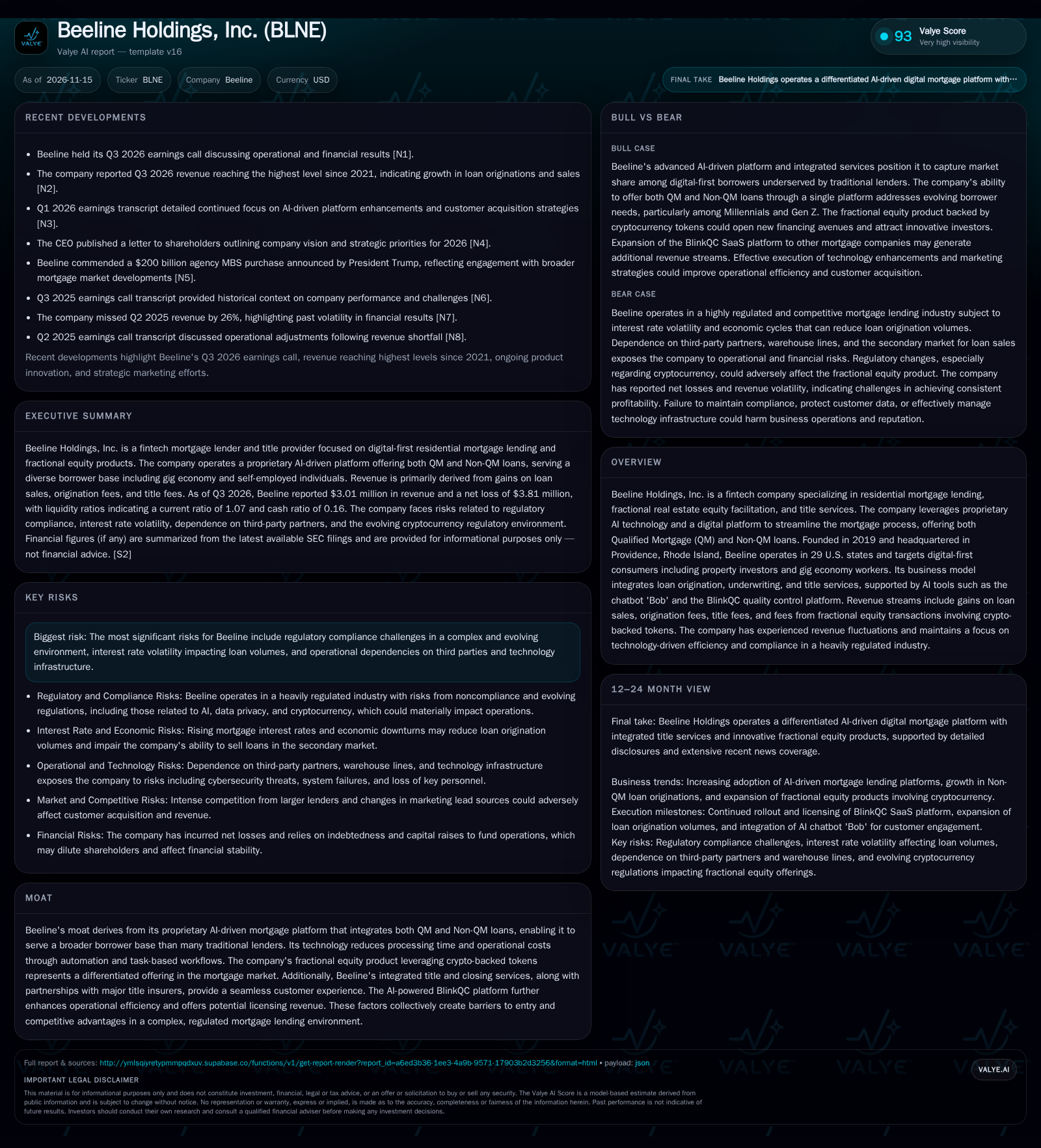
Beeline Holdings is a fintech lender and title provider targeting digital-first mortgage borrowers through an AI-powered platform. Its shift toward Non-QM loans, proprietary software, and a crypto-backed fractional equity product positions it as an innovator, but the business remains exposed to funding, regulatory, and macroeconomic risks. Q3 2026 revenue reached a five-year high, yet net losses persist and liquidity is tight. The company's future hinges on scaling originations, monetizing technology, and navigating compliance in a volatile sector. [S1] [S2] [N1] [N2]
Beeline Holdings, Inc. is betting on digital transformation in mortgage lending, blending AI-driven origination, Non-QM specialization, and innovative fractional equity offerings to capture a digitally savvy borrower base. The company’s trajectory will likely hinge on its ability to expand originations, monetize proprietary technology, and manage regulatory and funding risks amid evolving market dynamics. [S1] [S2] [N1] [N2]
Recent Revenue Recovery, Non-QM Loan Focus, and Persistent Losses Define Beeline’s Current State
Beeline Holdings reported Q3 2026 revenue of $3.01 million—the company’s highest quarterly result since 2021—reflecting a rebound in loan originations and sales activity [S2] [N2]. This revenue recovery follows a period of pronounced volatility, including a 26% revenue miss in Q2 2025, and suggests recent operational momentum but not yet sustained profitability [N7] [N8]. Non-QM loans made up 73% of 2025 originations, highlighting Beeline’s strategic focus on borrowers underserved by traditional lenders, such as gig economy workers and self-employed individuals [S1]. [S2] The recent launch of the BlinkQC AI-powered quality control platform and the rollout of the crypto-backed fractional equity product signal Beeline’s push for technology-driven differentiation [S1].
How Beeline’s Platform Attempts to Monetize Mortgage Friction and Digital Complexity
Beeline’s economics hinge on its ability to originate, underwrite, and sell residential mortgage loans at scale, while layering in ancillary revenue from title services and technology. The primary revenue driver is the net gain on sale of loans (69% of 2025 revenue), followed by loan origination fees (13%) and title fees (18%) [S1]. The company operates as both lender (with underwriting risk) and broker, with most transactions in 2025 carrying lender exposure. This model exposes Beeline to credit and funding risk but offers greater margin potential per transaction—if underwriting and pricing are executed effectively.
The company’s heavy tilt toward Non-QM loans positions it for higher yields, as these products typically command wider spreads due to their complexity and borrower risk profiles. However, Non-QM lending can be more cyclical and sensitive to liquidity and investor appetite in the secondary market, especially during economic stress.
Fixed costs are driven by technology development (BlinkQC, AI chatbot 'Bob'), compliance infrastructure, and marketing—especially digital lead generation, where Google advertising alone accounted for nearly half of all leads in 2025 [S1]. [S2] There is potential for operating leverage if origination volumes and SaaS licensing (BlinkQC) scale, but persistent net losses point to a business not yet at sustainable scale.
Digital-First Borrowers, Non-QM Specialization, and the Competitive Dynamics of Mortgage Tech
Beeline’s differentiation rests on its AI-powered digital platform, enabling rapid underwriting and a streamlined experience for borrowers who may not fit traditional credit boxes. By integrating both QM and Non-QM offerings, Beeline targets a broader population than conventional banks or legacy mortgage lenders, with a particular focus on property investors, gig workers, and the self-employed [S1]. The company’s AI chatbot and BlinkQC platform aim to reduce processing time and improve loan quality, potentially lowering operational costs and error rates.
However, the digital mortgage space is crowded, with established fintech lenders, large banks with digital channels, and emerging AI-driven platforms all vying for share. Many competitors are also integrating title, closing, and ancillary services, eroding some of Beeline’s platform advantage. The company’s crypto-backed fractional equity product is novel, but faces both regulatory uncertainty and the challenge of consumer trust and adoption.
Switching frictions in mortgage lending are moderate; once a borrower enters a process, inertia and complexity work in the incumbent’s favor, but comparison-shopping is easy and price sensitive. Beeline’s ability to drive repeat or referral business may depend on customer experience, speed, and perceived innovation.
AI Automation, Non-QM Growth, and SaaS Monetization Drive Operating Leverage
In a favorable scenario, Beeline leverages its AI-powered platform to drive rapid growth in Non-QM originations, capturing share from slower-moving traditional lenders as digital-first and self-employed borrowers increase in number. The BlinkQC SaaS platform gains traction as a compliance and quality-control tool for other lenders, providing recurring, high-margin software revenue. Title and closing integration further boosts per-loan economics, while the BeelineEquity fractional product attracts alternative investors and opens new fee pools—assuming regulatory frameworks clarify in favor of crypto-backed real estate.
Evidence that would confirm this scenario includes: sustained sequential growth in loan originations (especially Non-QM), revenue mix shifting toward software licensing and technology fees, expanding gross margins, and news of large-scale partnerships or adoption of BlinkQC by third-party lenders. Additional signs would be improved operating leverage (declining loss per loan as volume scales) and regulatory developments enabling wider use of crypto-backed home equity products.
Scaling Digital Mortgage Operations Amid Margin Pressure and Cyclical Headwinds
The most plausible mid-term outcome is that Beeline continues to grow its digital mortgage origination volumes—especially in the Non-QM segment—but faces sustained margin pressure from intense competition, rising customer acquisition costs, and sensitivity to interest rate cycles. The BlinkQC platform may generate incremental SaaS revenue, but adoption outside the company’s core operations is gradual. The BeelineEquity product gains limited early traction, constrained by regulatory uncertainty and slow mainstream adoption of crypto-backed fractional home equity.
In this scenario, Beeline’s revenue trend improves, but losses persist due to ongoing technology investment, marketing spend, and compliance costs. Confirmation would come from moderate but not exponential growth in loan and fee revenue, continued net losses, and periodic capital raises. Falsification would be either a dramatic acceleration in technology licensing or a sharp contraction in origination activity due to interest rate or regulatory shocks.
Funding Constraints, Regulatory Disruption, and Mortgage Market Cyclicality Threaten Scale Ambitions
A negative chain of events would see Beeline’s loan origination volumes stall or decline due to rising interest rates, investor pullback from Non-QM and crypto-backed products, or a general housing market slowdown. Regulatory developments—such as adverse cryptocurrency or AI compliance requirements—could halt or significantly curtail the BeelineEquity product and force costly changes to technology and data practices.
In this scenario, the company’s reliance on warehouse lines and capital raises becomes a liability; tighter funding conditions or risk aversion among lenders could restrict Beeline’s ability to originate and sell loans, forcing a contraction of operations or dilutive fundraising. Signs confirming this downside would be sequential declines in loan originations, widening losses, negative operating cash flow, and reported difficulty in accessing warehouse or equity capital. Falsification would require evidence of resilient origination activity and regulatory clarity favoring innovation.
Metrics and External Shifts That Will Shape Beeline’s Digital Mortgage Trajectory
Sequential growth in total loan origination volume, especially Non-QM segment performance, if disclosed.
Revenue mix evolution: proportion of net gain on sale versus SaaS (BlinkQC) and title/closing fees, if reported.
Gross margin trend and per-loan profitability, which would indicate progress toward operating leverage.
Adoption rate and external customer wins for the BlinkQC platform (third-party SaaS licensing).
Updates on regulatory developments impacting crypto-backed fractional equity offerings and AI compliance.
Warehouse line utilization, renewal, and cost of funds—any signals of tightening or stress, if disclosed.
Digital lead generation cost and conversion rates, particularly Google advertising efficiency.
Management commentary or disclosures regarding capital raising plans, runway, or changes in funding access.
Disclaimer: This is research-only, informational analysis and not investment advice. It may include AI-generated interpretation and general industry context. Always verify important details using primary sources.

Comments