
ADARx Pharmaceuticals: Post-IPO Liquidity, RNAi Pipeline Stakes, and the Road to 2027 Clinical Proof
ADARx enters late 2026 with over $900 million in cash and investments following its IPO and AbbVie private placement, positioning it to advance lead RNAi candidates Agazisiran and Onvuzosiran toward pivotal 2027 clinical readouts. With no marketed products and ongoing net losses, the company's value proposition now hinges on clinical execution, regulatory navigation, and the ability to translate RNAi technology into first-in-class or best-in-class therapeutics.
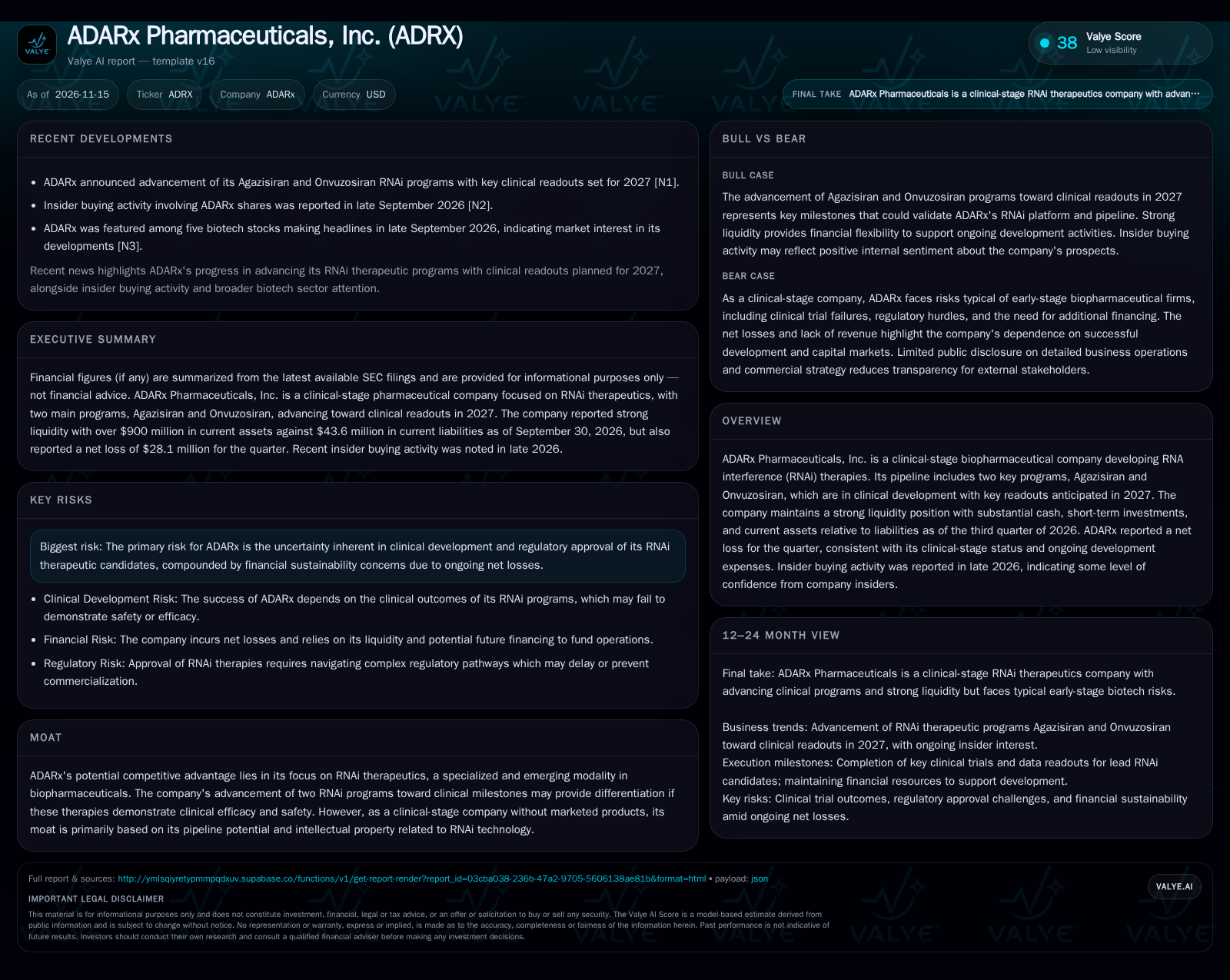
ADARx Pharmaceuticals has fortified its balance sheet with over $900 million in cash and investments post-IPO and strategic AbbVie investment. The company’s two lead RNAi programs, Agazisiran and Onvuzosiran, are set for key clinical readouts in 2027. With net losses typical of a clinical-stage biotech, ADARx’s near-term trajectory depends on advancing its pipeline, managing development risk, and leveraging its RNAi platform as a competitive differentiator in a field marked by both promise and regulatory/clinical uncertainty. [S1] [N1] [N2]
ADARx Pharmaceuticals, fresh from a substantial IPO and a strategic private placement with AbbVie, enters late 2026 among the most well-capitalized clinical-stage biotechs in the RNAi therapeutics space. With over $900 million in cash and investments and two lead programs—Agazisiran and Onvuzosiran—targeting clinical proof in 2027, the company has the financial runway to pursue pivotal trial milestones without immediate fundraising pressure. However, with net losses and no commercial products, ADARx’s future will be determined by its ability to deliver positive clinical results, navigate regulatory complexities, and demonstrate that its RNAi platform can produce differentiated, approvable therapies in a competitive and rapidly evolving field. [S1] [N1] [N2]
IPO Windfall, Strategic Investment, and Clinical Milestones Define Late 2026
ADARx Pharmaceuticals closed its IPO in September 2026, issuing 26.25 million shares at $17.00 each for $446.3 million in gross proceeds. Simultaneously, AbbVie invested $89.3 million in a private placement, resulting in total net proceeds of approximately $494.9 million after fees. This influx, combined with pre-existing resources, left ADARx with $901 million in cash, equivalents, and short-term investments at quarter-end and $918.5 million in current assets against $43.6 million in current liabilities, producing a current ratio above 21. The company reported cash and liquidity metrics for the period; these figures do not by themselves establish operating runway, investment capacity, financial flexibility, or financing capacity. [S1]
The company’s two lead programs—Agazisiran and Onvuzosiran—are RNAi-based therapies with key clinical readouts scheduled for 2027. ADARx reported a net loss of $28.1 million for Q3 2026, consistent with heavy R&D investment and no product revenue at this stage. Notably, insider buying was reported in September 2026, suggesting at least some internal optimism about forward prospects. [N1] [N2]
Translating RNAi Science into Sustainable Economics: Pathways and Constraints
As a clinical-stage company, ADARx currently generates no revenue from product sales. Its economics are dominated by R&D spending, regulatory costs, and operational expenses, offset by periodic capital raises. The recent IPO and AbbVie private placement have provided a multiyear cash runway, allowing the company to reach critical clinical milestones without near-term dilution pressure or forced cost-cutting. Fixed costs are substantial, with variable costs primarily tied to trial scale and pipeline breadth.
If Agazisiran or Onvuzosiran demonstrates compelling efficacy and safety, the company could pursue regulatory approval and, eventually, commercial launch. In the RNAi field, pricing power for first- or best-in-class therapies targeting high unmet medical need can be significant, but is tempered by payer scrutiny and the need to demonstrate both clinical and economic value. Manufacturing costs for RNAi therapeutics are typically higher than for small molecules but lower than for complex biologics, potentially offering attractive gross margins if scale is achieved. However, commercial ramp requires investment in sales infrastructure, market access, and medical affairs, all of which would increase burn rate ahead of revenue inflection.
The question is whether ADARx’s current capital base will be sufficient to fund the company through pivotal data, regulatory filings, and at least the initial phases of commercialization, or whether further dilution will be required before meaningful revenue is realized.
RNAi Innovation and the Dynamics of Emerging Biotech Competition
ADARx’s core competitive proposition lies in its proprietary RNA interference platform, which aims to selectively silence disease-driving genes. This modality benefits from increasing validation in rare diseases and select metabolic indications, but remains highly competitive, with multiple established and emerging players targeting similar pathways and indications.
The presence of a strategic investor like AbbVie could provide validation and potential future partnership opportunities, but large pharma interest also signals that the space is attracting significant attention and resources. Competing RNAi, antisense, and gene-editing platforms from both public and private biotechs may target overlapping indications, increasing the bar for differentiation. Key axes of competition will include clinical efficacy, safety/tolerability, dosing convenience, and durability of effect.
Switching costs for providers and payers are heavily dependent on clinical outcomes, safety profiles, and real-world evidence. If ADARx’s candidates ultimately demonstrate best-in-class profiles, they could command premium pricing; otherwise, they could face significant pricing and market-share pressure from similar or more advanced molecules.
Clinical Success Unlocks Platform Value and Commercial Optionality
The most favorable scenario for ADARx is a sequence of successful clinical readouts for Agazisiran and Onvuzosiran in 2027, demonstrating not just statistical significance but clear clinical benefit and safety. This would validate the RNAi platform and open the door to regulatory submissions, potential accelerated pathways, and partnership or acquisition interest from larger biopharma. Strong data could also support expansion into additional indications or pipeline candidates, leveraging platform synergies and intellectual property.
Confirmation of this scenario would come from positive top-line clinical data, regulatory feedback indicating a clear approval path, and evidence of early commercial partnership discussions. Share price appreciation and increased analyst coverage would likely follow, as would renewed strategic interest from partners like AbbVie or others in the biopharma ecosystem.
Falsification would be signaled by disappointing efficacy or safety data, regulatory setbacks, or a lack of partnering activity despite positive results.
Realistic Road: Delays, Mixed Data, and Gradual Value Accretion
The most plausible scenario is a mixed outcome in which at least one of ADARx’s lead programs achieves its primary endpoints, but with some caveats—such as less-than-expected effect size, manageable safety signals, or delays in trial enrollment and data disclosure. In this path, ADARx may secure regulatory approval for a niche indication or as a second-line therapy, leading to modest commercial uptake and gradual revenue build. The company would likely need to raise additional capital before achieving full commercial self-sufficiency, especially if it chooses to self-commercialize rather than partner.
Evidence supporting this trajectory would include clinical data that meets but does not exceed expectations, regulatory filings with requests for additional data or post-marketing commitments, and a measured ramp in commercial infrastructure. Falsification would be marked by either rapid, unequivocal clinical success (moving the company to the upside case) or outright clinical failure (moving to the downside scenario).
Pipeline Setbacks, Regulatory Hurdles, and Capital Erosion
In a negative scenario, one or both lead RNAi programs fail to demonstrate adequate efficacy or safety, resulting in trial discontinuations, regulatory holds, or unfavorable risk-benefit assessments. Such outcomes could sharply reduce the company’s valuation, limit its ability to raise additional capital, and force a retrenchment to preclinical or earlier-stage assets.
Further, the absence of near-term partnership or acquisition interest—particularly from strategic investors like AbbVie—would increase pressure on management to cut costs, seek alternative financing, or pursue out-licensing of remaining assets. If burn rate remains high and pipeline progress stalls, even the current reported cash balance could prove insufficient to maintain independent operations beyond a two- to three-year window.
Signals for this scenario would include adverse clinical events, missed trial milestones, negative regulatory feedback, and the initiation of restructuring or workforce reductions.
Milestones and External Catalysts That Will Shape the ADARx Thesis
Top-line clinical data releases for Agazisiran and Onvuzosiran in 2027—timing, magnitude of benefit, and safety outcomes will be determinative.
Updates or disclosures regarding additional pipeline candidates, especially transitions from preclinical to clinical stage.
Changes in cash burn rate and updated guidance on financial runway, particularly as trials progress and/or commercial infrastructure is built.
Announcements or evidence of new strategic partnerships, licensing deals, or co-development agreements, especially with existing investors like AbbVie.
Any regulatory feedback, fast-track designations, or requests for additional data that alter the approval or commercialization timeline.
Insider transaction activity was reported in the cited source; this activity does not by itself establish insider confidence.
Pipeline setbacks, adverse events, or clinical holds—if they occur—would challenge the core investment thesis.
Disclaimer: This is research-only, informational analysis and not investment advice. It may include AI-generated interpretation and general industry context. Always verify important details using primary sources.

Comments