
Polaryx Therapeutics: SOTERIA Trial Launch Sets Stage for Multi-Indication Rare Disease Play
With the first clinical site activated for its Phase 2 SOTERIA basket trial, Polaryx Therapeutics now faces the critical test of translating regulatory momentum and orphan drug designations into proof-of-concept data for its lead LSD therapy.
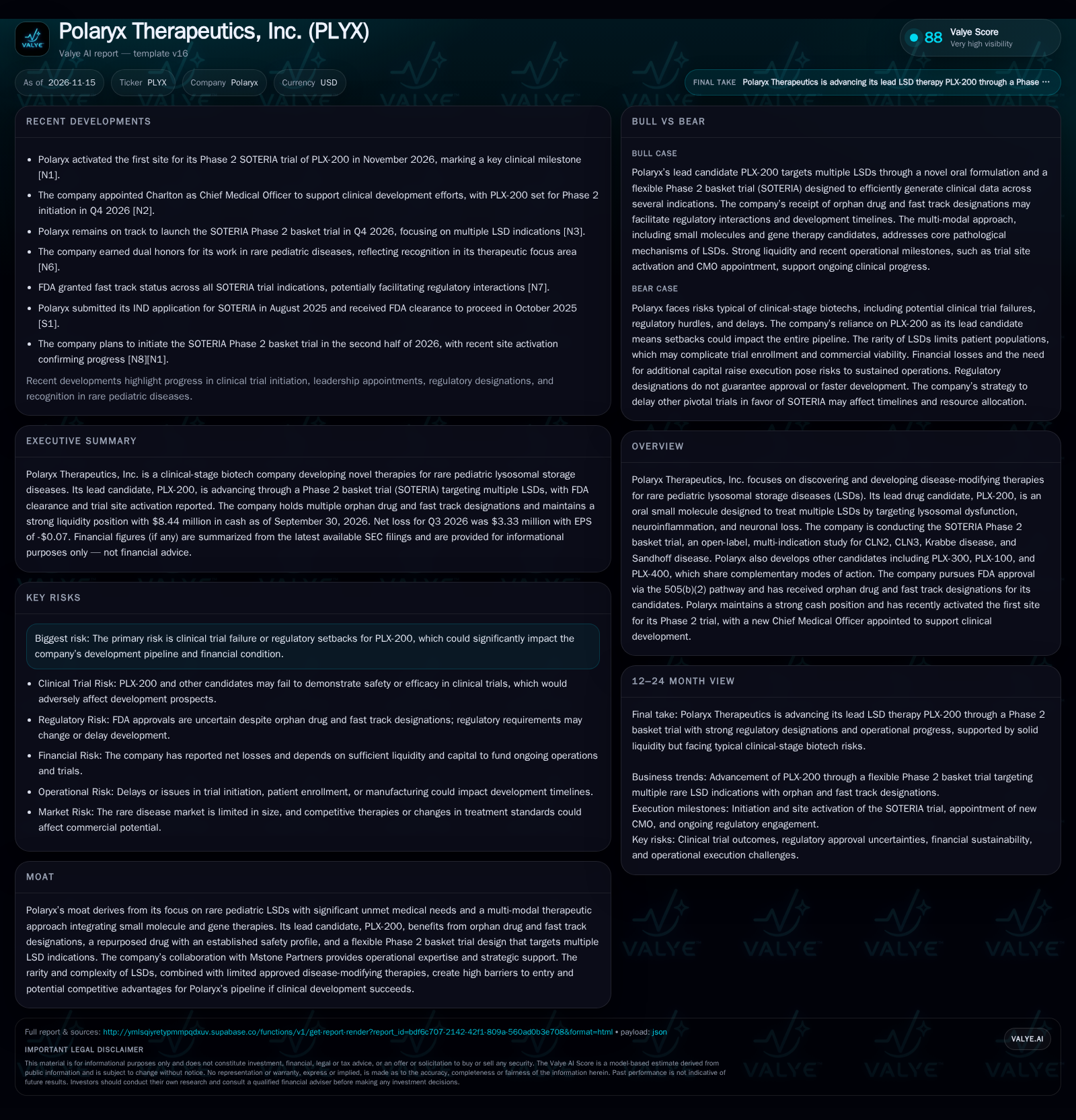
Polaryx Therapeutics (PLYX) has activated the first site for its pivotal Phase 2 SOTERIA basket trial of PLX-200 in rare pediatric lysosomal storage diseases, following FDA fast track status and multiple orphan designations. The outcome of SOTERIA will likely define the company’s future, with both regulatory advantages and rare disease market challenges shaping the risk/reward profile. [N1] [N3] [N7] [S2]
Polaryx Therapeutics has reached a pivotal moment as it activates the first site for its SOTERIA Phase 2 basket trial, targeting several ultra-rare pediatric lysosomal storage diseases (LSDs) with its oral candidate PLX-200. The company’s regulatory wins—including FDA fast track and multiple orphan drug designations—offer potential acceleration, but the challenge lies in generating compelling clinical data and navigating the small, fragmented rare disease markets. With a reported cash balance and a strategy focused on operational efficiency, Polaryx’s fortunes now turn on the SOTERIA trial’s trajectory and the broader dynamics of rare disease drug development.
From IND Clearance to First Patient: SOTERIA Trial Progress and Financial Snapshot
In November 2026, Polaryx activated the first clinical site for its Phase 2 SOTERIA basket trial of PLX-200, marking a key inflection point in its development timeline. This follows FDA fast track designation across all SOTERIA indications—a regulatory advantage that could streamline review and facilitate expedited communications. The SOTERIA trial’s design targets CLN2, CLN3, Krabbe disease, and Sandhoff disease, collectively representing approximately a quarter of the pediatric LSD population. [N1] [N3] [N7] [S2]
Economics of a Rare Disease Basket Approach: Pathways, Costs, and Value Drivers
Polaryx’s business model is predicated on the high-value, high-risk economics of rare pediatric disease therapeutics. With ultra-rare LSDs, commercial viability depends less on traditional scale and more on regulatory incentives, premium pricing, and payer willingness to fund therapies with limited alternatives. The basket trial design for PLX-200 enables simultaneous proof-of-concept across multiple indications, potentially lowering per-indication development costs and shortening time to pivotal data. However, the small patient populations constrain addressable market volume, making each regulatory and reimbursement win critical.
The pursuit of the FDA 505(b)(2) pathway—leveraging prior human data from gemfibrozil—could reduce both time and cost to approval compared to a traditional new chemical entity route. Orphan drug and fast track designations bring benefits such as seven years of market exclusivity (in the U.S.), waiver of certain fees, and eligibility for priority review. Fixed R&D and G&A costs are significant at this stage, but if SOTERIA demonstrates efficacy, operating leverage could be realized as revenue from a limited but high-value patient base would be accretive with relatively modest incremental costs. Conversely, ongoing net losses and limited cash emphasize the need for careful capital management and potential future financings if development timelines extend.
Barriers, Differentiation, and the Competitive Landscape in Pediatric LSDs
Polaryx operates in a domain characterized by high scientific and regulatory barriers. The rarity and heterogeneity of pediatric LSDs mean that few companies pursue these indications, but those that succeed can command substantial pricing power and patient loyalty due to the lack of alternatives. PLX-200’s oral formulation, multi-indication potential, and use of a repurposed molecule with an established safety profile provide a differentiated value proposition versus enzyme replacement therapies or emerging gene therapies, which may involve more invasive administration or higher risk.
However, competitive threats persist from both incumbent and pipeline therapies, including gene-editing approaches, enzyme replacement modalities, and next-generation small molecules. The basket trial's reliance on natural history controls may accelerate development, but also raises questions about regulatory acceptance and payer confidence in the absence of randomized comparator data. Polaryx’s ability to maintain and extend its orphan exclusivity, secure favorable reimbursement, and build relationships with rare disease advocacy groups will be crucial in defending its market position if clinical data are positive.
If SOTERIA Delivers: Path to Accelerated Approval and Portfolio Expansion
The most favorable scenario for Polaryx involves the SOTERIA trial demonstrating clear efficacy and safety signals in at least one major indication (such as CLN2 or CLN3), leveraging the fast track and orphan designations to secure accelerated or conditional approval. The trial’s basket structure could provide simultaneous readouts across multiple diseases, amplifying the impact of positive data and supporting broader label expansion. If the FDA accepts natural history data as a valid control and the results are compelling, this could lower the evidentiary threshold for approval and enable early market entry.
Such an outcome would position Polaryx to capture first-mover advantage in several LSDs, potentially unlocking priority review vouchers, premium pricing, and rapid uptake among patient advocacy communities. Confirmation would come from strong clinical efficacy data, FDA engagement around expedited pathways, and early signals of payer willingness to reimburse. Falsification would come from lackluster efficacy, safety concerns, or regulatory pushback on the trial’s methodology.
SOTERIA Progresses, but Clinical and Commercial Uncertainties Persist
The most plausible path is that SOTERIA progresses through patient enrollment and interim analyses, generating preliminary safety and efficacy data by late 2027. The trial may yield mixed or moderate results across different indications, with some signals of activity but insufficient strength for immediate approval. In this scenario, Polaryx would likely need to conduct further pivotal studies in select indications, extending timelines and requiring additional funding rounds.
Regulatory interactions may be constructive but cautious, with the FDA requesting more robust data before granting broader approvals. Commercial prospects would remain uncertain until more definitive clinical outcomes are available. This scenario would be confirmed by incremental trial updates, ongoing net losses, and new capital raises to bridge to subsequent development milestones.
Setbacks in Clinical Data or Enrollment Could Threaten the Pipeline
Downside risks for Polaryx center on the possibility that SOTERIA fails to demonstrate meaningful efficacy or encounters safety signals that undermine the clinical rationale for PLX-200. Enrollment challenges—exacerbated by the ultra-rare nature of the target diseases—could delay timelines or prevent the trial from reaching statistical significance. Regulatory authorities might reject the use of natural history controls, requiring new randomized studies and further capital outlays.
Financially, ongoing net losses and a finite cash reserve mean that prolonged delays or negative data could force Polaryx into defensive measures, such as pipeline reprioritization, licensing, or restructuring. Evidence for this scenario would include missed trial milestones, negative or equivocal interim data, or an inability to secure follow-on financing.
Milestones That Will Decide Polaryx’s Rare Disease Bet
Enrollment rates and patient retention in the SOTERIA trial—particularly for CLN2 and CLN3 cohorts—will be critical to maintaining clinical momentum.
Timing and content of interim and topline data releases from SOTERIA, including safety and efficacy readouts by indication.
Regulatory feedback on the acceptability of natural history data as a control arm and indications of expedited review or conditional approval.
Cash burn rate and runway disclosures in future SEC filings, as ongoing net losses require careful liquidity management.
Any additional capital raises, partnerships, or non-dilutive funding events that extend operational runway or de-risk development.
Progression of backup candidates (PLX-300, PLX-100, PLX-400) into clinical or IND-enabling stages, as a hedge against lead asset setbacks.
Updates on payer and advocacy group engagement, which may signal future reimbursement prospects and patient access.
Disclaimer: This is research-only, informational analysis and not investment advice. It may include AI-generated interpretation and general industry context. Always verify important details using primary sources.

Comments