
Marpai at a Crossroads: Technology, Liquidity Pressures, and the Stakes of Strategic Alternatives
Marpai, Inc. operates a technology-driven healthcare administration platform targeting self-insured SMEs and local governments.
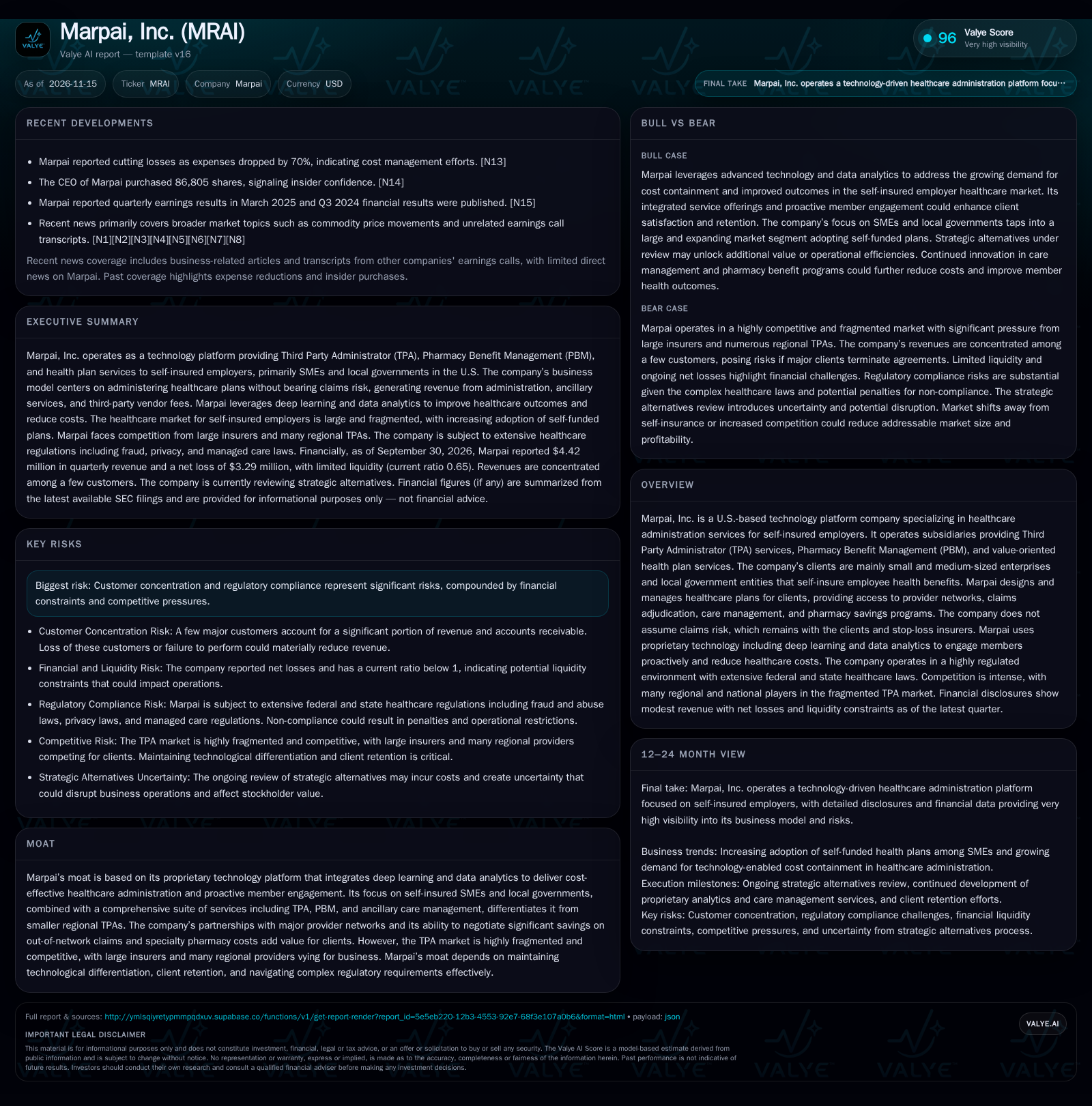
Marpai’s business model delivers health plan administration and value-added services to self-insured employers, primarily SMEs and local governments, using proprietary technology and data analytics. With a strategic alternatives review underway, Marpai’s future hinges on its ability to differentiate technologically, retain clients, and navigate funding and regulatory hurdles. [S1] [S2]
Marpai, Inc. stands at a pivotal moment as it works to leverage its data-driven health administration platform in a competitive and highly regulated market. The coming quarters will test whether Marpai can translate its technical advantages into sustainable operations—or if structural and financial headwinds will force a more radical outcome.
Liquidity Strains and Strategic Uncertainty Define the Present
Marpai reported $4.42 million in revenue and a net loss of $3.29 million for the quarter ended September 30, 2026. More critically, the company’s balance sheet showed only $360,000 in cash and equivalents, with current liabilities of $15.86 million and a current ratio of 0.65. At the same time, Marpai’s revenues are concentrated among a few customers, with one accounting for 13.6% of accounts receivable. These facts underscore both immediate financial vulnerability and operational exposure to client churn. The company is also reviewing strategic alternatives—a process that could involve a sale, merger, recapitalization, or other significant restructuring—with associated costs and uncertainty for operations and equity holders. [S2]
How Marpai’s Tech-Enabled Services Create—and Constrain—Value
Marpai generates revenue through health plan administration (TPA), pharmacy benefit management (PBM), and ancillary services such as clinical care management and claims repricing. The company does not assume insurance risk; instead, it earns administrative and service fees from self-insured clients, typically small and mid-sized employers and public entities. This asset-light, fee-based model minimizes underwriting risk but also caps revenue scalability to the number and size of client contracts.
The core economic lever is the ability to use proprietary analytics and deep learning to reduce clients’ healthcare costs, improve outcomes, and thereby justify premium pricing or win market share. In theory, this could support high gross margins, especially for software-enabled services and care management programs. However, the fragmented nature of the TPA market and price competition from both regional TPAs and national insurers limit pricing power. Marpai’s reported net losses and cost management efforts suggest that fixed costs—particularly technology development, regulatory compliance, and customer acquisition—currently outweigh variable-margin revenue streams.
Fragmented Markets, Powerful Rivals, and the Technology Differentiation Challenge
The U.S. self-insured employer market is large but highly fragmented. Marpai’s primary competitors include regional TPAs, national insurers offering administrative services-only (ASO) contracts, and specialized PBMs. Large incumbents benefit from scale, established provider networks, and regulatory infrastructure, while regional players compete on local relationships and price. Marpai’s potential advantage lies in its proprietary technology platform, which integrates deep learning and data analytics to drive proactive member engagement and cost savings.
However, barriers to switching between TPAs for many SMEs are relatively low—often tied to contract cycle, perceived service quality, and network access. Technology differentiation may be compelling if Marpai can demonstrate superior health outcomes or cost reductions, but this requires not just technical capability, but also robust sales, customer support, and integration with employer HR systems. Regulatory compliance is an additional hurdle, as TPAs must navigate a complex web of federal and state healthcare laws. Sustaining a moat in this environment depends on continual innovation, demonstrated value-add, and high client retention.
If Technology-Led Cost Savings Drive Retention and New Wins
A favorable outcome for Marpai would see its analytics and care management platform demonstrably reducing client healthcare costs and improving member outcomes. If these advantages translate into higher client satisfaction and lower churn—and if Marpai can prove this value proposition to potential new clients—revenue growth could accelerate without the need to assume claims risk.
Confirmation of this scenario would come from new contract wins, client renewals, or expanded share of wallet with existing customers, particularly in the SME and local government segments. Improved gross margins and a narrowing of net losses, even before any strategic transaction, would further validate operational leverage from technology investments. External evidence might include customer testimonials, case studies, or industry awards recognizing Marpai’s results. Conversely, if Marpai fails to grow its client base or demonstrates persistent customer attrition, the upside scenario would be undermined.
Facing Down the Funding Squeeze While Seeking a Strategic Solution
The most plausible near-term trajectory for Marpai is one of operational stasis or modest contraction as management seeks to preserve cash and maintain core client relationships while the strategic alternatives review unfolds. In this scenario, revenue remains relatively flat or declines slightly, reflecting both customer concentration and competitive headwinds.
Evidence supporting this scenario would include continued client retention, no major contract terminations, and incremental operating improvements (such as reduced losses or stabilized gross margins). If Marpai is able to announce a strategic partnership, capital raise, or asset sale that addresses liquidity without severely diluting existing shareholders or disrupting operations, this would further support the base case. Conversely, any abrupt loss of a major customer or failure to secure bridge financing would quickly tip the company into distress.
When Liquidity Runs Out: Client Losses, Operational Disruption, or Forced Sale
The main risk for Marpai is that liquidity constraints become acute before a strategic alternative can be executed. If the company is unable to secure new funding, extend payables, or monetize assets, it may be forced to curtail operations, delay payments, or enter restructuring. Loss of a major customer—given the current concentration—could trigger a rapid revenue decline, exacerbating the cash crunch and potentially leading to regulatory non-compliance or loss of provider network access.
Evidence for this scenario would be missed payments, workforce reductions, regulatory filings warning of going concern risk, or disclosure of failed financing efforts. A distressed sale or bankruptcy filing would represent a terminal downside, especially if regulatory or contractual obligations prevent orderly wind-down. If Marpai’s technology platform remains attractive, a strategic buyer could acquire assets at a discount, but equity holders would likely be impaired.
Signals That Will Shape Marpai’s Strategic and Financial Fate
Disclosure of any new customer wins, contract renewals, or expansions in the SME/local government segment would clarify demand and retention strength.
Any update on the outcome or progress of the strategic alternatives review—including letters of intent, partnership talks, or asset sale negotiations—would materially affect the outlook.
Trends in gross margin, net loss, and operating cash flow (if disclosed) would help assess whether cost management and technology leverage are improving underlying economics.
Changes in customer concentration—such as loss or gain of large accounts—would directly impact revenue stability and operational risk.
Evidence of additional financing, credit facility drawdowns, or capital injections would address immediate liquidity risk.
Regulatory disclosures or adverse findings related to compliance would signal potential operational or financial penalties.
If disclosed, client satisfaction or retention metrics, as well as member engagement rates with Marpai’s technology platform, would help test the company’s value proposition.
Material changes in provider network partnerships or pharmacy benefit arrangements would affect Marpai’s ability to deliver cost savings and access.
Disclaimer: This is research-only, informational analysis and not investment advice. It may include AI-generated interpretation and general industry context. Always verify important details using primary sources.

Comments