
Alumis: Positive Psoriasis Data, Lupus Setbacks, and the Path Toward Targeted Autoimmune Therapies
Alumis Inc. advances Envudeucitinib with strong Phase 3 results in plaque psoriasis, but faces clinical and commercial challenges as it seeks to expand into broader autoimmune indications.
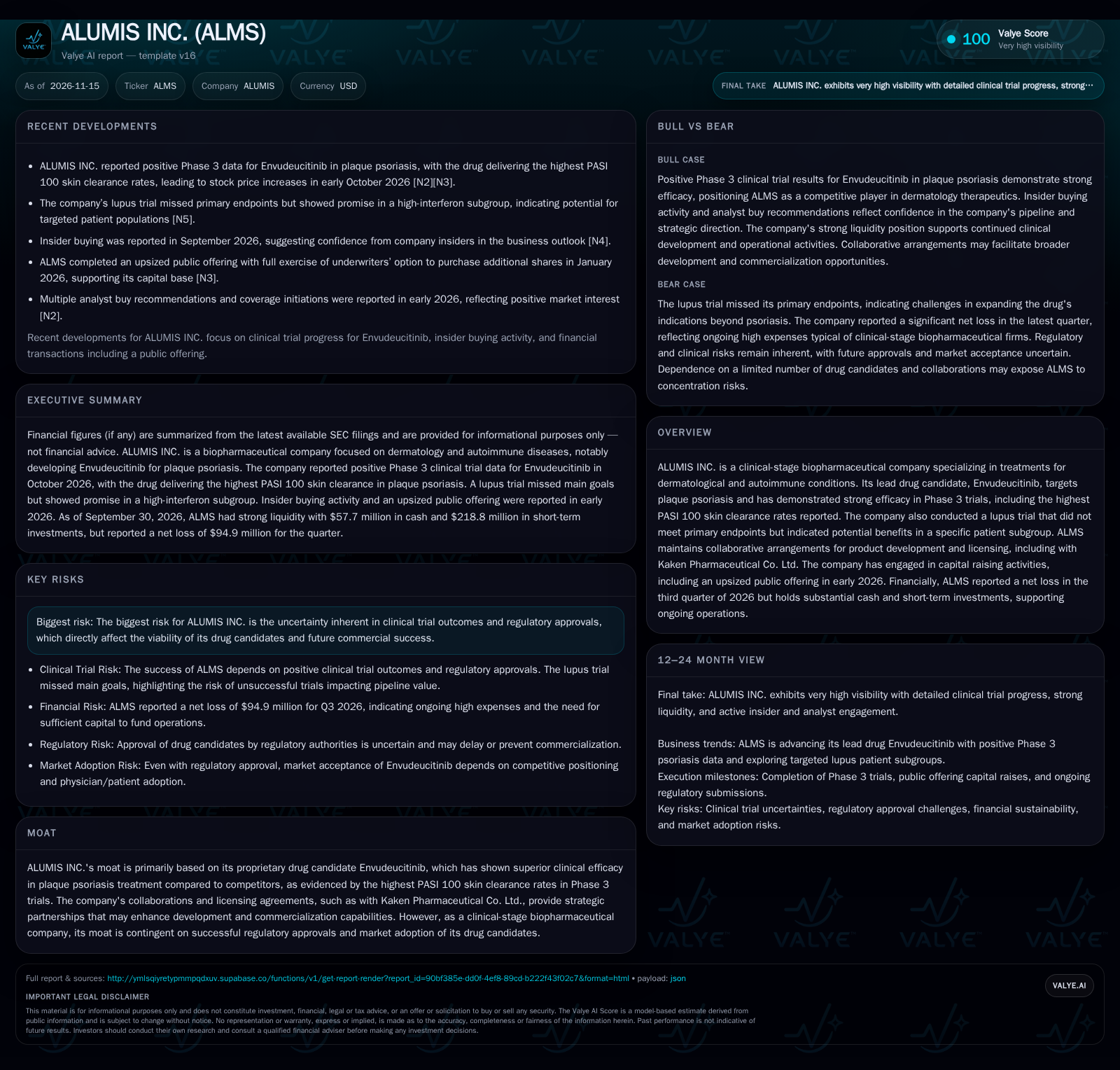
Alumis reported positive Phase 3 results for Envudeucitinib in plaque psoriasis, strengthening its lead asset’s profile, while its lupus study missed primary endpoints but showed potential in a specific subgroup. [S2] [N2] [N5]
Alumis Inc. stands at a critical juncture: its lead drug Envudeucitinib has delivered strong Phase 3 efficacy in plaque psoriasis, positioning the company to compete in a well-established but crowded dermatology market. However, Alumis’s attempt to broaden its pipeline with a lupus indication fell short of primary endpoints, highlighting both the scientific complexity and the commercial risk of autoimmune drug development. With substantial liquidity but persistent operating losses, Alumis must now translate its clinical momentum into regulatory progress and targeted market penetration—while navigating the inherent volatility of late-stage biopharma development. [S2] [N2] [N5]
Recent Clinical Results and Financial Position Define Alumis’s Outlook
The most material current facts for Alumis are the positive Phase 3 results for Envudeucitinib in plaque psoriasis, the failure of its lupus trial to meet primary endpoints (with a signal in a high-interferon subgroup), and its financial position as of September 30, 2026: $57.7 million in cash, $218.8 million in short-term investments, and a net loss of $94.9 million for the quarter. These developments matter because the psoriasis data validate the company’s lead asset in a large, competitive market, while the lupus setback narrows its near-term label expansion opportunities. The company reported cash and liquidity metrics for the period; these figures do not by themselves establish operating runway, investment capacity, financial flexibility, or financing capacity. [S2] [N2] [N4] [N5]
Revenue Potential Hinges on Clinical Success, Label Breadth, and Market Penetration
Alumis’s business model is typical of late-stage biopharma: it incurs high R&D and operating expenses upfront, aiming for future commercial payoffs if its pipeline assets reach approval and reimbursement. Envudeucitinib’s positive Phase 3 data in plaque psoriasis positions it for potential regulatory submission and, if approved, commercial launch in a competitive but large and reimbursed dermatology market. Revenue will depend on pricing, formulary access, and physician adoption—factors that hinge on demonstrated efficacy, safety, and differentiation from entrenched therapies.
The economics of autoimmune drugs are shaped by a combination of fixed (R&D, regulatory, infrastructure) and variable (manufacturing, sales force) costs, with substantial operating leverage if sales ramp up post-approval. However, as of now, Alumis remains pre-revenue, and its quarterly net loss of nearly $95 million reflects the high cost base of ongoing clinical programs and platform development. If Envudeucitinib achieves approval and uptake, the company could shift toward positive operating leverage, but this transition is neither immediate nor assured.
The lupus program’s missed endpoints illustrate the risk of indication expansion: broader labels can multiply revenue potential, but failed trials can strand investment and limit addressable market. Collaborations, such as with Kaken Pharmaceutical, may supplement non-U.S. commercialization or provide milestone payments, but the main value driver remains U.S. and EU market entry for lead indications. Further capital raises may be needed if commercial timelines slip or R&D intensity remains high. [S2]
Navigating a Crowded Autoimmune Landscape: Differentiation and Partnership as Levers
Alumis competes in an intensely crowded field of dermatology and autoimmune therapeutics, facing entrenched biologics, next-generation small molecules, and emerging modalities. In plaque psoriasis, competitors include established biologics (e.g., adalimumab, ustekinumab), JAK inhibitors, and other TYK2 inhibitors. The positive Phase 3 data for Envudeucitinib is a critical differentiator, but commercial success will likely hinge on superior efficacy (such as PASI 100 rates), safety profile, dosing convenience, and payer acceptance.
The company’s failed lupus trial (except in a high-interferon subgroup) highlights the difficulty of achieving broad differentiation in heterogeneous autoimmune conditions. If Alumis can secure a label for genetically or serologically defined subgroups, it may carve out a niche, but this approach often results in smaller addressable patient pools and requires precision in trial design, physician education, and payer negotiation.
Partnerships, such as the collaboration with Kaken Pharmaceutical, may provide access to international markets or development synergies, but the bulk of value realization for most U.S.-listed biopharmas remains tied to U.S. regulatory and commercial outcomes. Alumis’s competitive position will ultimately be tested at the intersection of clinical data, regulatory approval, and real-world adoption.
If Envudeucitinib Gains Approval and Outcompetes in Psoriasis, Value Could Scale Rapidly
The favorable scenario for Alumis rests on a successful regulatory approval and launch of Envudeucitinib in plaque psoriasis, followed by rapid adoption driven by superior efficacy (e.g., PASI 100 rates), a differentiated safety profile, or greater convenience relative to incumbents. If payers grant broad formulary access and physicians shift prescribing, Alumis could see swift revenue ramp and margin expansion due to high operating leverage.
Further upside could come if the company leverages positive subgroup data from its lupus trial to design a successful, targeted pivotal study, ultimately broadening the label to include high-interferon lupus patients—a smaller but potentially high-value segment with limited options.
Confirmation of this scenario would require regulatory acceptance (e.g., FDA or EMA approval), positive launch metrics (script growth, formulary wins), and clear signals from additional trials or real-world evidence supporting use in subgroups or adjacent indications. [N2] [N7]
Most Likely Trajectory: Psoriasis Launch Proceeds, Lupus Becomes a Targeted Niche
The most plausible path forward is that Alumis advances Envudeucitinib toward regulatory submission for plaque psoriasis, with approval and commercial launch as the next major milestones. Market uptake is likely to be moderate, as payers and prescribers weigh the new therapy’s attributes against established biologics and oral competitors. Revenue growth may be gradual, with initial penetration in moderate-to-severe patients who have failed prior therapies.
The lupus program, having missed primary endpoints, is repositioned for a precision-medicine approach targeting high-interferon patients.
This scenario would be corroborated by regulatory filings and subsequent approvals for psoriasis, moderate but not breakout launch data, and the announcement of a new, subgroup-focused lupus trial design. [S2] [N5]
Delayed Approvals or Commercial Stagnation Could Force Strategic Retrenchment
A negative scenario would unfold if regulatory review of Envudeucitinib is delayed, receives a complete response letter, or is approved with a restrictive label, undermining commercial potential. In this case, payer pushback, safety signals, or lackluster real-world efficacy could result in slower-than-expected uptake, extended cash burn, and an urgent need for additional financing.
If follow-up studies in lupus or other indications fail to replicate positive subgroup findings, the pipeline could contract to a single, moderately successful asset, increasing concentration risk and reducing optionality. In the event of a prolonged revenue ramp or unfavorable reimbursement dynamics, Alumis could be compelled to cut expenses, out-license assets, or pursue strategic alternatives.
Evidence of this scenario would include regulatory setbacks, disappointing launch metrics (e.g., persistently low script counts, limited payer coverage), failed or discontinued pipeline trials, and capital-raising events at unfavorable terms. [S2] [N5]
Milestones and Metrics That Will Determine Alumis’s Value Creation in Immunology
Regulatory submission and acceptance of Envudeucitinib for plaque psoriasis, with subsequent FDA/EMA approval status.
Initial commercial launch metrics for Envudeucitinib, such as prescription volume, new patient starts, and formulary access—if disclosed.
Updates on payer coverage decisions and net pricing achieved in the U.S. and key international markets.
Announcement and design details of any new lupus trials targeting high-interferon or other subgroups.
Quarterly R&D and SG&A expense trends to assess burn rate and financial discipline.
Pipeline expansion efforts—new indications, partnerships, or in-licensing deals—that diversify beyond the current lead asset.
Capital-raising events (equity, debt, or partnership funding) that could affect shareholder dilution or strategic flexibility.
If disclosed, patient-reported outcomes or real-world data supporting differentiation versus existing psoriasis therapies.
Disclaimer: This is research-only, informational analysis and not investment advice. It may include AI-generated interpretation and general industry context. Always verify important details using primary sources.

Comments