
authID’s Inflection Point: Biometric Innovation Confronts Debt Maturity, Nasdaq Compliance, and Strategic Uncertainty
While its technology and partnerships offer market potential, operational continuity and shareholder value now hinge on capital access, execution of financial maneuvers, and the stabilization of leadership.
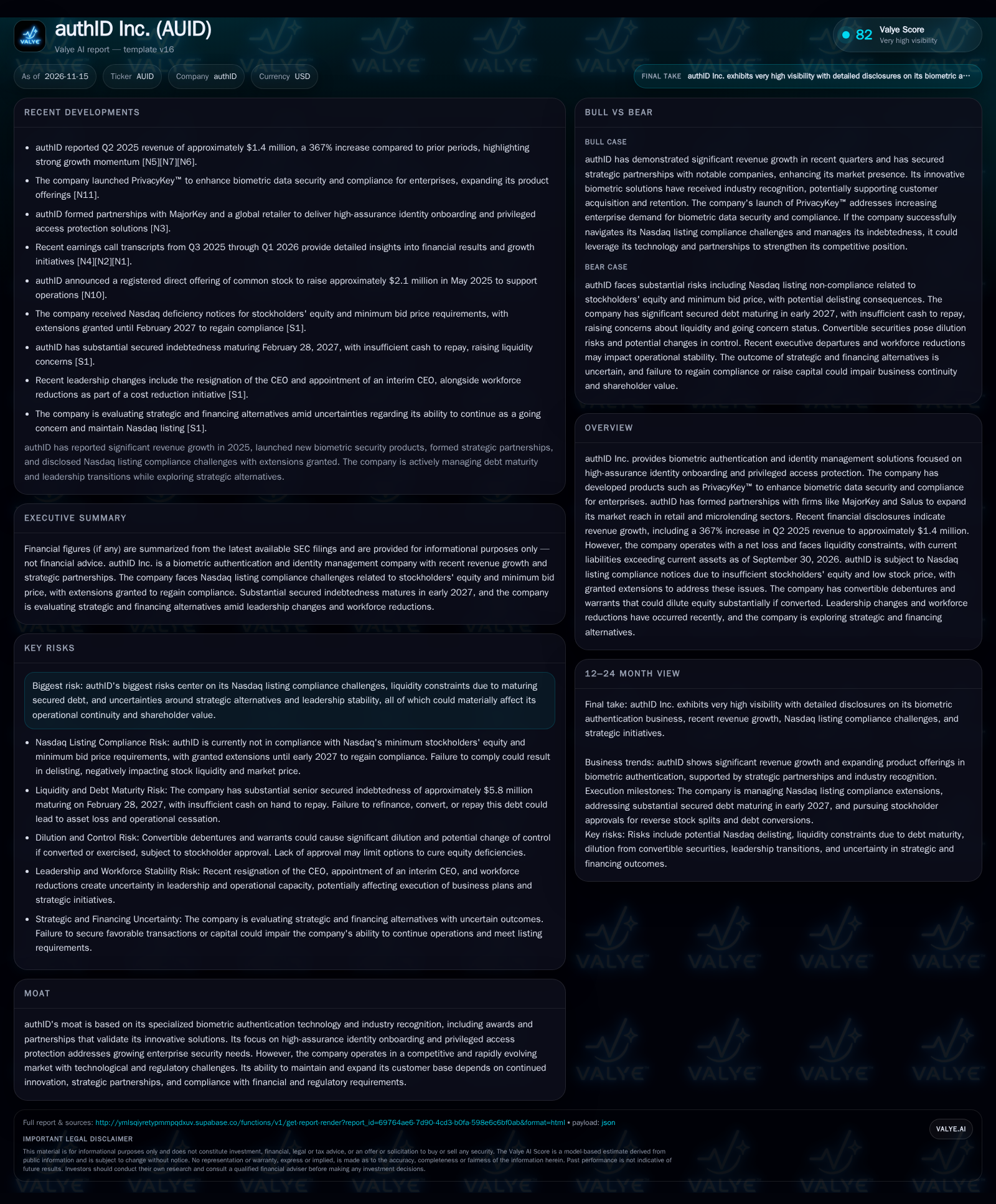
authID’s advanced biometric identity solutions have earned industry accolades and strategic partnerships, but the company’s near-term outlook is dominated by pressing financial constraints. With senior secured debt maturing in early 2027, a non-compliant Nasdaq listing, and an acute liquidity shortfall, the company’s fate depends on its ability to raise capital, execute balance-sheet restructuring, and maintain operational focus amid executive turnover and workforce reductions. The next 12–18 months will test whether innovation and partnerships can overcome structural financial headwinds. [S1]
authID Inc. stands at a strategic crossroads. Despite developing recognized biometric authentication solutions and forging partnerships in retail and microlending, the company’s financial position has deteriorated. The interplay between its platform’s market potential and the urgency of financial restructuring will determine whether authID can survive—and eventually capitalize on—its early-mover advantage in biometric identity.
Liquidity Squeeze, Debt Maturity, and Compliance Deadlines Define the Near-Term Landscape
As of September 30, 2026, authID reported quarterly revenue of $279,155 and a net loss of $4,079,350, underscoring persistent negative operating leverage. The company reported cash and liquidity metrics for the period; these figures do not by themselves establish operating runway, investment capacity, financial flexibility, or financing capacity. [S1]
The most urgent catalyst is the $5.8 million in senior secured debt maturing on February 28, 2027. authID lacks the cash to repay this obligation and has disclosed that it may not be able to refinance or convert it, raising the specter of asset forfeiture or operational cessation if alternative funding is not secured. [S1]
Layered onto this is the risk of Nasdaq delisting: the company is out of compliance with both minimum stockholders’ equity ($2.5 million required; $2.04 million reported as of June 30, 2026) and the $1.00 minimum bid price. Nasdaq has granted extensions into early 2027 for both issues, but failure to resolve them could result in delisting, further restricting capital access and investor confidence. [S1]
With convertible debentures and warrants outstanding, any near-term capital raise or debt conversion could trigger substantial dilution or even a change of control, compounding uncertainty for existing shareholders. [S1]
Biometric Platform Monetization: Scale Hurdles, Cost Structure, and Funding Imperatives
authID’s business model is built on providing high-assurance biometric authentication and identity management solutions to enterprises, primarily through SaaS-like offerings and integration partnerships. In principle, this model should create attractive gross margins due to software delivery and scalable cloud infrastructure, with incremental costs for onboarding new customers lower than for legacy hardware-based authentication players.
However, the company’s current revenue base remains insufficient to cover fixed costs, as evidenced by the persistent multi-million dollar quarterly net losses. The business likely faces high customer acquisition costs, long enterprise sales cycles, and ongoing R&D and compliance expenses—all of which are difficult to leverage without a substantial installed base.
authID’s capital needs are acute: with negative operating cash flow and reported cash balance, the company is forced to pursue dilutive financings or strategic alternatives simply to maintain operations. This funding dependence limits its ability to invest in product expansion, salesforce growth, or broader go-to-market initiatives, creating a vicious cycle in which underinvestment impedes scale, and lack of scale perpetuates underinvestment.
If authID can execute a successful conversion of its debt and/or secure equity infusions without catastrophic dilution, the business could, in theory, benefit from operating leverage as recurring software revenues grow. However, until a step-change in customer adoption or a strategic transaction occurs, the company’s economics are dominated by funding constraints and fixed-cost absorption challenges.
Innovation and Partnerships Versus a Crowded, Fast-Moving Identity Security Market
authID’s core competitive advantage is its advanced biometric authentication platform, validated by industry recognition such as the 2025 FinTech Breakthrough Award for Best ID Management Platform. Strategic partnerships with firms like MajorKey and Salus expand its reach into retail and microlending, providing proof points for real-world adoption. [N3]
Nonetheless, the digital identity market is highly competitive, populated by incumbent security vendors, cloud-native identity-as-a-service providers, and niche biometric specialists. Barriers to switching may be moderate for enterprise customers, especially if integration is API-driven and vendor lock-in is limited.
authID’s technology focus on high-assurance onboarding and privileged access protection aligns with rising enterprise concerns about identity fraud and compliance. However, larger competitors with deeper resources may outspend authID on R&D and sales, while start-ups could undercut on price or innovate rapidly.
The company’s operational instability—evident in recent executive turnover and workforce reductions—may erode customer and partner confidence at a critical juncture. Its ability to retain and expand relationships will depend on both the perceived superiority of its biometrics solution and its continued ability to operate as a going concern.
Restructuring and Strategic Investment Unlock authID’s Growth Potential
The most favorable outcome for authID would be a successful recapitalization—potentially via a reverse stock split, conversion of convertible debt, and new equity or strategic investment—that restores Nasdaq compliance, addresses the 2027 debt maturity, and stabilizes operations.
Such a reset could allow management to focus on commercial execution, leveraging the PrivacyKey™ platform and recent partnership wins to demonstrate traction with large enterprise customers. If the company can show consistent sequential revenue growth, expanding gross margins, and improved customer retention, it would validate product-market fit and support a path to eventual profitability.
Evidence that would confirm this scenario includes approval and execution of balance-sheet restructuring actions (reverse split, debt conversion), successful new financing or strategic partnership announcements, and news of contract wins or renewals with significant enterprise clients. A return to Nasdaq compliance—both on equity and bid price—would further reinforce investor confidence.
Balancing Survival: Dilutive Financing and Operational Retrenchment as Default Outcomes
The most plausible near-term scenario is that authID pursues a combination of highly dilutive financings (including equity raises, debt conversions, and a reverse split) simply to extend its runway through the 2027 debt maturity. Operationally, the company may continue to cut costs, slow hiring, and defer investment in order to preserve cash.
In this scenario, ongoing uncertainty about Nasdaq listing status and going-concern risk may limit the company’s ability to attract new customers or partners, further constraining revenue growth. Existing shareholders would likely suffer significant dilution, and the company could remain stuck in a cycle of capital raises and operational retrenchment.
Indicators that would confirm this scenario include continued workforce reductions, small-scale equity offerings at depressed valuations, and minimal or lumpy revenue growth. Ongoing Nasdaq deficiency notices or further delays in compliance would reinforce this as the base case.
Failure to Secure Capital or Strategic Alternatives Triggers Delisting and Asset Liquidation Risk
The most adverse outcome is that authID fails to raise sufficient capital, refinance or convert its maturing debt, or secure a strategic acquirer. In this case, the company could lose its Nasdaq listing, further impairing liquidity and access to institutional investors.
If unable to repay or restructure the $5.8 million secured debt maturing in early 2027, asset forfeiture or forced liquidation could follow, resulting in little or no recovery for equity holders. In this scenario, customer and partner confidence would likely collapse, and the company’s technology assets could be acquired at distressed valuations.
Early warning signs would include the inability to execute planned balance-sheet actions (reverse split, debt conversion), missed debt payments, or failure to announce new financings. A Nasdaq delisting notice without a credible remediation plan would also signal that this downside scenario is materializing.
Milestones and Evidence for Testing authID’s Survival and Rebound Thesis
Nasdaq compliance status for both minimum stockholders’ equity and bid price—updates on extension deadlines, and progress toward regaining compliance.
Execution and stockholder approval of a reverse stock split and conversion of convertible debentures to common stock—actual completion, not just intent.
Announcements of new equity financings, strategic investments, or non-dilutive funding sources that materially extend the cash runway.
Updates on refinancing, conversion, or repayment plans for the $5.8 million senior secured debt maturing February 2027.
Retention, expansion, or loss of key enterprise customers or partners—especially any new contract wins or renewals with significant revenue impact.
Disclosure of sequential revenue growth and gross margin trends—if disclosed, these would clarify commercial momentum and path to breakeven.
Management stability and depth—any further executive departures or board changes, and the ability to attract permanent leadership.
Clarity on the outcome of strategic alternatives exploration, including potential asset sales, business combinations, or outright acquisition offers.
Disclaimer: This is research-only, informational analysis and not investment advice. It may include AI-generated interpretation and general industry context. Always verify important details using primary sources.

Comments