
Prairie Operating Co.: Asset Scale, Liquidity Pressure, and the Stakes of Capital-Efficient Growth in the DJ Basin
The company’s ability to translate reserves and operational gains into sustainable economics will define its next phase.
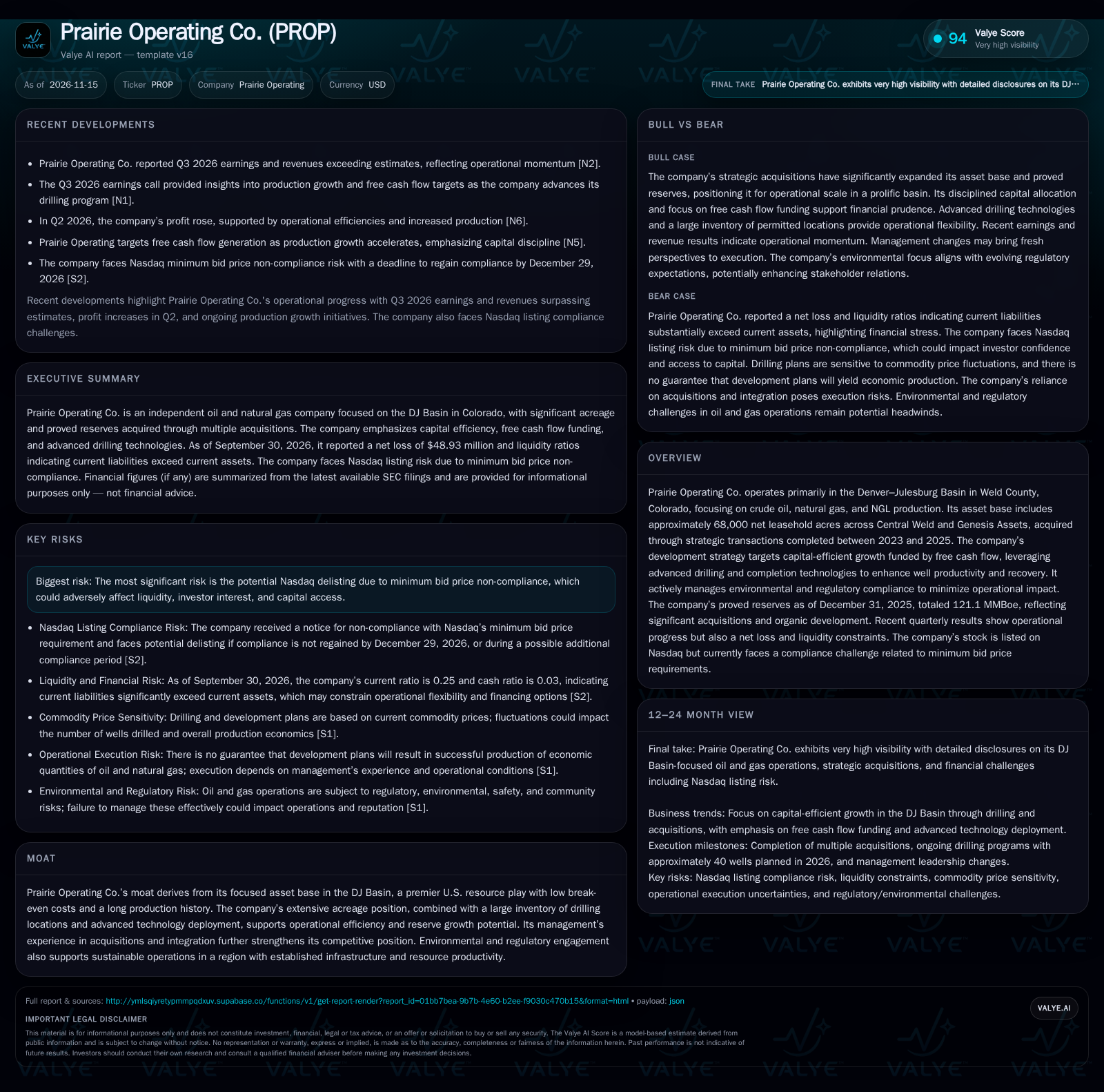
Prairie Operating Co. holds extensive DJ Basin acreage, has grown reserves through acquisitions, and aims for capital-efficient drilling funded by free cash flow. The next year will test whether asset scale and operational plans can overcome financial and market-access challenges. [S1] [S2] [N1] [N2]
Prairie Operating Co. has quickly built a substantial position in Colorado’s DJ Basin, leveraging acquisitions to amass a sizable inventory of drilling locations and proved reserves. The company’s focus on capital-efficient, free cash flow-funded development and use of advanced drilling technologies aligns with best practices among independent E&Ps. Yet, Prairie faces a sharp test: a large working capital deficit, ongoing net losses, and a Nasdaq delisting threat due to minimum bid price non-compliance. The coming year will determine if operational scale and discipline can overcome financial constraints—or if capital structure and market access risks will overshadow the company’s resource potential.
Asset Base Expansion and Liquidity Crunch Define the Current Moment
Prairie Operating Co. now controls approximately 68,000 net leasehold acres in the DJ Basin, split between Central Weld and Genesis Assets, following a series of acquisitions from 2023 through 2025. As of December 31, 2025, proved reserves totaled 121.1 MMBoe, reflecting the scale achieved through these transactions. [S1]
Despite operational progress—including Q3 2026 earnings and revenues that topped estimates—Prairie reported a net loss of $48.93 million for the quarter ended September 30, 2026. Its cash and equivalents of $7.75 million are dwarfed by current liabilities of $254.67 million, producing a current ratio of 0.25 and cash ratio of 0.03. [S2]
The company faces a Nasdaq minimum bid price non-compliance notice, with a December 29, 2026 deadline to regain compliance or risk delisting. This combines with its tight liquidity to create high near-term execution stakes. [S2]
How Prairie’s DJ Basin Model Could Translate Scale into Cash Flow
Prairie Operating’s business economics hinge on converting its substantial DJ Basin acreage and reserves into production growth while keeping capital intensity in check. The company’s stated approach is to fund drilling and completions—targeting around 40 gross wells in 2026—primarily from free cash flow, rather than external debt or equity. This model depends on wellhead economics: high initial production rates, rapid payback periods, and cost discipline.
The DJ Basin is known for relatively low break-even costs and established infrastructure, which can enable lower operating expenses per barrel, especially when drilling is concentrated and supply chains are optimized. Prairie’s use of 3-D seismic mapping and geo-steering aims to maximize recovery and minimize dry holes, theoretically improving returns on capital deployed.
However, the company’s current liquidity position means that any operational hiccup, commodity price downturn, or cost overrun could force a shift to external financing or asset sales. The mismatch between current assets and liabilities points to a business model that requires swift conversion of reserves into cash flow, with little margin for error.
DJ Basin Dynamics: Prairie’s Place Among Independents and the Role of Technology
Within the DJ Basin, Prairie competes with both large independents and smaller private operators, many of whom also benefit from attractive geology and established infrastructure. The company’s competitive edge may derive from its large, contiguous acreage position and inventory of drilling locations, which can support development scale and operational efficiency.
Advanced drilling and completion technologies—such as 3-D seismic and geo-steering—can provide an edge in well productivity and resource recovery, but these tools are increasingly standard among leading basin operators. True differentiation may come from execution: keeping costs low, minimizing downtime, and navigating regulatory hurdles.
Prairie’s recent acquisitions give it a larger operational footprint, but integration risk and the challenge of scaling up efficiently remain real. In addition, the company’s financial constraints may limit its ability to outspend or outpace better-capitalized rivals if market conditions tighten or if regulatory costs rise.
Translating Reserves into Cash Flow: The Path to Self-Funded Growth
The bullish scenario for Prairie Operating hinges on successful, capital-efficient execution of its drilling plan, with rapid conversion of proved reserves into high-margin production.
Confirmation of this scenario would come from sequential increases in production volumes, improving operating margins, and positive free cash flow in quarterly results. Regaining Nasdaq compliance—either through sustained price appreciation or a reverse split—would also bolster confidence. Evidence of successful cost control, asset integration, and minimal regulatory disruptions would further validate the upside case. [N1] [N2] [N5]
Scaling Under Constraint: Operational Progress, But Potential Financial Flexibility Remains Tight
The most plausible path forward is that Prairie continues to deliver incremental production growth and some operational improvements, but remains hampered by its liquidity position and market-access risks. Moderate success in drilling and completions could allow the company to narrow its losses and partially fund development from cash flow, but the working capital deficit persists.
In this scenario, Prairie may need to pursue some form of balance sheet repair—potentially through asset sales, joint ventures, or selective capital raises—to address upcoming liabilities and support drilling momentum. Regaining Nasdaq compliance is possible, but not assured, and would likely require both operational delivery and some form of capital structure action.
Confirmation would come from steady production growth, stable or modestly improving net losses, and announcements of non-dilutive financing or strategic partnerships. Failure to materially improve liquidity or address listing risk would challenge the base case.
Liquidity Squeeze and Market-Access Risk Could Force Strategic Retreat
In the adverse scenario, persistent net losses and a widening working capital deficit force Prairie Operating into difficult decisions. If commodity prices weaken, well performance disappoints, or regulatory costs escalate, the company may be unable to fund its drilling program without significant external capital—potentially at unfavorable terms.
A failure to regain Nasdaq compliance could further limit access to public equity markets, depress share liquidity, and erode investor confidence, making refinancing or recapitalization more difficult. In extremis, Prairie could be forced to curtail drilling, sell core assets, or restructure its liabilities to avoid insolvency.
Evidence for this scenario would include missed production or drilling targets, continued negative free cash flow, delisting from Nasdaq, or announcements of asset sales under distress. Any sign of covenant breaches, vendor payment delays, or inability to meet regulatory obligations would also support the bear case.
Testing the Thesis: What Will Determine Prairie’s Next Chapter
Quarterly production growth relative to guidance: Sustained increases would support the free cash flow funding thesis, while stagnation or declines would raise red flags.
Net cash from operating activities and free cash flow (if disclosed): Positive or improving cash generation is critical for self-funded growth.
Drilling and completion costs per well: Evidence of cost discipline or overruns will directly impact margins and capital efficiency.
Progress toward regaining Nasdaq compliance: Share price movements, reverse split announcements, or formal SEC filings will clarify market-access risk.
Changes in current liabilities or working capital position: Material improvement would reduce liquidity risk; deterioration would heighten concern.
Asset sales, joint ventures, or capital raises: Announced transactions would signal management’s approach to addressing the funding gap.
Regulatory or environmental developments: New requirements or compliance issues could alter cost structure and operational flexibility.
Disclaimer: This is research-only, informational analysis and not investment advice. It may include AI-generated interpretation and general industry context. Always verify important details using primary sources.

Comments