
GCT Semiconductor’s 5G Ambitions: Commercialization Progress, Margin Uncertainty, and the Stakes of Design Wins
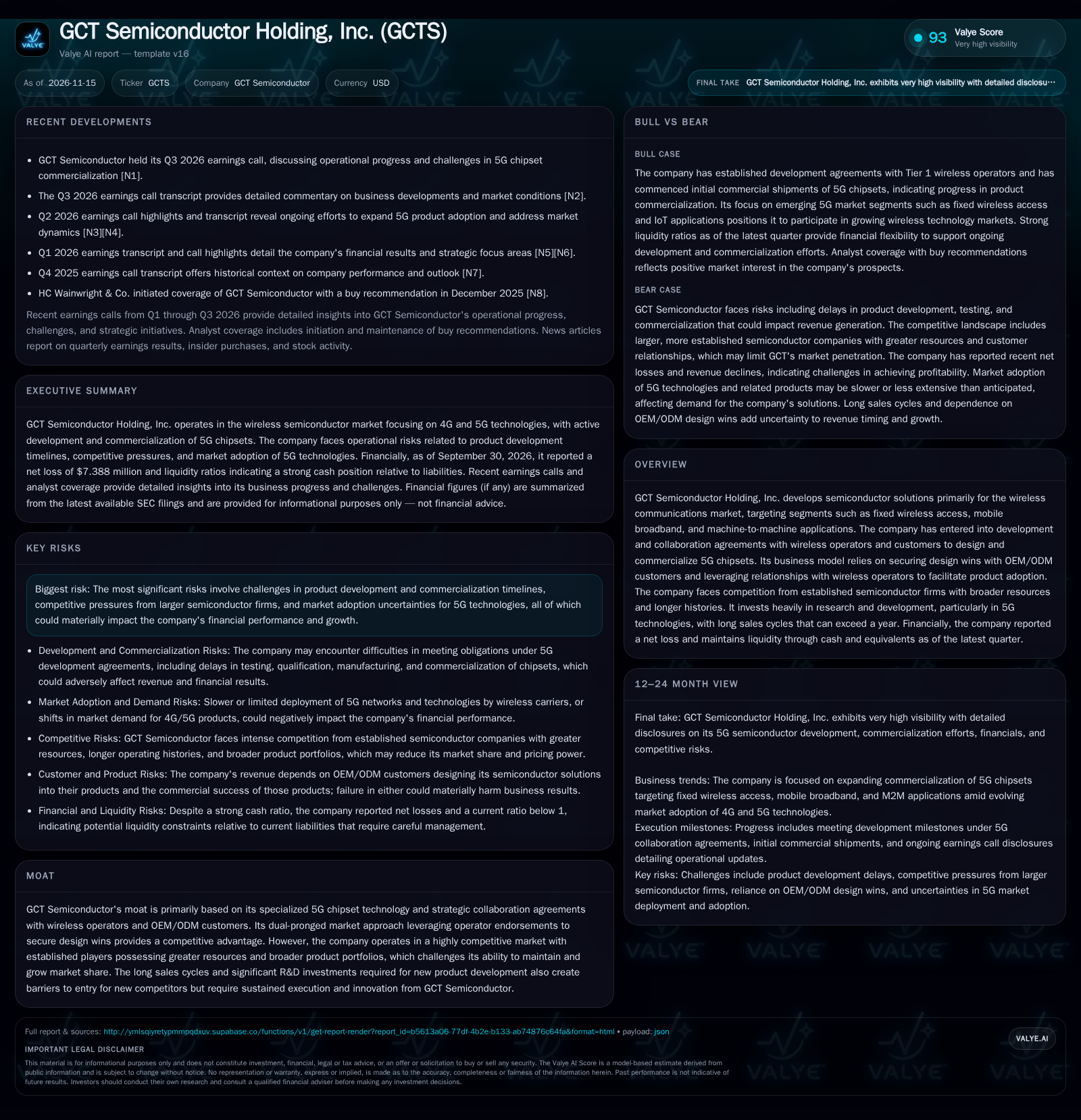
GCT Semiconductor is moving from 5G development into early commercialization, evidenced by initial chipset shipments and collaboration with a Tier 1 operator.
GCT Semiconductor is moving from 5G development into early commercialization, evidenced by initial chipset shipments and collaboration with a Tier 1 operator. The path forward hinges on accelerating design wins, navigating protracted sales cycles, and defending against larger competitors.
GCT Semiconductor Holding, Inc. is at a crucial inflection point as it transitions from R&D-heavy 5G chipset development to the early stages of commercialization. The company’s recent Tier 1 operator agreements and the first wave of 5G chipset shipments demonstrate that its technology is gaining initial traction.
Early 5G Shipments and Tier 1 Agreements Set the Stage, But Losses Persist
GCT Semiconductor has begun initial commercial shipments of its 5G chipsets to select customers, underpinned by development and collaboration agreements with both wireless operators and OEM/ODM partners—including at least one Tier 1 wireless communications operator [S2] [N1]. This marks a tangible move from product development into the first stages of market entry. The company reported cash and liquidity metrics for the period; these figures do not by themselves establish operating runway, investment capacity, financial flexibility, or financing capacity. [S2] The cash and cash equivalents balance stood at $17.155 million, and quarterly EPS was -$0.08 [S2]. While initial revenues from 5G shipments may begin to flow, the company continues to face revenue declines and ongoing losses, highlighting the challenge of scaling commercialization before financial resources become constrained.
How GCT’s 5G Commercialization Could Drive (or Drain) Economic Value
GCT’s business model is built around securing design wins with OEM/ODM customers, who then incorporate GCT’s chipsets into their own wireless equipment. This model typically yields lumpy, back-weighted revenue recognition; significant effort and R&D investment are required upfront, but revenue only materializes if and when the customer’s product goes into volume production. In the 5G segment, these sales cycles often exceed 12 months, stretching working capital and increasing the risk of missed volume ramps.
Pricing power is constrained by intense competition, especially against larger semiconductor incumbents who can leverage scale to cut prices or bundle solutions. Gross margin potential depends on GCT’s ability to differentiate technologically and avoid commoditization. The capital intensity of semiconductor R&D and the need for ongoing investment in new process nodes and standards compliance create high fixed costs, with limited room to flex down in a slow adoption scenario.
Operating leverage could be significant if GCT achieves multiple high-volume design wins, as incremental chip sales carry relatively low variable cost. However, the absence of recurring revenue contracts or guaranteed volume commitments means that each design win is a fresh battle, and customer concentration risk remains high. If initial 5G shipments do not translate into sustained orders, the cash burn rate may accelerate, forcing difficult capital-raising or cost-reduction decisions.
Competing Against Scale: GCT’s Position Versus Established Semiconductor Giants
GCT operates in an environment dominated by well-capitalized, diversified semiconductor firms with entrenched customer relationships and the ability to cross-subsidize product lines. These incumbents can afford to undercut pricing, offer broader product portfolios, and weather protracted market downturns. For GCT, differentiation rests on the technical performance, power efficiency, and cost competitiveness of its 5G solutions.
The company’s dual-pronged approach—targeting both wireless operators (for early validation and influence) and OEM/ODM partners (for design wins)—may help establish credibility and secure initial adoption. However, switching costs for OEMs are generally low once a design cycle is complete, and established players can use their scale to lock in customers with volume discounts, integrated solutions, or long-term supply agreements.
Potential substitutes include not just rival chipsets but also system-level integration by OEMs, or alternative wireless standards if the 5G rollout is delayed or fragmented. GCT’s ability to maintain technical leadership and secure repeat design wins will be critical to defending any share gained in early commercialization.
If Design Wins Convert to Volume Ramps: The Path to Margin Expansion and Cash Flow
The favorable scenario for GCT is one in which its initial 5G chipset shipments lead to high-profile design wins at major OEM/ODM customers, followed by rapid scaling as those customers launch successful wireless products. If 5G adoption accelerates among wireless operators and fixed wireless access providers, GCT could benefit from a rising tide of demand. In this case, operating leverage would kick in, with incremental chip sales boosting gross margins and potentially swinging the company to profitability.
Confirmation would come from sequential revenue growth, margin expansion, and repeat orders from initial customers. Announcements of new design wins, especially with top-tier OEMs or expanded agreements with major operators, would further validate this trajectory. Evidence that GCT’s technology is being adopted for multiple end markets (e.g., IoT, FWA, mobile broadband) would suggest reduced customer concentration and increased resilience.
Falsification would be indicated by stagnant or declining shipment volumes, lack of follow-on orders, or persistent negative gross margins despite new product launches.
Commercialization Proceeds, but Sales Cycles and Losses Remain Drag on Progress
The most plausible path is one where GCT achieves incremental progress in 5G commercialization—converting some initial shipments into modest recurring orders, but encountering continued delays and long sales cycles typical of the industry. Revenue growth may be slow and uneven, with periodic setbacks as customers delay or cancel product launches due to market or technical factors.
Margins may remain under pressure as GCT competes for share in price-sensitive markets, and the company may not achieve the scale needed for meaningful operating leverage in the near term. Cash burn persists, and management is forced to prioritize between continued R&D investment and near-term liquidity management. The company’s ability to secure additional funding or renegotiate supplier/customer terms could determine whether it can bridge to a more robust growth phase.
Evidence supporting this scenario includes ongoing net losses, flat or modestly rising revenues, and continued reliance on milestone payments rather than large-volume commercial orders. If disclosed, customer concentration and order backlog metrics would help clarify the pace and breadth of adoption.
Design Wins Stall and Liquidity Tightens Amid Competitive and Market Delays
In the adverse scenario, GCT’s early 5G shipments do not lead to substantial design wins or follow-on orders. Competitive pressure intensifies, with larger rivals undercutting prices or accelerating their own product launches, eroding GCT’s value proposition. OEM/ODM customers may delay or abandon programs due to technical issues, shifting standards, or weak end-market demand.
Cash burn accelerates as revenues stagnate or decline, and the company’s sub-1 current ratio and high liability load become acute. GCT may be forced to seek dilutive financing, sell assets, or curtail R&D, further weakening its competitive position. In the worst case, inability to meet obligations under collaboration agreements or to deliver on technical milestones could result in customer or partner defections.
This scenario would be confirmed by sequential revenue declines, negative gross margins, shrinking cash balances, or disclosures of restructuring, layoffs, or covenant breaches. A lack of new design wins or customer renewals would signal erosion of future pipeline.
Milestones That Will Define GCT’s 5G Commercialization Trajectory
Sequential revenue growth from 5G chipset shipments, which would indicate successful customer adoption and volume ramp.
Gross margin trends—expansion would suggest scale benefits or pricing power; persistent compression could imply competitive or cost pressure.
Number and quality of new design wins, especially with Tier 1 OEM/ODM customers or major wireless operators; if disclosed, this would clarify future revenue visibility.
Repeat orders or multi-generation engagements with initial customers, signaling customer satisfaction and stickiness.
Evidence of delayed or canceled customer programs, which would increase the risk of missed revenue targets and underutilized R&D investment.
Updates on the pace of 5G infrastructure and service adoption among wireless carriers, as slower market deployment would directly affect addressable demand.
Disclaimer: This is research-only, informational analysis and not investment advice. It may include AI-generated interpretation and general industry context. Always verify important details using primary sources.

Comments