
MultiSensor AI: SaaS Expansion Ambitions Confront Persistent Losses and Revenue Headwinds
Recent quarterly losses and revenue shortfalls highlight execution risks, with customer retention and capital discipline emerging as critical levers for the company’s next phase.
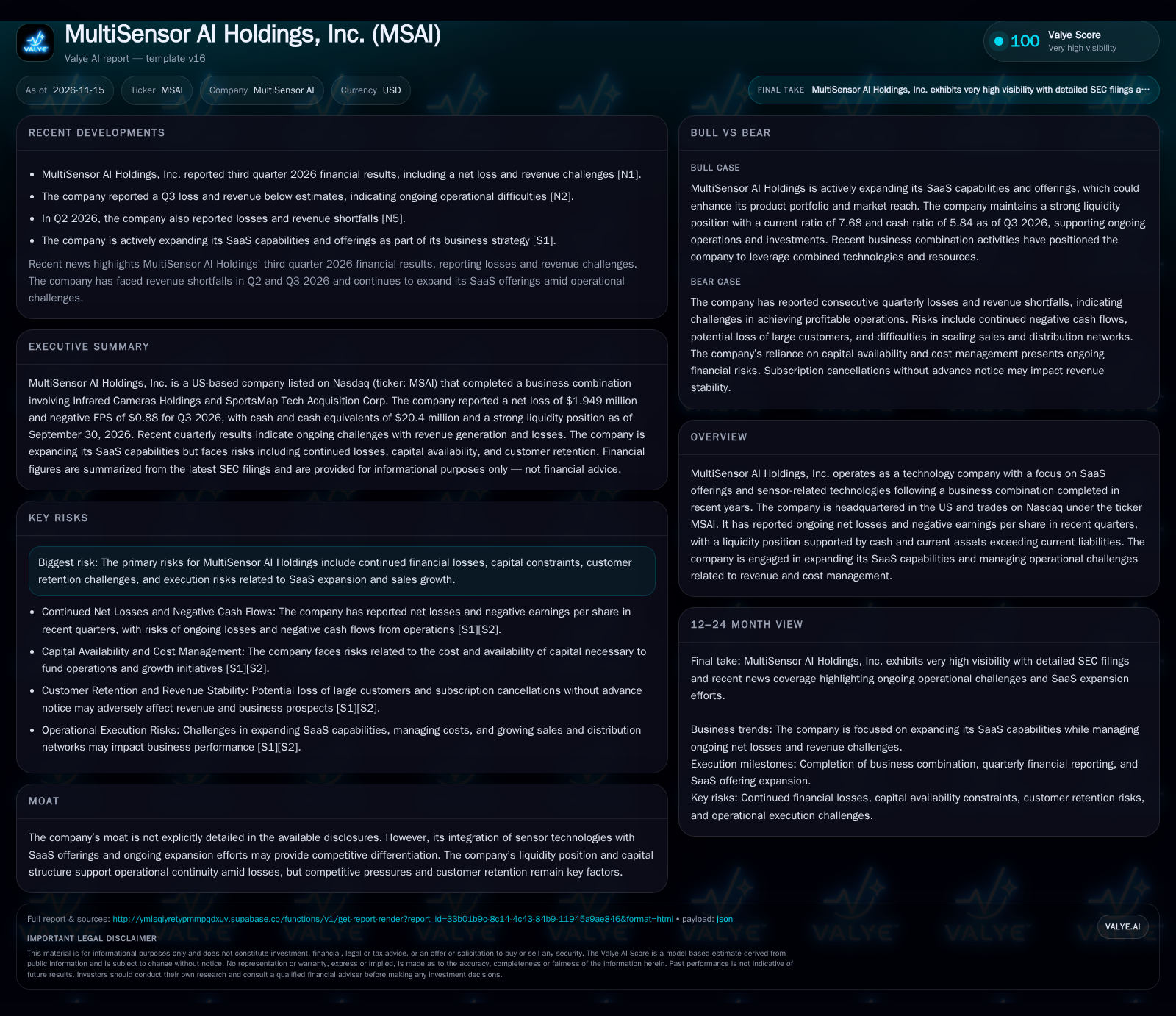
MultiSensor AI Holdings, Inc. (Nasdaq: MSAI) has completed a business combination and is focused on expanding SaaS capabilities, but continues to report quarterly net losses and revenue below expectations. Success will hinge on scaling SaaS adoption, managing costs, and demonstrating tangible sales traction in a competitive environment. [S1] [S2] [N1] [N2] [N5]
MultiSensor AI Holdings, Inc. stands at a strategic crossroads following its business combination and pivot toward SaaS-driven sensor technology solutions. While the company’s liquidity position is reflected in $20.4 million in cash and a significant current ratio, its Q3 2026 results underscore persistent losses and underperformance relative to revenue expectations. The critical question is whether MultiSensor AI can translate its technology investments and SaaS expansion into a scalable, profitable business model before capital constraints or customer churn undermine its ambitions.
Quarterly Losses and Liquidity Define the Present Landscape
MultiSensor AI Holdings, Inc. reported a net loss of $1.949 million for Q3 2026, with an EPS of -$0.88, continuing a trend of negative earnings and quarterly revenue shortfalls versus estimates. However, these resources are being drawn down as the company invests in SaaS expansion and attempts to overcome weak revenue generation. The combination of persistent losses and underwhelming sales performance underscores the urgency for improved execution and commercialization. [S2] [N1] [N2] [N5]
How SaaS Expansion Could Reshape Revenue and Cost Structure
MultiSensor AI is attempting to shift its business model toward SaaS, which could, in theory, drive recurring revenue, improve gross margins, and reduce revenue volatility compared to one-time hardware or project-based sales. In a typical SaaS model, revenue is recognized over the contract period, and operating leverage increases as customer acquisition costs are amortized and gross margins expand with scale. However, the company’s continued net losses and revenue shortfalls suggest that adoption has not yet reached the critical mass required for positive operating leverage.
The transition period is often costly: up-front investments in R&D, customer onboarding, and distribution expansion can outpace initial subscription inflows. If MultiSensor AI succeeds in signing large, multi-year SaaS contracts, the path to breakeven could accelerate, but this requires both compelling product-market fit and scalable sales execution. Unit economics will ultimately depend on customer retention, upsell rates, and the ability to minimize churn—metrics that have not been disclosed but are critical to SaaS sustainability.
The SaaS model inherently demands a nuanced understanding of customer lifetime value (CLV) versus customer acquisition cost (CAC). For MultiSensor AI, achieving a favorable CLV to CAC ratio is pivotal; if the upfront costs to acquire and onboard customers consistently exceed the long-term subscription revenue, scaling will remain unprofitable. Additionally, the timing of cash flows is critical—while SaaS contracts may generate predictable revenue streams, the lag between initial sales and cash realization can strain liquidity, especially if churn rates are elevated or contract renewals are delayed. Therefore, a rigorous focus on shortening sales cycles and improving onboarding efficiency would materially impact the path to profitability.
Furthermore, the shift to SaaS often transforms the cost structure from predominantly fixed hardware production costs to a mix of fixed and variable expenses tied to cloud infrastructure, customer support, and continuous software development. This evolution means that economies of scale depend not only on increasing subscriber counts but also on optimizing platform architecture to minimize incremental costs per user. If MultiSensor AI can leverage modular, scalable cloud solutions and automate customer support functions, it could reduce marginal costs and improve gross margins. Conversely, failure to control these variable costs could perpetuate losses despite revenue growth.
Sensor-SaaS Integration: Differentiator or Commodity in a Crowded Field?
MultiSensor AI’s competitive ambition lies in integrating sensor technologies with SaaS offerings, potentially enabling real-time data analytics, monitoring, and automation for industrial or commercial clients. In theory, this integration can increase switching costs if customers embed these solutions into their core workflows, but such stickiness typically depends on proprietary data, seamless platform integration, and high-quality support. The competitive landscape is crowded, with established sensor manufacturers, pure-play SaaS analytics providers, and integrated industrial IoT platforms all vying for similar enterprise budgets.
Without evidence of exclusive technology, network effects, or unique data assets, MultiSensor AI may face pricing pressure and high customer acquisition costs. The company’s success will likely hinge on its ability to demonstrate superior functionality, reliability, or cost-effectiveness relative to both legacy hardware providers and emerging digital-first competitors. The challenge is compounded by the need to build trust and demonstrate ROI for risk-averse enterprise customers, who may be slow to switch vendors or adopt unproven platforms.
In addition to product differentiation, MultiSensor AI’s ability to establish strategic partnerships within the broader IoT ecosystem could be a critical competitive lever. Collaborations with platform integrators, cloud service providers, or industry-specific solution vendors can extend market reach and embed the company’s offerings into larger value chains. Such partnerships often could create network effects, where the value of the platform increases as more complementary services and users join, enhancing customer stickiness and reducing price sensitivity. Without these alliances, the company risks isolation in a fragmented market, limiting its ability to scale and defend against competitors with more extensive ecosystems.
Moreover, regulatory and data privacy considerations increasingly affect sensor data management and SaaS deployments, particularly in industrial and commercial contexts. MultiSensor AI’s competitive positioning could be strengthened by proactively addressing compliance requirements and embedding robust security features into its platform. This would not only mitigate customer concerns but also serve as a differentiator in sectors where data governance is paramount. Conversely, lagging in these areas could expose the company to legal risks and customer attrition, especially as enterprises become more cautious about vendor risk profiles.
A Breakout in SaaS Adoption Could Catalyze Operating Leverage
The most favorable scenario for MultiSensor AI is a rapid acceleration in SaaS customer acquisition, leading to recurring, high-margin revenue streams and positive operating leverage. This could be triggered by successful deployment with one or more marquee customers, strong product differentiation, or a strategic partnership that accelerates market penetration. Confirmation of this scenario would require evidence such as: a sharp increase in SaaS contract wins, disclosure of multi-year agreements with large enterprises, a material improvement in gross margin, or a clear inflection in revenue growth outpacing expense increases.
Other confirming signals would include a reduction in churn, rising customer lifetime value, and evidence that SaaS revenues are offsetting or exceeding hardware or legacy service declines. A falsification of this scenario would be continued revenue stagnation despite reported expansion efforts, persistent net losses without improving gross margins, or the absence of large contract announcements or meaningful customer traction.
Incremental Progress Amid Execution and Capital Constraints
The most plausible near-term path is one of gradual improvement: MultiSensor AI continues to invest in SaaS expansion, but revenue growth remains modest and losses persist as the company contends with sales-cycle friction, customer hesitancy, and a competitive marketplace.
This scenario would be confirmed by continued quarterly losses, incremental revenue growth without a pronounced inflection, and management commentary emphasizing pipeline development and operational discipline. A falsification would be either a sharp deterioration in liquidity (suggesting a need for emergency capital raises) or, conversely, a sudden acceleration in revenue and margin improvement indicating that the SaaS pivot is gaining traction faster than expected.
Sustained Losses and Revenue Stagnation Erode Strategic Options
If MultiSensor AI fails to meaningfully ramp SaaS revenues, persistent net losses and revenue underperformance could erode its cash and current asset position, forcing the company to seek dilutive capital or consider strategic alternatives under pressure. This could be exacerbated by customer churn, inability to replace lost contracts, or cost overruns in R&D and sales expansion.
Falsifying this downside would require stabilization of losses, successful cost reductions, or evidence of new revenue streams materializing before liquidity becomes a constraint.
Milestones and Metrics That Will Shape MultiSensor AI’s SaaS Pivot
Quarterly SaaS revenue growth rates—if disclosed—to gauge adoption velocity and validate expansion strategy.
Gross margin trends, particularly the mix between SaaS and any remaining hardware/service components.
Churn and retention rates for SaaS customers, which are pivotal for recurring revenue sustainability; a useful metric would be logo or dollar retention if disclosed.
Net cash burn per quarter, as a gauge of capital efficiency and the pace at which cash reserves are being drawn down.
Announcement of major customer wins or partnerships, especially multi-year agreements or strategic alliances.
Evidence of cost discipline, such as reductions in SG&A or R&D as a percentage of revenue, without compromising growth.
Management commentary or disclosures around sales pipeline health, conversion rates, and average deal size.
Any signals of capital raises, debt issuance, or warnings regarding future liquidity requirements or going concern risks.
Disclaimer: This is research-only, informational analysis and not investment advice. It may include AI-generated interpretation and general industry context. Always verify important details using primary sources.

Comments