
Presurance Holdings: Concentrated Homeowners Focus, Underwriting Progress, and the Fragility of Outsourced Scale
Presurance Holdings, after divesting its agency operations and exiting commercial lines, now pursues a targeted homeowners insurance strategy—primarily in Texas—but faces structural vulnerabilities from shrinking premiums, ongoing underwriting losses, and heavy dependence on third-party agencies for core operations.
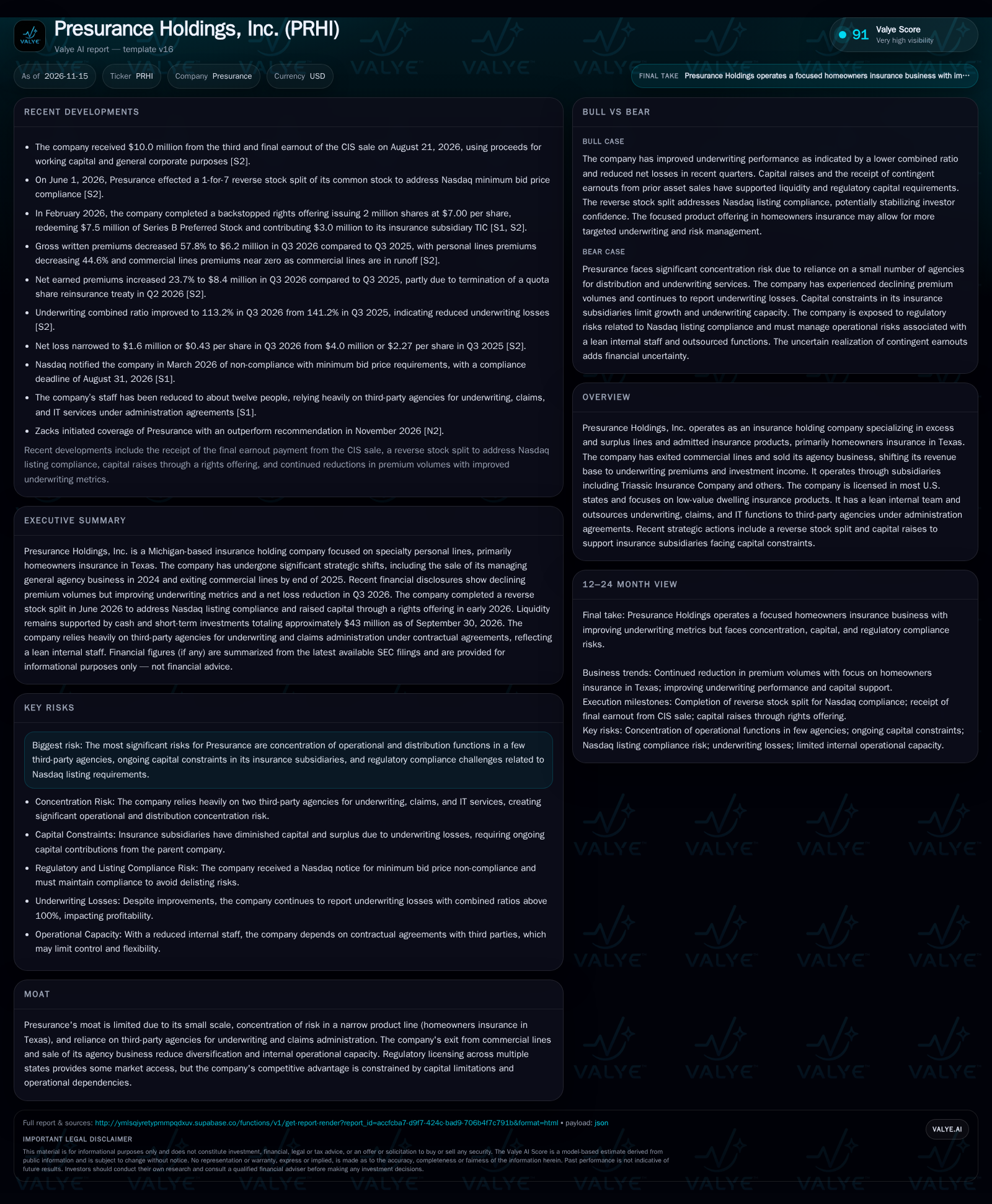
Presurance Holdings is now a focused homeowners insurance underwriter, operating mainly in Texas, after selling its agency business and ceasing commercial lines. While underwriting losses have narrowed and liquidity is bolstered by recent asset sale earnouts and capital raises, the company’s business is materially smaller, less diversified, and increasingly reliant on a handful of third-party partners for distribution and administration. The critical watchpoints are premium stabilization, further underwriting improvement, agency partner resilience, and the ability to maintain regulatory and capital compliance in an environment of reduced scale and persistent losses. [S1] [S2]
Presurance Holdings, Inc.’s post-divestiture story is defined by sharp strategic contraction and operational streamlining. The company now runs a concentrated homeowners insurance platform—primarily in Texas—after selling its managing general agency and exiting commercial lines. While recent quarters show improved underwriting ratios and a narrowed net loss, the steep decline in premium volume and ongoing reliance on a handful of third-party agencies for essential functions expose the business to acute concentration and execution risks. The next phase depends on whether Presurance can stabilize its premium base, further reduce underwriting losses, and maintain regulatory compliance in the face of diminished scale and persistent capital pressures. [S1] [S2]
Recent Strategic Shifts and Their Immediate Impact
Presurance Holdings has undergone a marked transformation in the past two years: it sold its managing general agency (Conifer Insurance Services) in August 2024 and has now exited all commercial lines, shifting to a singular focus on homeowners insurance—primarily in Texas. As of September 30, 2026, gross written premiums declined 57.8% year-over-year to $6.2 million, reflecting the sharp contraction in business scope. The company’s underwriting combined ratio improved to 113.2% in Q3 2026 from 141.2% a year prior, but results still reflect underwriting losses. To address capital and liquidity needs, Presurance completed a rights offering in early 2026 and received a final $10 million earnout from the CIS sale in August 2026, using proceeds to redeem preferred stock and inject capital into its insurance subsidiaries. [S1] [S2]
Lean Operations, Underwriting Leverage, and the Limits of Outsourcing
Presurance’s revenue model now depends almost entirely on earned premiums from underwriting homeowners insurance, supplemented by investment income on its cash and short-term investments. The exit from commercial lines and the sale of its agency business removed diversification and agency commission income, leaving the company’s economics highly sensitive to underwriting results and catastrophe exposure in its target geography. With a staff of about twelve, Presurance relies on third-party agencies for distribution, underwriting, claims, and IT functions. This outsourced, asset-light approach limits fixed overhead but also constrains operational control and flexibility.
The improvement in net earned premiums (up 23.7% in Q3 2026) was partly due to the termination of a quota share reinsurance treaty, which increased the company’s retained risk and premium base, but also raises the stakes for underwriting accuracy. Despite the better combined ratio, the company is still running at an underwriting loss—suggesting negative operating leverage at current scale. Capital remains a binding constraint: the insurance subsidiaries have required parent-level capital contributions, and further growth or even maintenance of the existing book may demand additional injections if losses persist or adverse events occur. [S1] [S2]
Niche Focus and the Double-Edged Sword of Agency Dependence
Presurance competes in the specialty homeowners insurance market, with a focus on low-value dwellings in Texas—a segment where underwriting skill and local distribution relationships can be differentiators. Its licensing footprint is broad, but actual business is now highly concentrated. Larger national carriers, regional specialists, and insurtech entrants with advanced data analytics all compete for similar risks. Presurance’s reliance on a small number of third-party agencies for both distribution and core operations is a double-edged sword: it enables a lean cost structure but exposes the company to significant concentration risk if an agency partner underperforms, terminates the relationship, or shifts business elsewhere.
The company’s limited scale restricts negotiating power with reinsurers and service providers, and the absence of in-house distribution or claims infrastructure reduces its ability to respond swiftly to market or regulatory changes. While the asset-light model can be efficient, it is vulnerable to shifts in partner incentives, regulatory scrutiny of outsourced arrangements, and loss of local market knowledge over time.
If Underwriting Discipline and Agency Partnerships Deliver Stability
A favorable trajectory for Presurance would involve continued improvement in underwriting performance, with the combined ratio falling below 100%—signaling profitable insurance operations. If the company can stabilize or modestly grow its premium base in Texas, while maintaining strong agency relationships and managing catastrophe exposure, it could achieve positive operating leverage even at a reduced scale. The capital raised and earnout proceeds would then support both regulatory capital and selective expansion into adjacent segments or geographies, leveraging the existing licensing footprint.
Evidence that would confirm this scenario includes: sustained improvement in the combined ratio below 100%; modest premium growth or stabilization; no further need for parent-level capital contributions; and continued profitable agency partnerships with no partner turnover or disruption. Any disclosure of new agency relationships, technology investments to improve underwriting accuracy, or reinsurance cost reductions would further bolster the case.
Sustained Operating Strain Amid Shrinking Scale and Persistent Reliance
The most plausible near-term path is one of continued operating strain: Presurance remains a sub-scale homeowners insurer with ongoing underwriting losses, but manages to cover regulatory and operational requirements through periodic capital injections and cost controls. Premium volumes may decline further or stabilize at a low base, while the combined ratio remains above 100%, reflecting the challenges of achieving profitability in a concentrated, catastrophe-prone market with limited pricing power.
This scenario would be confirmed by continued negative net income, modest or declining premium volumes, and further capital contributions to insurance subsidiaries. Any signs of agency partner turnover, regulatory scrutiny of outsourced arrangements, or inability to renew or place reinsurance at acceptable terms would reinforce the persistence of these challenges. Conversely, a break-even or profitable quarter, or evidence of new agency or distribution partners, would begin to falsify this middle path.
Concentration and Capital Risks Trigger a Downward Spiral
The adverse scenario unfolds if one or more of Presurance’s key agency partners curtail their relationship, underperform, or exit, leading to a sudden loss of distribution capacity and premium volume. Simultaneously, persistent underwriting losses could exhaust available capital at the subsidiary level, triggering regulatory intervention or an inability to write new business. In this case, the asset-light model’s lack of internal redundancy amplifies operational fragility, and the company may face delisting or forced asset sales to meet obligations.
Confirmation of this scenario would include: a sharp drop in premium writings not attributable to market conditions; disclosures of agency partner disputes or terminations; urgent new capital raises or asset sales; regulatory actions against insurance subsidiaries; and Nasdaq delisting notices beyond the remedial period. If disclosed, declining reinsurance support or increased cost of reinsurance would further validate the downside thesis.
Milestones That Will Determine Presurance’s Strategic Viability
Quarterly trend in combined ratio—sustained improvement toward or below 100% would signal underwriting progress; further deterioration would confirm ongoing margin pressure.
Gross and net written premium volumes in Texas—stabilization or growth would suggest franchise resilience, while continued declines would exacerbate scale and capital constraints.
Frequency and magnitude of parent-level capital contributions to insurance subsidiaries—a decrease would indicate improved subsidiary performance and capital adequacy.
Agency partner concentration and continuity—any disclosures of new, lost, or renegotiated agency agreements would test the vulnerability to distribution disruption.
Nasdaq compliance status and stock price performance—maintenance above minimum bid price and continued listing are essential for potential financial flexibility and investor confidence.
Disclosure of reinsurance arrangements and terms—favorable renewals or cost reductions would ease capital pressure; tightening terms would increase risk.
Staffing levels and internal capability changes—any shift from outsourced to in-house operations, or vice versa, would signal a strategic reappraisal of operational risk.
Disclaimer: This is research-only, informational analysis and not investment advice. It may include AI-generated interpretation and general industry context. Always verify important details using primary sources.

Comments