
4D Molecular Therapeutics: Gene Therapy Ambitions, Clinical Milestones, and the Funding Imperative
With a late-stage pipeline targeting durable genetic therapies and a lead program in wet AMD, 4D Molecular Therapeutics faces the dual challenge of advancing high-cost R&D while navigating regulatory, financing, and operational hurdles.
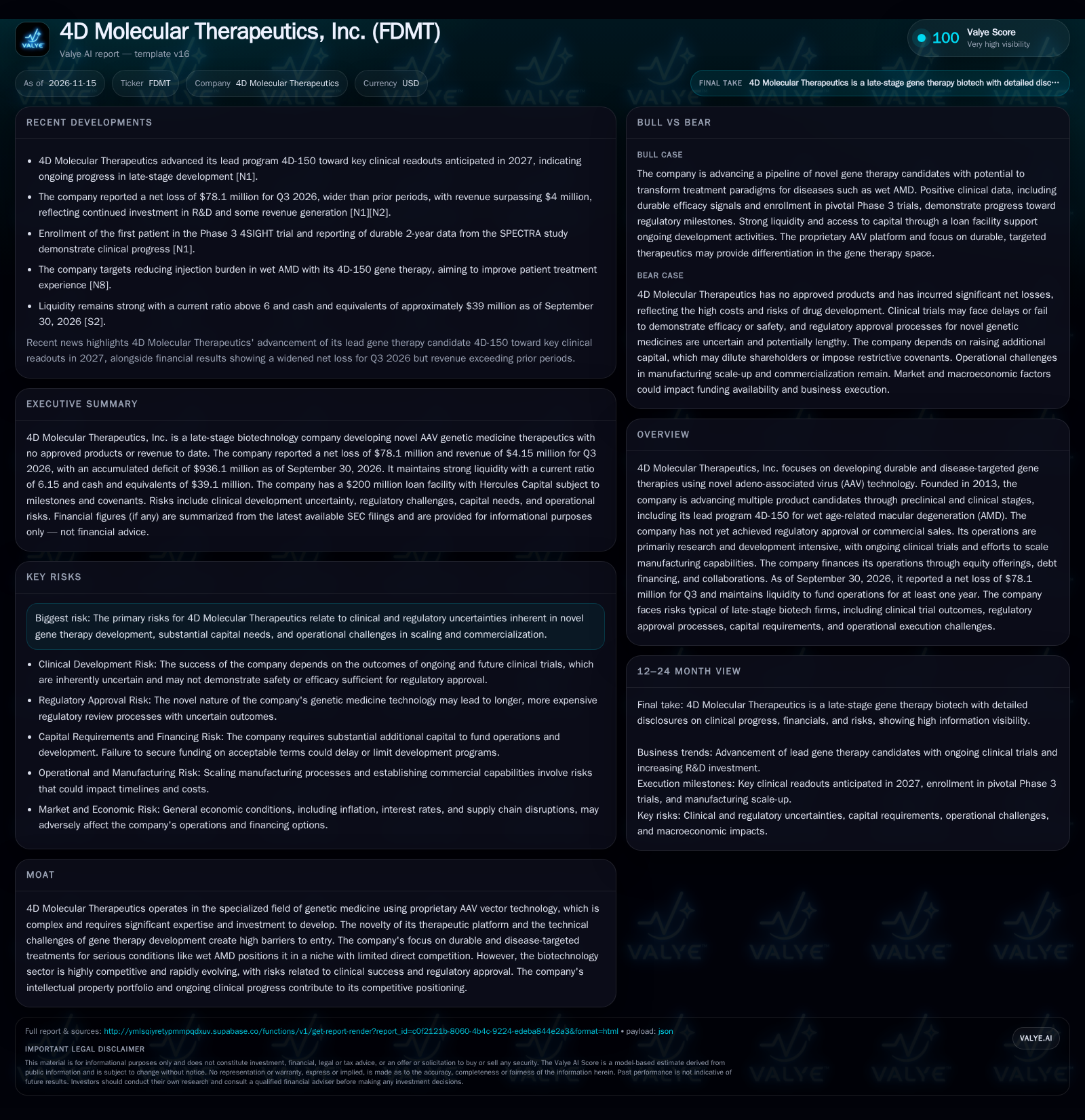
4D Molecular Therapeutics, Inc. is a late-stage gene therapy company specializing in novel AAV-based therapeutics, with no approved products and ongoing clinical trials. As of September 30, 2026, it reported a $78.1 million quarterly net loss, $4.15 million in revenue, and $39.1 million in cash. Its $200 million loan facility offers milestone-tied funding, but restrictive covenants and persistent operating losses underline the critical need for clinical success and future financing [S2] [N2].
4D Molecular Therapeutics stands at a pivotal juncture as a late-stage gene therapy developer leveraging proprietary AAV technology. Despite a robust pipeline and targeted innovation in diseases like wet age-related macular degeneration (AMD), the company has yet to achieve commercial product approval or meaningful revenue. With $39.1 million in cash and a significant loan facility, 4DMT’s ability to translate clinical progress into regulatory success and eventual market entry will define its trajectory. However, persistent net losses, restrictive loan covenants, and the capital-intensive nature of gene therapy development underscore substantial risk and the importance of timely clinical milestones [S2] [N2] [N8].
Recent Financials, Pipeline Progress, and the Capital Structure Landscape
As of September 30, 2026, 4D Molecular Therapeutics reported a net loss of $78.1 million for the quarter and revenue of approximately $4.15 million, reflecting its ongoing pre-commercial, R&D-intensive phase [S2] [N2]. The company had $39.1 million in cash and a current ratio of 6.15, indicating significant but finite liquidity [S2]. Importantly, 4DMT has access to a $200 million loan facility with Hercules Capital, though only $20 million was drawn at closing and further tranches are contingent on achieving milestones and lender discretion [S2]. The loan agreement imposes restrictive covenants, including minimum cash levels and performance metrics tied to market capitalization and product revenue, which could constrain operational flexibility [S2]. On the pipeline front, the company’s lead program, 4D-150, aims to decrease the injection burden for wet AMD—an area with substantial unmet need and high patient demand for improved treatment modalities [N8]. These facts frame a business with tangible innovation prospects but significant exposure to clinical, regulatory, and funding risks.
Gene Therapy Economics: Capital Demands, Revenue Pathways, and Scaling Challenges
The economics of late-stage gene therapy development are characterized by high upfront R&D and manufacturing costs, lengthy timelines, and binary value inflection points centered on clinical and regulatory outcomes. 4DMT’s cost structure is dominated by research, clinical trials, and expanding manufacturing capacity, with minimal current revenue and no approved products [S2]. If the lead asset 4D-150 or other pipeline candidates achieve approval, revenue generation would likely be driven by a combination of high-value, potentially one-time or infrequent dosing regimens—typical of gene therapy models—targeting premium pricing in specialized indications.
Operating leverage is plausible in a commercial scenario, as fixed R&D and platform costs could be amortized across multiple programs and indications, but near-term economics are negative due to persistent losses and ongoing investment [S2]. The $200 million loan facility provides non-dilutive capital, but milestone-based drawdowns and restrictive covenants create financial discipline pressures. The need for eventual commercial-scale manufacturing—potentially requiring additional capital investment—adds further complexity. The company’s ability to secure out-licensing, collaborations, or milestone payments could supplement cash flows, but these are not established as current revenue streams.
Overall, the business model is high-risk/high-reward, with substantial capital intensity, significant uncertainty around the timing and magnitude of future revenue, and a dependence on external funding until approvals are secured.
Positioning in the Genetic Medicine Ecosystem: Differentiation and Counterforces
4D Molecular Therapeutics operates in a highly specialized and rapidly evolving segment of biotechnology, where the technical complexity of AAV vector design and disease targeting creates meaningful barriers to entry. The company’s proprietary platform and focus on durable, disease-specific therapies—such as targeting wet AMD with 4D-150—offer potential differentiation if clinical results validate superior efficacy or patient experience compared to existing standards of care [N8].
However, the competitive landscape in gene therapy is intense, with large pharma and emerging biotech peers investing heavily in similar modalities. Substitutes include traditional biologics, small-molecule therapies, and emerging RNA-based approaches, many of which are further advanced in terms of regulatory approval or commercialization. Intellectual property portfolios provide some defensibility, but first-mover advantage is often offset by the need for robust long-term safety and efficacy data.
The company’s ultimate competitive strength will depend on demonstrating not only clinical benefit but also manufacturability, scalability, and payer acceptance—each of which presents its own set of hurdles as gene therapies move from trial to market.
Clinical Validation and Regulatory Success Unlock Commercial Potential
A favorable outcome for 4DMT would see successful pivotal trial results for 4D-150, leading to regulatory approval for wet AMD and rapid uptake due to the therapy’s potential to reduce treatment burden for patients and providers [N8]. Positive data would likely catalyze additional pipeline programs, attract strategic partnerships, and enable premium pricing due to the durable nature of gene therapy solutions. This scenario could also unlock access to subsequent tranches of the Hercules loan and/or provide leverage in future equity or partnership negotiations [S2].
Confirmation of this scenario would come from the release of statistically significant, clinically meaningful pivotal trial data, regulatory filings and approvals, and announcements of commercial or licensing partnerships. Early payer engagement and clear reimbursement pathways would further support the upside case. The primary falsifiers would be negative trial outcomes, regulatory setbacks, or a failure to differentiate clinically versus existing therapies.
Progress Amid Uncertainty: Managing Cash, Milestones, and Clinical Risk
The most plausible trajectory is one in which 4DMT continues to advance its lead programs through ongoing clinical trials, incurring sizable operating losses and tapping existing liquidity and milestone-based debt as needed [S2]. Clinical readouts may be mixed, with some signals of efficacy and safety but also the risk of delays or inconclusive data. Regulatory interactions could extend timelines, requiring additional bridge financing or equity raises—potentially diluting shareholders or tightening covenant constraints.
In this scenario, the company keeps its pipeline moving but faces periodic volatility in valuation and funding access, with commercial revenues still several years away. Evidence would include incremental clinical updates, continued cash burn, milestone-based loan drawdowns, and possible early-stage partnership deals that provide non-dilutive capital but not full commercial validation. Negative signals would be a rapid deterioration in cash, inability to meet loan covenants, or major clinical or regulatory setbacks.
Clinical or Regulatory Setbacks Trigger Funding and Operational Stress
The adverse case involves failure to achieve key clinical endpoints for 4D-150 or other pipeline assets, resulting in halted programs and a collapse of near-term value. Regulatory rejections or demands for further studies could significantly extend timelines and increase burn [S2]. Inability to access additional tranches of the Hercules loan, breach of cash or performance covenants, or a weak capital market environment could force the company to pursue highly dilutive financings or strategic alternatives at unfavorable terms.
This scenario could be confirmed by public disclosure of negative trial results, SEC filings indicating going concern risk, or the announcement of workforce reductions and program discontinuations. Falsifiers would be unexpected positive clinical or regulatory developments, or new non-dilutive capital inflows.
Milestones and Conditions That Will Shape the 4D Molecular Therapeutics Thesis
Pivotal clinical trial results for 4D-150 in wet AMD—early efficacy and safety signals will be decisive for future value creation.
Regulatory filings and agency feedback on lead programs—timelines and requirements for approval will impact capital needs and investor sentiment.
Cash burn trajectory and runway updates—quarterly disclosures of operating cash flow and liquidity will test the sufficiency of current resources.
Access to additional tranches of the Hercules loan—updates on milestone achievement and compliance with covenants will indicate funding flexibility.
Progress on manufacturing scale-up and readiness for commercial production—if disclosed, this would reveal operational execution risk.
Announcements of licensing, collaboration, or commercialization agreements—new deals could validate technology and supplement cash.
Dilution from equity offerings or changes in capital structure—SEC filings on new financings will signal the company’s capital market access and shareholder impact.
Competitive clinical readouts from peer gene therapy programs in ophthalmology or other targeted indications—external progress could affect 4DMT’s positioning and market expectations.
Disclaimer: This is research-only, informational analysis and not investment advice. It may include AI-generated interpretation and general industry context. Always verify important details using primary sources.

Comments