
Electra Therapeutics: Precision Immunology Platform Faces the Hurdles of Clinical-Stage Value Creation
Recent overweight ratings from major investment banks signal market anticipation—but not yet commercial validation—of its SIRP-targeting approach.
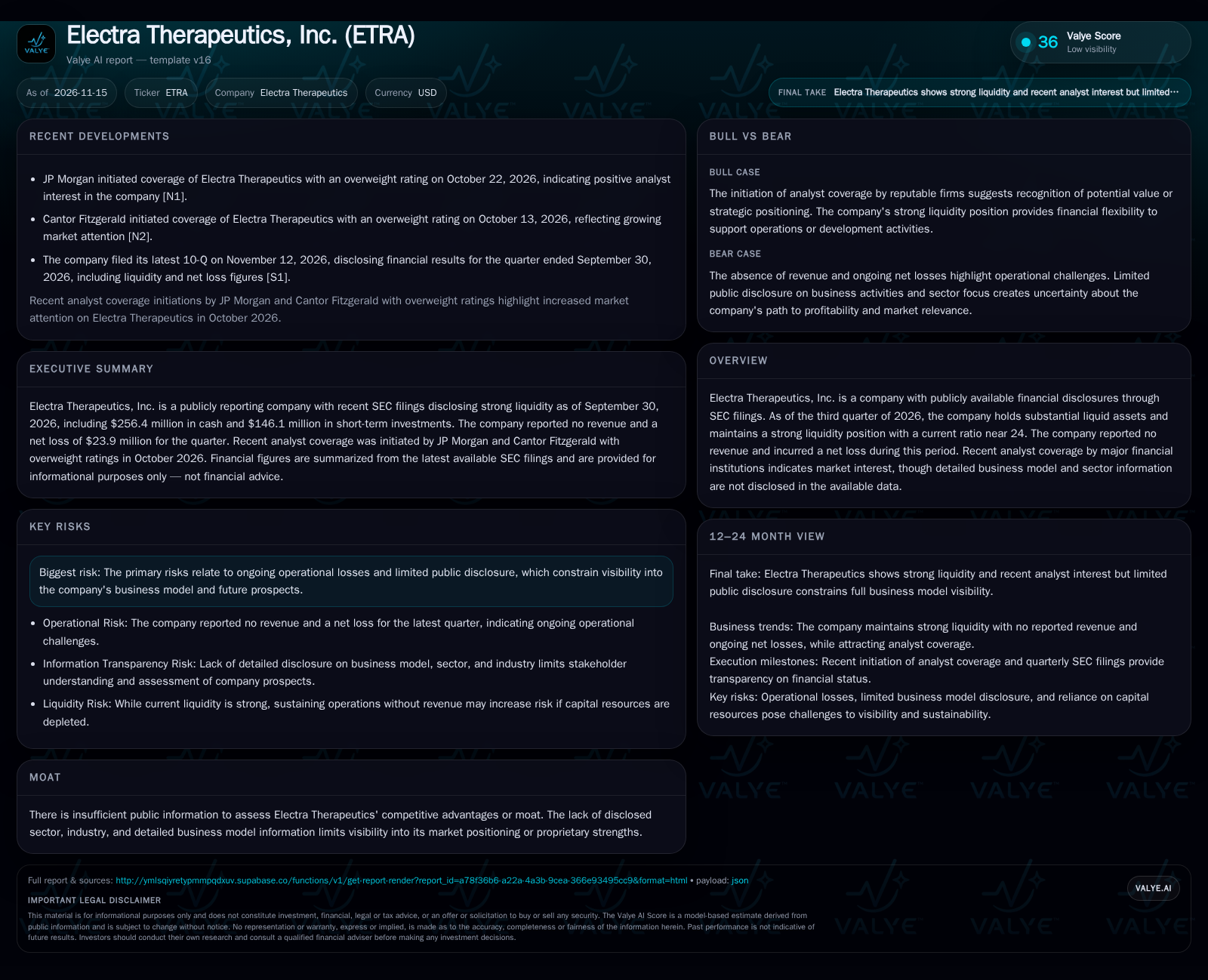
Electra Therapeutics holds over $400 million in liquid assets as of Q3 2026 and is advancing two novel antibody programs—ipsoprubart and ELA822—targeting immune-mediated diseases and cancer. The company has reported no revenue to date, with a net loss of $23.9 million last quarter. Recent overweight ratings from JP Morgan and Cantor Fitzgerald point to growing investor attention, but Electra remains a pre-commercial, high-burn biotech with substantial execution risk ahead. [S1] [N1] [N2]
Electra Therapeutics, Inc. occupies a familiar but high-stakes position in the biotech lifecycle: well-capitalized, science-driven, and pre-revenue. With over $400 million in liquid assets and two late-stage monoclonal antibody programs targeting immune and cancer indications, Electra is attempting to pioneer a new class of precision immunotherapies. Yet, the company’s financials reflect persistent net losses and no commercial revenue, highlighting the binary nature of clinical-stage value creation. Recent overweight ratings from major investment banks underscore anticipation around Electra’s platform, but the company’s fortunes still hinge on clinical and regulatory outcomes.
A Capital-Rich Clinical Biotech with Market Attention, But No Revenues
As of September 30, 2026, Electra Therapeutics reported $256.4 million in cash and cash equivalents and $146.1 million in short-term investments, for a total of $402.5 million in liquid assets. The company’s current assets ($406.9 million) vastly exceed current liabilities ($17.0 million), yielding a current ratio of nearly 24—an unusually reported liquidity position for a clinical-stage biotech. However, Electra recorded zero revenue and a net loss of $23.9 million for the quarter, underscoring that it remains in a pre-commercial phase. The company’s lead programs, ipsoprubart and ELA822, both target the SIRP family of immune receptors, aiming to selectively deplete pathogenic immune cells while sparing normal function. Recent overweight coverage initiations by JP Morgan and Cantor Fitzgerald highlight growing investor interest, but there is no evidence of imminent commercial milestones or partnerships. [S1] [N1] [N2]
The Pre-Commercial Biotech Playbook: Burn, Build, and Bet on Clinical Proof
Electra’s economics are typical of a late clinical-stage biotech: high fixed costs (notably R&D and G&A), zero product revenue, and a reliance on liquidity from equity raises or IPO proceeds. With a quarterly net loss of $23.9 million and no revenue, the company’s cash burn is dominated by clinical trial costs, manufacturing scale-up, and overhead. Operating leverage is negative until commercialization; incremental costs are likely to rise as programs advance into pivotal trials. The company’s $402.5 million in liquid assets provides a substantial runway, potentially supporting several years of R&D and clinical operations, but the duration depends on trial scale, regulatory timelines, and potential expansion of the pipeline.
If Electra’s lead assets are approved, the commercial model could shift dramatically—monoclonal antibodies in immune and oncology indications often command high prices, but require substantial investment in medical affairs, distribution, and post-marketing studies. Gross margins for biologics can be high, but commercial success would hinge on payer adoption, physician uptake, and competitive differentiation. Until then, the company’s economics remain binary: value creation is driven by clinical data readouts and regulatory progress, not recurring revenue or operating leverage.
The financial dynamics of late-stage biotech companies like Electra Therapeutics often hinge on the timing and outcomes of clinical milestones, which can dramatically influence capital markets access and valuation. Given the high fixed costs and absence of revenue, the company’s liquidity management must balance aggressive clinical development with prudent cash conservation. If clinical progress accelerates or setbacks occur, this will directly impact the company’s financing strategy, potentially necessitating equity raises at dilutive valuations or strategic partnerships to extend the runway. Furthermore, the scalability of the platform beyond initial indications could influence long-term economics; success in multiple therapeutic areas may justify increased upfront investment, whereas limited expansion potential would constrain future capital allocation.
Innovation in SIRP Targeting: Promise and Crowded Terrain
Electra’s competitive positioning is shaped by its focus on signal regulatory proteins (SIRP), a family of immune checkpoints with relevance in both immune-mediated diseases and oncology. Its lead candidate, ipsoprubart, is a pan-SIRP monoclonal antibody designed to deplete pathological myeloid and T cells, while ELA822 targets SIRPγ for selective T cell depletion. This approach aims to enable precision immune modulation without broadly suppressing normal immune function.
However, the competitive landscape in immunology and oncology is crowded, with large pharmaceutical companies and numerous biotechs pursuing overlapping pathways—especially in the checkpoint inhibitor and cell therapy spaces. The degree of differentiation for Electra’s assets will depend on clinical efficacy, safety, and the ability to address unmet needs where existing therapies are inadequate or intolerable. Intellectual property, orphan drug exclusivity (if applicable), and data exclusivity may provide temporary barriers, but competitive pressure is likely to intensify if proof-of-concept is achieved.
Electra’s focus on SIRP-targeting antibodies must be understood within the broader immuno-oncology and immune modulation landscape, where differentiation is critical for market success. The specificity and selectivity of its molecules could confer advantages in safety and efficacy profiles, but these benefits must be demonstrated convincingly in clinical settings to overcome entrenched standards of care. Additionally, competitive pressure from alternative modalities such as bispecific antibodies, CAR-T therapies, or small molecule inhibitors targeting complementary immune checkpoints could influence Electra’s market positioning. The company’s ability to generate robust clinical data supporting unique mechanisms of action and superior benefit-risk profiles will be essential to justify premium pricing and secure reimbursement in increasingly cost-conscious healthcare systems.
Breakthrough Clinical Data Catalyzes Pipeline Value and Strategic Optionality
The most favorable scenario for Electra is that its lead assets—particularly ipsoprubart—deliver strong efficacy and safety signals in late-stage trials, targeting indications with high unmet need and limited competition. This could unlock multiple sources of value: accelerated regulatory pathways (such as Fast Track or Breakthrough Therapy), potential partnerships or licensing deals with larger pharma companies, and a platform effect enabling pipeline expansion into new indications.
Confirmation of this scenario would come from positive pivotal trial readouts, regulatory designations (e.g., orphan drug status), and evidence of pharma partnering or acquisition interest. Additional upside could be realized if Electra’s approach demonstrates disease modification or superior safety relative to existing immunotherapies. Falsification would occur if pivotal trials fail to meet primary endpoints, reveal unacceptable safety signals, or if external competitors launch more effective therapies first.
Clinical Progress, Persistent Burn, and the Wait for a Pivotal Readout
The most likely near-term scenario is continued advancement of Electra’s clinical programs, steady cash burn, and periodic data updates that sustain investor interest without delivering a clear commercial inflection.
Confirmation would come from successful completion of ongoing trials, initiation of pivotal studies, and maintenance of a robust balance sheet. Falsification would be visible in delayed trial timelines, adverse data, or a material acceleration in cash burn without corresponding pipeline progress.
Clinical Setbacks, Cash Burn, and the Risk of a Value Inflection Failure
The primary risk for Electra is that its lead programs fail to demonstrate compelling clinical benefit or encounter safety issues, resulting in trial discontinuations or regulatory setbacks. In this scenario, the company would continue to burn cash without a clear path to revenue, eroding its liquidity position and potentially requiring dilutive equity raises or strategic pivots to survive.
This scenario would be confirmed by negative or inconclusive clinical data, regulatory holds, or the announcement of program discontinuations. Additional downside risk would materialize if competitors achieve first-mover advantage in the same indications, further reducing Electra’s addressable opportunity.
Milestones That Will Determine Electra’s Transition from Platform to Product
Progress on pivotal trial enrollment and top-line data readouts for ipsoprubart and ELA822—timing, endpoints, and safety/tolerability outcomes will be critical.
Updates on regulatory interactions, including Fast Track, Breakthrough Therapy, or orphan drug designations, which would validate the platform’s novelty and accelerate timelines.
Evidence of partnership activity, licensing agreements, or strategic collaborations, signaling external validation and potential for non-dilutive funding.
Cash burn trajectory—quarterly net loss and operating expense trends, as well as any changes toreported liquidity position projections.
Pipeline expansion announcements or entry into new indications, which could suggest platform scalability.
Competitive developments in SIRP-targeting therapies or adjacent immunology/oncology modalities, as these could alter Electra’s addressable market.
If disclosed, patient-reported outcomes or real-world evidence from early access or expanded access programs would help test the thesis.
Disclaimer: This is research-only, informational analysis and not investment advice. It may include AI-generated interpretation and general industry context. Always verify important details using primary sources.

Comments