
Imunon’s Singular Bet: Clinical Progress in Ovarian Cancer, Asset Streamlining, and the High Stakes of Focus
Imunon’s future turns on the clinical and commercial success of IMNN-001—its DNA-based immunotherapy for ovarian cancer—amid a narrowed portfolio, manufacturing concentration, and the uncertain monetization of legacy assets. Execution, capital, and clinical data are the main levers from here.
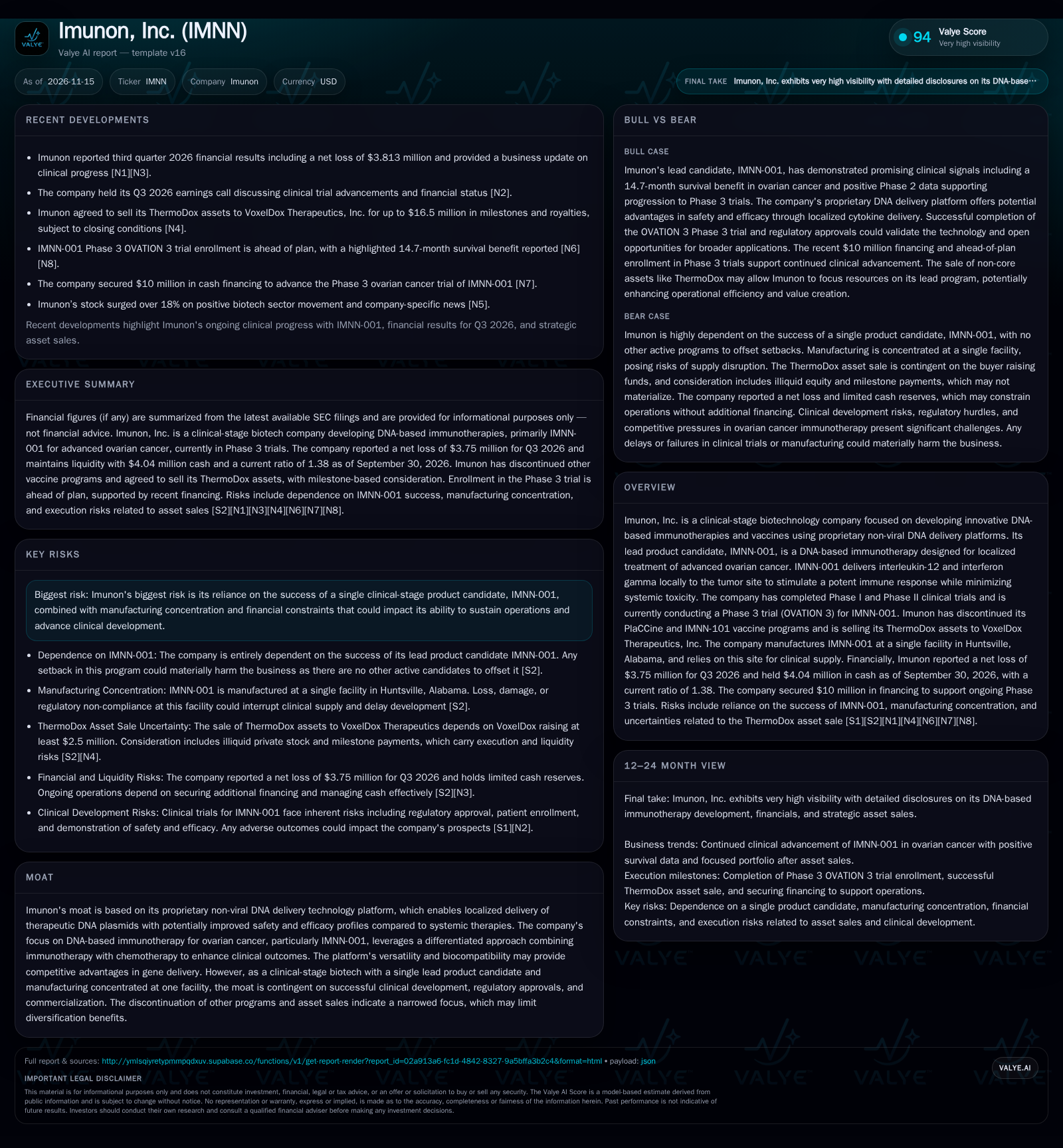
Imunon, Inc. is now a pure-play developer of DNA-based immunotherapy for ovarian cancer, with its fate tied to the late-stage development of IMNN-001. The company’s Q3 2026 net loss was $3.75 million, and it held $4.04 million in cash. The sale of ThermoDox assets could bring up to $16.5 million, but is contingent on buyer financing and milestone achievement. The OVATION 3 Phase 3 trial for IMNN-001 is ahead of schedule, with a 14.7-month survival benefit reported. Risks include single-product dependence, manufacturing concentration, and financial constraints. [S2] [N3] [N4] [N6] [N8]
Imunon, Inc. has repositioned itself as a single-asset, clinical-stage biotech, focusing all resources on the late-stage development of IMNN-001, a DNA-based immunotherapy for ovarian cancer. With discontinued vaccine programs and a divestiture of ThermoDox assets underway, the company’s value proposition is now directly linked to IMNN-001’s clinical and regulatory outcomes. This strategic narrowing brings sharper operational focus but amplifies risk: potential financial flexibility is limited, manufacturing is concentrated at one facility, and monetization of legacy assets is uncertain. The next inflection points will be driven by clinical data, execution on asset sales, and the company’s ability to secure additional funding if needed. [S2] [N4] [N6] [N8]
Where Imunon Stands: Focused Pipeline, Capital Constraints, and Asset Sale Uncertainty
Imunon is now a clinical-stage biotech with a single active program: IMNN-001, a DNA-based immunotherapy for advanced ovarian cancer, currently in Phase 3 (OVATION 3) trials. All other pipeline assets have been discontinued, and the PlaCCine and IMNN-101 vaccine programs are no longer being pursued. The company reported a net loss of $3.75 million for Q3 2026 and held $4.04 million in cash as of September 30, 2026, with a current ratio of 1.38. The only material non-dilutive funding event on the horizon is the sale of ThermoDox assets to VoxelDox, which could bring up to $16.5 million in milestones and royalties, but depends on VoxelDox’s ability to raise at least $2.5 million and future milestone achievement. Manufacturing for IMNN-001 is concentrated at a single FDA-regulated facility, a potential single point of failure for ongoing clinical supply. [S2] [N3] [N4]
How Value Could Be Created: IMNN-001 Economics and Resource Allocation
Imunon’s business model is now binary: success or failure depends on IMNN-001’s clinical and commercial trajectory. If IMNN-001 demonstrates a robust efficacy and safety profile in Phase 3, the company could unlock substantial value through out-licensing, partnership, or eventual commercialization. The economics of DNA-based immunotherapies may offer attractive gross margins if approved, as the localized delivery mechanism could reduce systemic toxicity and hospitalizations, potentially making reimbursement more straightforward compared to systemic immunotherapies. However, clinical manufacturing remains a fixed cost center, and current production is concentrated at a single facility, limiting operational flexibility.
With all other programs discontinued, Imunon’s fixed costs and R&D spending are now largely dedicated to IMNN-001. The company reported cash and liquidity metrics for the period; these figures do not by themselves establish operating runway, investment capacity, financial flexibility, or financing capacity. If IMNN-001 advances to market, commercial launch would require significant additional investment, and the company may not have the resources to self-commercialize without a partner.
Assessing Imunon’s Place in the Ovarian Cancer Immunotherapy Landscape
Imunon’s competitive case is built on its proprietary non-viral DNA delivery technology, designed to produce localized immune activation by instructing tumor cells to generate interleukin-12 and interferon gamma. This approach aims to enhance efficacy while minimizing systemic toxicity, a key challenge in cancer immunotherapy. If successful, this could differentiate IMNN-001 from other immunotherapies that rely on systemic cytokine delivery or checkpoint inhibition.
However, the ovarian cancer treatment landscape is crowded, with established standards such as chemotherapy, PARP inhibitors, and a growing number of immuno-oncology agents in development. Large biopharma competitors have greater resources, broad pipelines, and established commercial infrastructure. Imunon’s narrow focus and single-site manufacturing present both a nimble, focused innovation story and an acute vulnerability to setbacks in development, regulatory, or supply chain execution. The company’s ability to secure a commercial partner or acquirer may hinge on clear, compelling Phase 3 data that demonstrate a clinically meaningful survival benefit over existing standards of care.
What Unlocks Value: Superior Efficacy, De-Risked Asset Sale, and Capital Access
The most favorable outcome for Imunon is that IMNN-001’s Phase 3 OVATION 3 trial continues to show a strong survival benefit—building on the reported 14.7-month advantage—and delivers a clear, statistically significant improvement over chemotherapy alone. Positive pivotal results would attract potential partners or acquirers, enable non-dilutive capital raises, or accelerate regulatory pathways. The successful closing of the ThermoDox asset sale, with VoxelDox raising the required $2.5 million and subsequent milestone achievements, would provide much-needed cash runway, reducing financing risk.
Confirmation signals would include: (1) final OVATION 3 data showing robust efficacy and safety, (2) closing and initial proceeds from the ThermoDox sale, and (3) announcement of a partnership or non-dilutive financing tied to IMNN-001’s clinical momentum. Falsification would occur if OVATION 3 fails to meet endpoints, if the ThermoDox transaction falls through, or if the company is forced into dilutive financings on unfavorable terms.
Most Likely Trajectory: Clinical Progress, Liquidity Management, and Ongoing Uncertainty
The most plausible scenario is that Imunon continues to advance the OVATION 3 trial for IMNN-001, with enrollment proceeding ahead of plan and interim data updates providing incremental validation, but with final pivotal results still pending. The company manages its limited cash through cost discipline and potentially small bridge financings, while the ThermoDox asset sale remains in process but does not immediately deliver significant cash. Manufacturing remains uninterrupted, but the facility concentration risk persists.
In this scenario, the company remains a binary bet on IMNN-001 with ongoing execution risks but no catastrophic clinical or operational failure in the near term. Confirmation would come from continued progress in trial enrollment, timely reporting of interim data, and at least partial realization of asset sale proceeds. Falsification would involve a major trial delay, clinical hold, or operational disruption at the Huntsville facility.
How Things Could Go Wrong: Single-Asset Failure and the Limits of Potential Financial Flexibility
The negative scenario emerges if IMNN-001 fails to meet efficacy or safety endpoints in OVATION 3, or if unforeseen adverse events halt or delay the trial. In this case, with no other active pipeline programs, Imunon would face a collapse in value and an urgent need to restructure, liquidate, or pursue a reverse merger. Manufacturing disruption—whether due to regulatory issues, physical damage, or compliance failures—would similarly jeopardize the clinical program’s continuity.
If the ThermoDox asset sale falls through (for example, if VoxelDox cannot raise the required $2.5 million), Imunon would lose a key potential source of non-dilutive capital. Confirmation of this downside would be clinical setbacks, failure of the asset sale, or a material adverse event at the manufacturing facility.
Milestones That Will Shape Imunon’s Investment Case
Final or interim efficacy and safety data from the OVATION 3 Phase 3 trial of IMNN-001, particularly survival and progression-free endpoints.
Updates on the closing and initial proceeds from the ThermoDox asset sale, including whether VoxelDox successfully raises the required $2.5 million.
Quarterly cash burn trends and updated cash runway projections, especially if disclosed or discussed in future filings or calls.
Any announcement of a partnership, licensing agreement, or non-dilutive financing tied to IMNN-001 or the DNA immunotherapy platform.
Status of manufacturing operations at the Huntsville, Alabama facility, including any reported disruptions, regulatory inspections, or upgrades.
Changes in competitive landscape—e.g., new approvals or clinical data from rival ovarian cancer immunotherapies—that could affect market opportunity or standard of care.
Board or management changes, particularly those indicating a potential shift in strategy, capital allocation, or readiness for M&A.
Disclaimer: This is research-only, informational analysis and not investment advice. It may include AI-generated interpretation and general industry context. Always verify important details using primary sources.

Comments