
Bitwise Hyperliquid ETF: Profitability and Volatility in the Evolving Crypto ETF Arena
Bitwise Hyperliquid ETF has reported solid quarterly profits and captured investor attention as a liquid vehicle for cryptocurrency exposure, but faces shifting inflows and inherent market volatility. The challenge ahead is to sustain operational success in a sector shaped by unpredictable sentiment and regulatory flux.
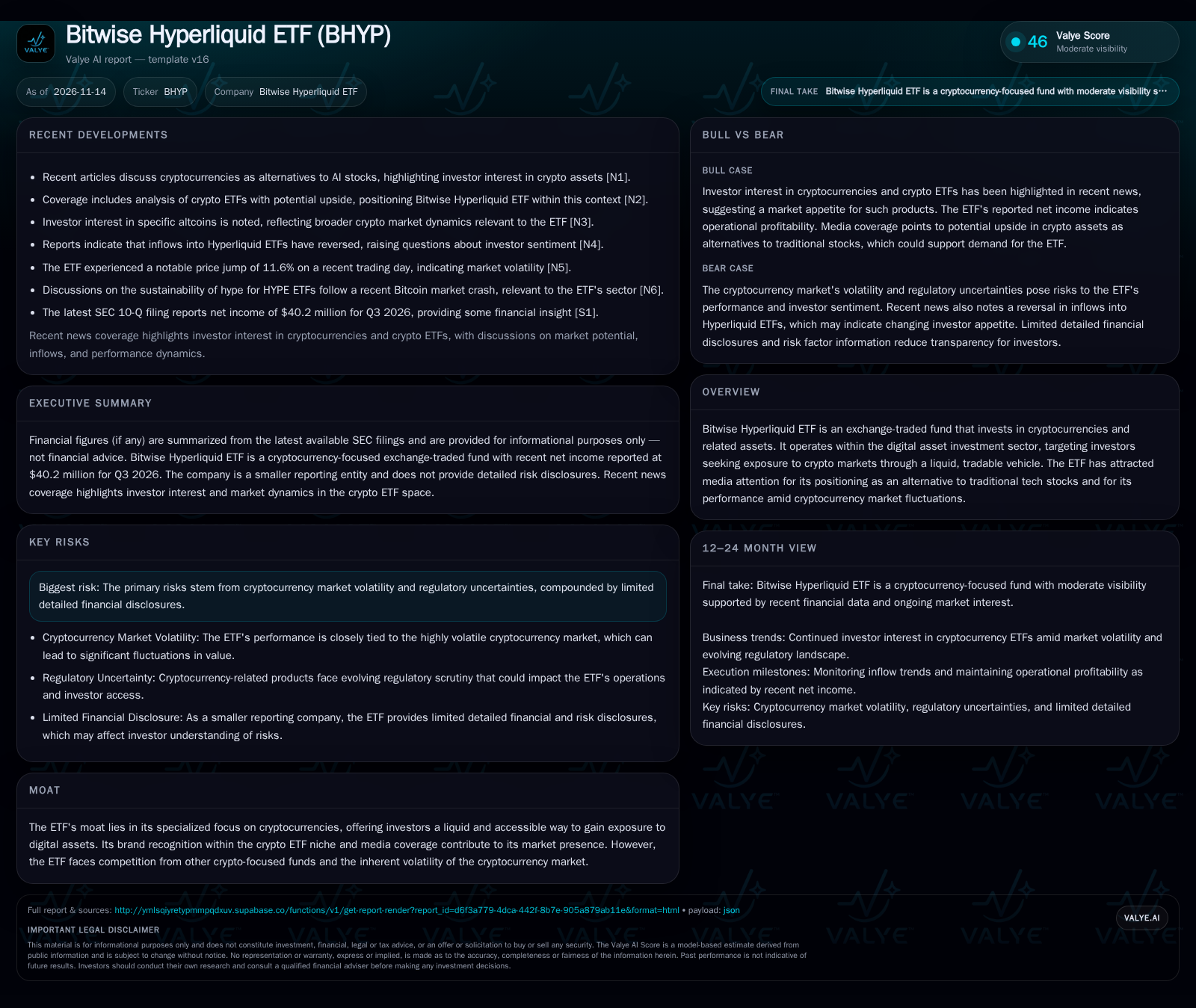
Bitwise Hyperliquid ETF posted $40.2 million in net income for Q3 2026, reflecting operational profitability in a volatile crypto market. Recent reversals in fund inflows and an 11.6% price jump highlight the ETF's sensitivity to investor sentiment and market swings. The fund's future will hinge on its ability to navigate persistent volatility, competitive pressures from other crypto ETFs, and evolving regulation.
Bitwise Hyperliquid ETF stands out as a profitable, high-profile player in the crypto ETF space, having reported $40.2 million in net income for the third quarter of 2026. Its appeal lies in offering liquid exposure to volatile digital assets, attracting both media coverage and investor flows. However, recent reversals in inflows and pronounced price swings reveal the ETF's vulnerability to rapidly changing market sentiment and regulatory uncertainty. The fund’s future performance will depend on its ability to maintain profitability and investor interest amid the evolving dynamics of the cryptocurrency sector.
Recent Profitability and Market Volatility Define Current Standing
Bitwise Hyperliquid ETF reported net income of $40.2 million for Q3 2026, providing clear evidence of operational profitability despite the inherent volatility of its underlying crypto assets [S1]. This profit figure is notable for a sector where rapid swings in asset prices can quickly erode capital. At the same time, the ETF has seen a reversal in inflows, as recent coverage suggests investors are becoming more cautious or reallocating capital elsewhere [N4]. The fund also experienced an 11.6% price surge on a single trading day, illustrating just how reactive the ETF is to shifts in market sentiment and crypto asset prices [N5]. These facts anchor the fund’s present reality: while it is capable of generating profits, it operates in a market where capital flows and valuations can change abruptly.
How the ETF Earns: Fee Structure, Volume, and Market Dynamics
Bitwise Hyperliquid ETF generates revenue primarily through management fees based on assets under management (AUM), a standard model for exchange-traded funds. The magnitude of these fees is directly tied to the fund’s AUM, which in turn is highly sensitive to both market performance and investor inflows/outflows. In periods of rising crypto prices and strong investor demand, AUM and thus fee income can expand rapidly. Conversely, reversals in inflows or sharp declines in underlying asset values can quickly compress the fee base.
Operating leverage in this model is significant: fixed costs (such as regulatory compliance, fund administration, and custody) are relatively stable, while incremental fee income from higher AUM typically drops to the bottom line. This dynamic can produce substantial earnings growth in bull markets but also exposes the fund to pronounced earnings contraction in downturns. The ETF’s capital needs are modest compared to operating companies, as it does not manufacture products or require significant physical infrastructure. However, the business is exposed to external shocks—regulatory actions, exchange outages, or custody failures—that could have outsized impacts on both AUM and investor confidence.
Positioning in a Crowded, Fast-Moving Crypto ETF Landscape
Bitwise Hyperliquid ETF’s central competitive advantage is its specialized focus on providing liquid, regulated access to cryptocurrencies—a service that appeals to investors reluctant to hold digital assets directly. Brand recognition, media coverage, and early-mover status in the crypto ETF category strengthen its market presence. However, the fund faces intense competition from other crypto-focused ETFs, index funds, and potentially from traditional asset managers expanding into digital assets. The low structural barriers to entry in ETF management mean that fee compression is a persistent risk, especially as larger players can leverage scale to undercut smaller funds.
Substitution risk is also meaningful: investors seeking crypto exposure can turn to direct ownership, futures-based products, or more diversified digital asset funds. Furthermore, any regulatory advantage is likely transient, as new entrants quickly adapt to evolving compliance standards. The ETF’s value proposition relies on maintaining liquidity, tight tracking of crypto asset prices, and minimizing tracking error versus benchmarks—areas where operational lapses could quickly erode its appeal.
If Crypto Sentiment Turns: Rapid AUM Growth and Margin Expansion
A favorable scenario would see renewed investor enthusiasm for cryptocurrencies—perhaps driven by a broad rally in crypto prices, positive regulatory developments, or increased mainstream adoption. In this environment, Bitwise Hyperliquid ETF could experience a surge in inflows, driving up AUM and boosting fee income. The ETF’s operating leverage would allow much of this incremental revenue to translate into higher net income, as fixed costs remain largely unchanged.
Confirmation would come from reported increases in AUM, a return to positive net inflows, and strong sequential growth in net income. Additional evidence might include tighter trading spreads, higher daily trading volumes, and persistent premium or minimal discount to net asset value, all signaling robust secondary market demand. Falsification would occur if, despite a broader crypto rally, the ETF failed to capture inflows or saw its fee base stagnate—suggesting brand or operational shortcomings.
Navigating Ongoing Volatility: Moderate Flows and Profit Fluctuations
The most plausible scenario is one of continued volatility in both crypto asset prices and investor sentiment. In this environment, Bitwise Hyperliquid ETF may see oscillating inflows and outflows, with net AUM and fee income fluctuating accordingly. While the fund’s Q3 2026 net income demonstrates profitability, these results may not be sustainable if inflows continue to reverse or if crypto prices remain range-bound or trend lower.
Evidence supporting this scenario would include continued news coverage of both inflows and outflows, modest changes in AUM quarter over quarter, and net income figures that vary but remain positive or only modestly negative. This outcome would reflect the ETF’s role as a proxy for crypto market sentiment—benefiting from periodic rallies but subject to sharp pullbacks. The scenario would be falsified if the ETF either broke out to sustained, outsized AUM growth (indicating a shift to the upside case) or experienced persistent, large net outflows and losses (moving toward the downside).
Adverse Outcomes: Persistent Outflows and Regulatory Headwinds
A negative turn could be triggered by a sustained decline in crypto prices, an extended period of negative headlines, or new regulatory restrictions on crypto ETFs or their underlying assets. In this scenario, Bitwise Hyperliquid ETF could suffer persistent net outflows, shrinking AUM and compressing fee income, potentially turning net income negative if fixed costs become a larger share of revenue.
This outcome would be confirmed by consecutive quarters of declining AUM, ongoing net outflows reported in fund disclosures (if available), and a reversal from profitability to operating losses. Additional warning signs would include a widening discount to net asset value, declining trading volumes, and any publicized regulatory actions that limit the fund’s ability to operate or restrict investor access. The scenario would be falsified if the ETF maintained or grew AUM despite adverse market headlines or managed to offset outflows with new product launches or operational efficiencies.
Milestones and Data Points That Will Shape Bitwise Hyperliquid ETF’s Next Chapter
Quarterly changes in assets under management (AUM) as reported in future filings will be crucial for gauging the fund's health and market share.
Net inflow and outflow figures, if disclosed, would help clarify whether the ETF is attracting or losing investor capital in real time.
Quarterly net income trends will indicate the sustainability of recent profitability and the degree of operating leverage.
Tracking the ETF’s market price premium or discount to net asset value (NAV) can reveal shifts in investor demand and liquidity.
Public regulatory developments affecting U.S. crypto ETFs will directly impact product viability and investor access.
Comparative fee levels and any announced changes in the ETF’s expense ratio could influence competitive positioning and retention.
Secondary market trading volumes and bid-ask spreads will serve as proxies for liquidity and retail/institutional engagement.
Material operational disclosures (e.g., custody arrangements, technology upgrades, or tracking error) would help test the ETF’s execution quality.
Disclaimer: This is research-only, informational analysis and not investment advice. It may include AI-generated interpretation and general industry context. Always verify important details using primary sources.

Comments