
Buda Juice: UltraFresh™ Ambitions, Cold Chain Complexity, and the Stakes of Scaling Beyond Texas
Buda Juice has carved out a niche in the ultra-fresh, cold-crafted juice segment, leveraging a proprietary cold chain and asset-light model for growth. As the company expands beyond its Texas base following its 2026 IPO, the challenge will be scaling operations, diversifying its customer base, and defending its freshness-focused brand against deep-pocketed competitors.
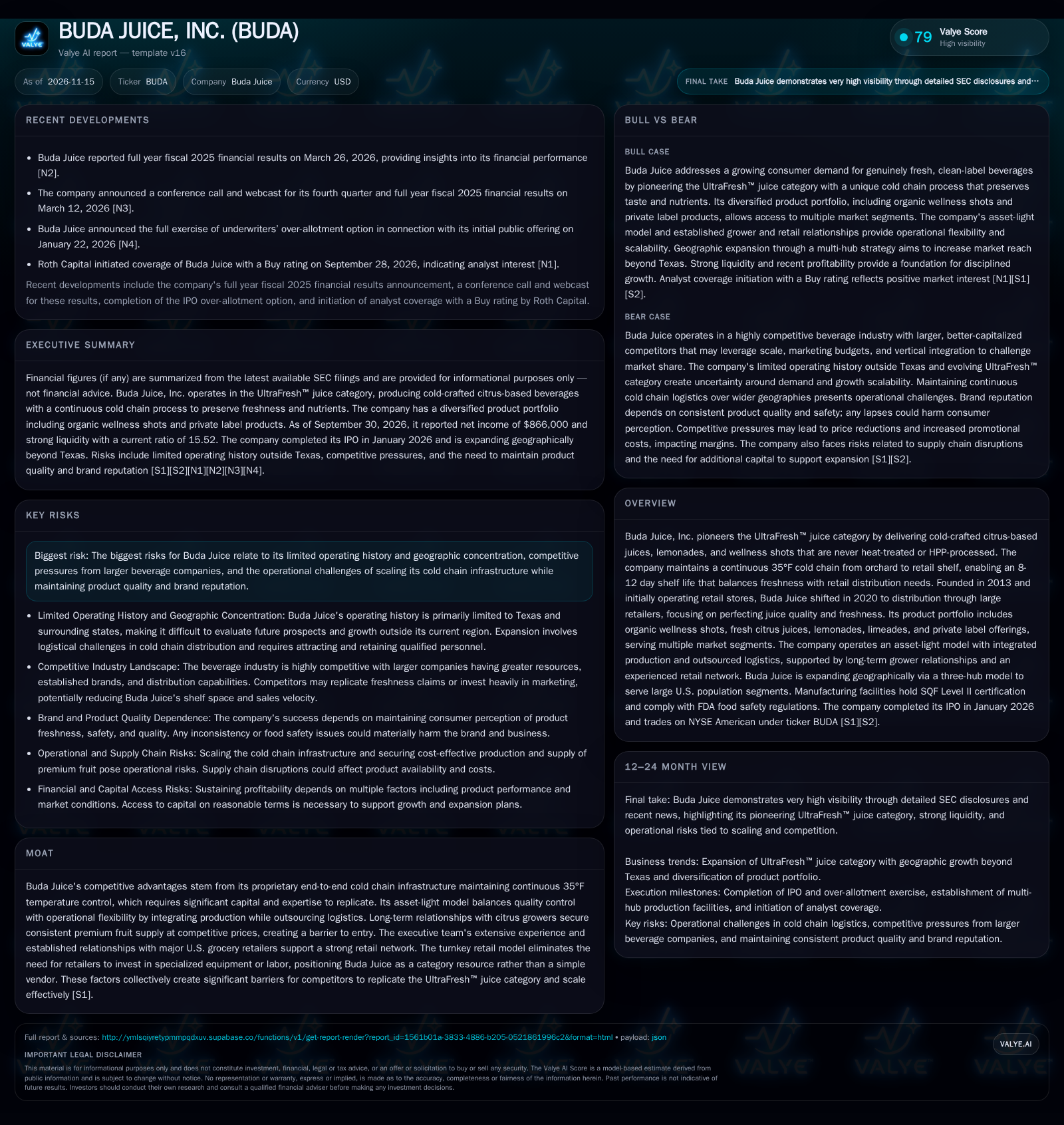
Buda Juice's UltraFresh™ juice model—featuring a strict cold chain and short shelf life—positions it as a premium player in fresh beverages. With reported liquidity position post-IPO and recent profitability, the company is pursuing geographic expansion beyond Texas. However, heavy reliance on a single customer, operational complexity in scaling the cold chain, and formidable competition from established beverage giants pose significant risks to the thesis [S1] [S2].
Buda Juice, Inc. is betting that consumers will continue to pay a premium for truly fresh, cold-crafted juices—delivered from orchard to shelf in a tightly controlled cold chain. Its UltraFresh™ positioning, asset-light operations, and recent profitability have enabled an initial public offering and geographic expansion plans. But as the company pushes beyond its Texas stronghold, outsized reliance on a single customer, the logistical demands of scaling fresh distribution, and the ever-present threat from beverage giants will test whether Buda’s differentiation can drive durable, profitable growth [S1] [S2].
Financial and Strategic Position Post-IPO: What’s Changed in 2026?
Buda Juice completed its IPO in January 2026 and now trades on the NYSE American under the ticker BUDA, marking a significant milestone for capital access and organizational maturity [S1]. As of September 30, 2026, the company reported $19.3 million in cash and equivalents, $22.6 million in current assets, and $1.46 million in current liabilities, resulting in a current ratio of 15.52 and a cash ratio of 13.24 [S2]. The company reported cash and liquidity metrics for the period; these figures do not by themselves establish operating runway, investment capacity, financial flexibility, or financing capacity.
For the quarter ended September 30, 2026, Buda Juice posted net income of $866,000 and basic/diluted EPS of $0.07, suggesting recent profitability at the operating level [S2]. However, a critical vulnerability is customer concentration: a single customer accounted for 97% of net sales in 2025, highlighting a major risk to revenue stability as the company seeks to diversify its base [S1].
The company’s strategic focus is now on expanding its UltraFresh™ juice offering beyond Texas and surrounding states, using a three-hub model to penetrate larger U.S. population centers [S1]. This geographic push is central to its growth thesis but introduces new operational challenges, especially given the cold chain’s complexity.
How the UltraFresh™ Model Shapes Buda Juice’s Economics
Buda Juice’s value proposition is rooted in freshness: cold-crafted, never heat-treated or HPP-processed juices delivered via a continuous 35°F cold chain. This allows for an 8–12 day shelf life—long enough for retail distribution but short enough to position the product as ultra-fresh [S1]. Pricing likely targets a premium segment, with product lines spanning organic wellness shots, citrus juices, lemonades, and private label offerings. The premium positioning may support higher gross margins, but the economics are sensitive to spoilage, logistics costs, and inventory write-downs given the short shelf life.
The company operates an asset-light model, integrating production but outsourcing logistics. This lowers fixed capital requirements and can enable faster scaling, but it also makes Buda Juice heavily dependent on third-party logistics partners for cold chain integrity [S1]. Operating leverage could be favorable if volumes scale without proportional increases in fixed costs, but margin volatility may rise if spoilage or logistics disruptions increase with geographic spread.
Customer concentration—where one account represented 97% of 2025 sales—limits pricing power and exposes the company to abrupt revenue swings if that relationship is disrupted [S1]. Expansion into new geographies and channels will be essential for long-term economic resilience.
Defending Differentiation: Can Cold Chain and Brand Hold Off Beverage Giants?
Buda Juice’s proprietary cold chain and UltraFresh™ positioning are its primary differentiators, creating a product that is difficult for shelf-stable or HPP-treated competitors to replicate. Achieving and maintaining SQF Level II certification and FDA compliance reinforces quality claims and could support premium pricing [S1].
However, the beverage industry is dominated by large, well-capitalized players—such as multinational juice brands and private label divisions of major grocery chains—that can invest heavily in marketing, innovation, and distribution [S1]. These competitors may attempt to emulate freshness claims or leverage their scale to undercut pricing and secure shelf space.
Switching costs for retailers are low unless Buda Juice’s turnkey cold chain model creates operational efficiencies or compliance benefits for grocers. The moat is therefore most durable if Buda can maintain both its quality reputation and exclusive supply/grower relationships while expanding its retail network.
A further competitive risk is that the UltraFresh™ category itself is still nascent; if consumer demand shifts or the freshness premium narrows, Buda’s differentiation could erode.
Freshness Wins: Scaling the Model and Diversifying Revenue Streams
In a favorable scenario, Buda Juice successfully leverages its IPO capital and reported liquidity position to establish additional regional hubs, allowing it to serve large urban centers while maintaining cold chain integrity. Investments in logistics partnerships and technology minimize spoilage and enable efficient distribution, even as the company expands beyond Texas.
If Buda can add new major retail accounts, reducing reliance on its largest customer, and drive velocity through multiple product lines—including wellness shots and private label deals—top-line growth could accelerate and margins could improve due to operating leverage. Consumer trends toward clean-label, minimally processed beverages would need to persist, supporting premium pricing and category expansion.
Confirmation would come from reported growth in the number of retail doors, declining customer concentration (e.g., no single customer representing more than 50% of sales), and gross margin improvement even as geographic footprint expands. Announcements of retail partnerships in new states or national chains would further validate the scenario.
Managing Growth and Complexity: Gradual Expansion with Operational Hurdles
The most plausible outcome is that Buda Juice achieves moderate growth as it pushes into new geographies, but faces the expected challenges of scaling cold chain logistics and diversifying its customer base. Spoilage and distribution costs may rise as the company learns to manage longer supply chains, offsetting some of the gains from new accounts.
Customer concentration likely improves but remains a material risk for several quarters. The company maintains profitability, but margin expansion is limited by promotional costs and the need to invest in quality control and compliance as the business grows. Supply disruptions or brief lapses in cold chain integrity could periodically impact results, but are contained through improved processes.
Evidence for this scenario would include steady, incremental increases in retail penetration, stable or slightly improving gross margins, and gradual reduction in the largest customer’s share of total sales. Profitability persists, but EPS and margin trends are uneven due to the volatility inherent in perishable product categories.
When Scale Becomes a Liability: Customer Loss, Quality Lapses, and Margin Compression
In an adverse scenario, Buda Juice fails to diversify its customer base quickly enough, and the loss or reduction of orders from its largest customer leads to a sharp revenue decline [S1]. As the company expands into new geographies, the complexity and cost of maintaining the cold chain increase disproportionately, resulting in higher spoilage, inventory write-downs, and eroded margins.
If a food safety incident or cold chain failure occurs, the brand’s reputation could suffer, leading to lost shelf space and lower consumer trust. Larger competitors may respond to Buda’s expansion with aggressive promotional campaigns or copycat products, squeezing Buda’s pricing power and shelf presence.
Confirmation of this scenario would include a sudden drop in revenue, negative gross margins, or a spike in spoilage/write-offs. News of a major customer loss, supply chain disruption, or publicized product recall would be strong negative signals.
Testing the UltraFresh™ Thesis: Metrics and Events That Will Signal Success or Trouble
Quarterly disclosure of customer concentration—particularly the percentage of sales from the largest customer—will be critical for assessing revenue diversification progress.
Gross margin trends, especially as the company expands into new states or regions, will indicate whether scale is driving efficiency or introducing margin risk.
Spoilage and inventory write-down rates (if disclosed) would provide insight into the operational effectiveness of the cold chain as geographic complexity increases.
Announcements of new retail partnerships, especially national or multi-state accounts, would validate the expansion thesis.
Any public disclosure of food safety incidents, recalls, or regulatory actions would be a significant negative for the brand and growth prospects.
Operating cash flow and net income trends, particularly post-expansion, will test whether the business model can sustain profitability at scale.
The pace and cost of establishing new distribution hubs or production facilities—relative to initial guidance—will reveal the true capital intensity of the UltraFresh™ model.
Analyst coverage updates and changes in institutional ownership could reflect evolving market confidence in Buda Juice’s long-term prospects.
Disclaimer: This is research-only, informational analysis and not investment advice. It may include AI-generated interpretation and general industry context. Always verify important details using primary sources.

Comments