
Alussa Energy Acquisition Corp. II: SPAC Execution Risks and Opportunity in the Energy Transition
As Alussa Energy Acquisition Corp. II approaches the midpoint of its SPAC lifecycle, the company faces a narrowing window to identify and consummate a business combination in the energy transition sector.
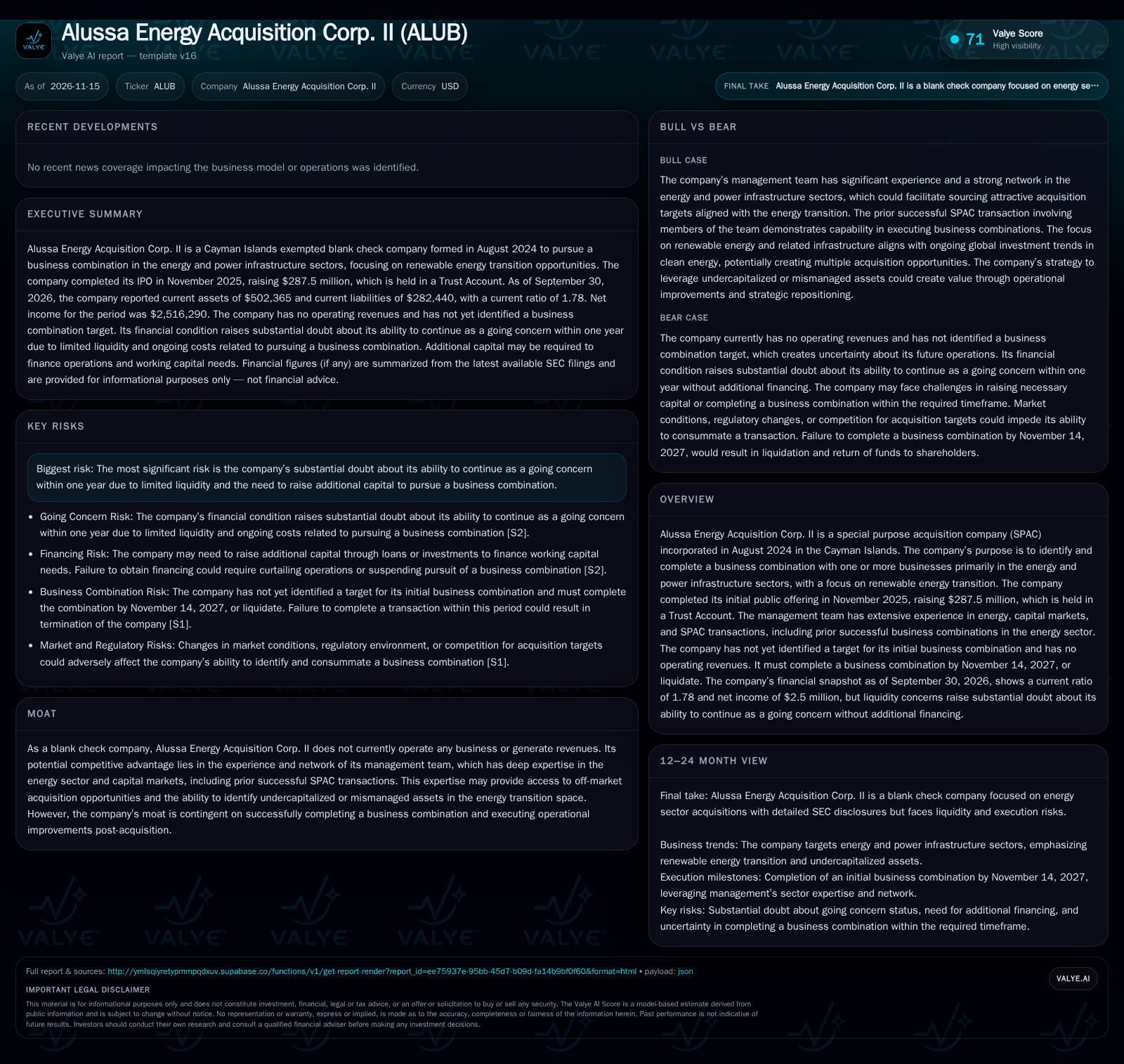
Alussa Energy Acquisition Corp. II is a blank check company with $287.5 million in trust, targeting energy and power infrastructure acquisitions—particularly in renewables. With no target identified and reported liquidity position for ongoing costs, the company’s ability to close a deal by November 2027 is in question. Management’s energy sector and SPAC experience may help source and execute a transaction, but the risk of liquidation or dilution from additional capital needs is rising as the SPAC clock ticks down. [S1] [S2]
Alussa Energy Acquisition Corp. II sits at a crossroads typical of midlife SPACs: flush with trust capital but under mounting pressure to secure a compelling deal before time runs out. With a mandate to pursue energy and power infrastructure assets—especially those aligned with the global push toward renewables—the company’s management brings sector-specific credibility and prior SPAC execution experience. Yet, with no acquisition target in hand, ongoing operating costs, and a flagged going-concern risk, the next twelve months will be pivotal in determining whether Alussa II can convert its structural and team advantages into a successful business combination—or face the prospect of forced liquidation and value return to shareholders. [S1] [S2]
Liquidity Pressures and the Ticking SPAC Clock
Alussa Energy Acquisition Corp. II has not identified a business combination target and reports no operating revenues, as is typical for a SPAC at this stage. The company raised $287.5 million in gross proceeds via its November 2025 IPO, with funds placed in a trust account, and completed a concurrent $2.5 million private placement of warrants. As of September 30, 2026, its balance sheet showed current assets of $502,365 and current liabilities of $282,440, yielding a current ratio of 1.78 but a cash ratio of 0. Importantly, the company’s auditors have raised substantial doubt about its ability to continue as a going concern within one year due to reported liquidity position and ongoing costs required to identify and close a business combination. Without additional capital, Alussa II risks curtailing operations or suspending deal pursuit. The company must complete a business combination by November 14, 2027, or liquidate and return funds to shareholders. [S1] [S2]
SPAC Business Model Mechanics and Economic Levers
As a SPAC, Alussa II’s economics hinge entirely on its ability to identify, negotiate, and close a value-accretive business combination before its deadline. The $287.5 million trust account is segregated and generally not available for operating expenses, which are funded from sponsor capital and any interest income. The core economic lever is the post-merger company’s valuation and the ability to raise PIPE (private investment in public equity) or other follow-on funding at favorable terms. If a deal is consummated, sponsor and founder shares can deliver substantial upside—often at significant dilution to public shareholders. The fixed costs during the pre-deal phase (legal, diligence, administrative) create operating leverage: the longer the search, the higher the dilution or capital-raising need for working capital. If no deal is reached, shareholders receive trust value back, minus limited allowable expenses, and sponsors lose their at-risk capital. The economics for public shareholders are thus strongly binary, hinging on deal quality and timing.
Sourcing Advantage or Commodity SPAC? Management’s Role in a Crowded Field
Alussa II’s potential competitive advantage lies in its management team, which brings prior SPAC execution and deep energy sector networks. The experience of having closed a previous SPAC transaction (Alussa I with T1 Energy) could help in identifying off-market or undercapitalized assets, especially in a sector where operational complexity can deter less specialized SPACs. However, the broader SPAC market is saturated, with numerous vehicles targeting energy transition and infrastructure deals. Competition extends to private equity, strategics, and infrastructure funds—many of which may offer more flexible capital or faster execution. Moreover, the market for high-quality renewable and energy transition assets is highly competitive and often bid up, compressing returns. Alussa II’s ability to win attractive deals may hinge on sector credibility, willingness to tackle operationally complex assets, and speed of execution as its deadline approaches.
When Sector Networks Yield a Proprietary, High-Return Transaction
The most favorable outcome for Alussa II is that its management team leverages its sector relationships and prior SPAC experience to source a proprietary or mispriced asset in the energy transition space. This could involve a renewable power project, energy storage platform, or grid infrastructure company overlooked by mainstream capital. If the team can execute diligence rapidly, negotiate favorable terms, and secure a PIPE or institutional anchor investors at attractive valuations, the merged entity could command premium public market multiples. Confirmation would come from a timely deal announcement, PIPE commitments at or above trust value, and minimal redemptions by public shareholders. Falsification would be a delayed deal process, inability to raise outside capital, or a transaction at heavy dilution to existing shareholders, indicating weak sourcing or negotiating leverage.
Most Likely Path: Deal Squeeze, Funding Hurdles, and Moderate Outcomes
The most plausible scenario is that Alussa II identifies a target in the next 6-12 months—likely in the energy transition or infrastructure space—but faces a competitive process, requiring concessions on valuation or terms. The company may need to raise additional working capital from sponsors or third parties to fund ongoing diligence and deal costs. A deal may be announced closer to the SPAC’s deadline, increasing the risk of high shareholder redemptions and greater dilution from any required PIPE financing. The resulting business combination may be value-neutral or only modestly accretive for public shareholders, with sponsor economics preserved but limited upside for those who do not redeem. Evidence for this scenario would include a late-stage deal announcement, PIPE pricing at or below trust value, and significant redemptions at merger close. A deviation would be a high-quality deal with oversubscribed PIPE and low redemptions, suggesting above-average execution.
Deal Failure, Forced Liquidation, or Highly Dilutive Rescue
Downside risks for Alussa II are rising as liquidity tightens and the SPAC clock winds down. If the management team is unable to source a credible target, or if market volatility, regulatory uncertainty, or sector-specific headwinds deter deal-making, the company may be forced to liquidate and return trust funds to shareholders—leaving sponsors with losses on at-risk capital and public shareholders with minimal or no returns above trust value. Alternatively, if working capital needs become acute, the company could pursue a highly dilutive financing (from sponsors or third parties) just to keep operations running, eroding potential upside even if a later deal is struck. Confirmation of downside would be further warnings about going concern status, failure to announce a deal within the next 6-9 months, or large, dilutive financings disclosed in SEC filings. Falsification would require clear evidence of a high-quality, fully financed deal announcement.
Milestones and Metrics That Will Determine Alussa II’s Fate
Announcement of a definitive agreement for a business combination, including details on target sector, valuation, and investor commitments.
PIPE (private investment in public equity) financing terms—size, pricing relative to trust value, and quality of institutional investors—if disclosed.
Shareholder redemption rates at the time of business combination close; high redemptions would signal weak deal reception.
Additional capital raises or loans from sponsors or third parties to fund working capital; a useful metric would be the size, terms, and dilution impact of such financings.
Updated auditor statements or SEC filings indicating continued or resolved going concern risk.
Timeline disclosures on the progress of deal sourcing or due diligence, especially as the November 2027 deadline approaches.
Sector trends or regulatory changes in the energy transition space that could affect the pool of viable targets or deal valuations.
Sponsor equity infusions or changes in sponsor commitment, which would help test management’s alignment and risk appetite.
Disclaimer: This is research-only, informational analysis and not investment advice. It may include AI-generated interpretation and general industry context. Always verify important details using primary sources.

Comments