
Bio Essence Corp: Post-Divestiture Realities, Outsourcing Risks, and Legal Uncertainty in Herbal Supplement OEM
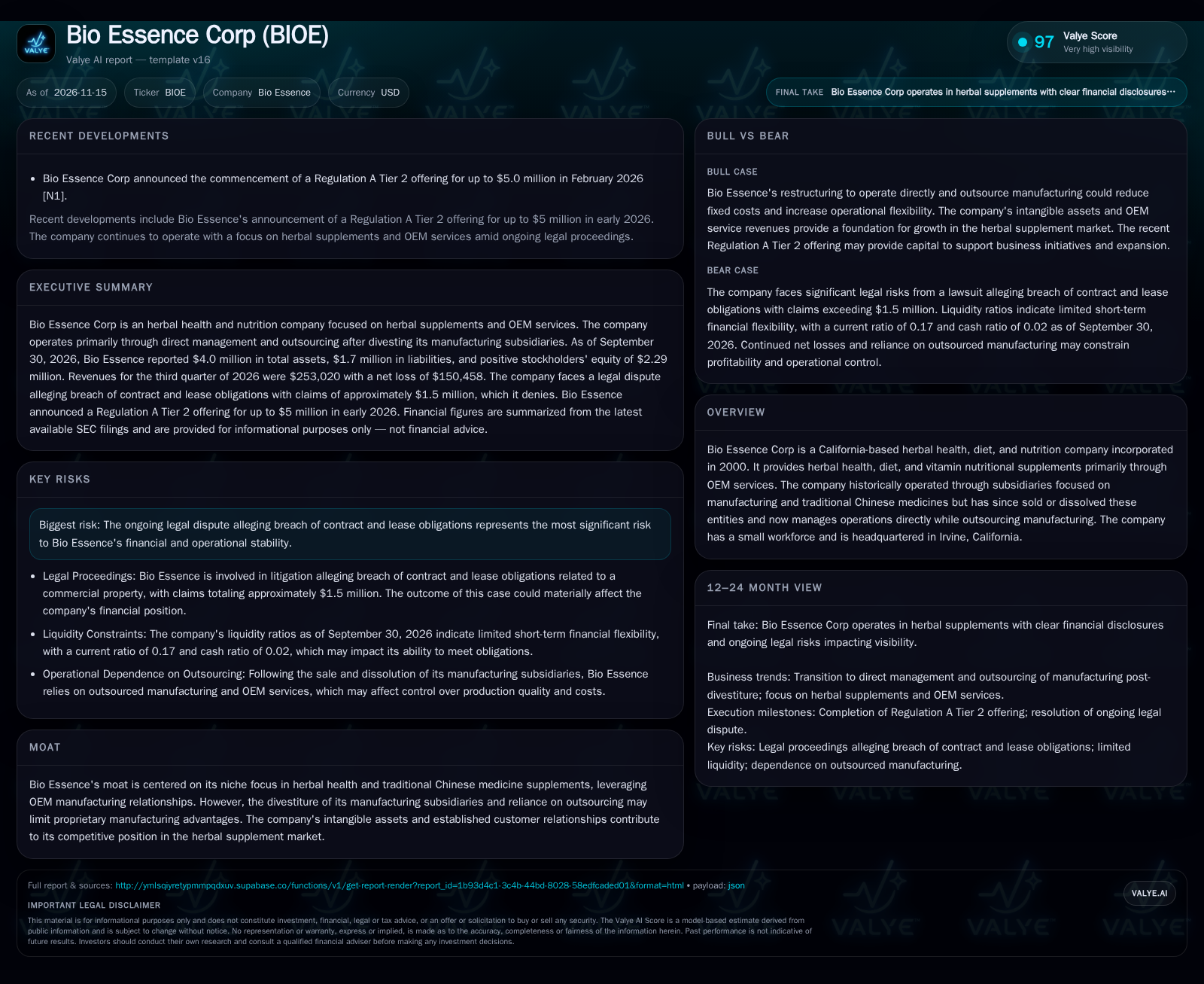
Bio Essence Corp shifted to a direct management and outsourcing model after divesting its manufacturing subsidiaries, generating Q3 2026 revenue of $253,020 mainly through OEM services.
Bio Essence Corp shifted to a direct management and outsourcing model after divesting its manufacturing subsidiaries, generating Q3 2026 revenue of $253,020 mainly through OEM services. The outcome of its $5 million Regulation A offering and litigation will likely determine its near-term strategic latitude and resilience in the competitive herbal supplement market. [S2]
Bio Essence Corp’s transformation from a vertically integrated herbal supplement company to a lean OEM-focused operator marks a pivotal shift in its business model. Following the divestiture of its manufacturing subsidiaries, Bio Essence now manages operations directly and outsources production—streamlining costs but reducing control over quality and supply chain. These factors combine to create a business with potential for adaptability but also heightened vulnerability to external shocks and margin pressures. [S2]
Recent Divestitures, Liquidity Pressures, and Legal Headwinds Define Bio Essence’s Position
Bio Essence Corp reported $253,020 in Q3 2026 revenue, primarily from OEM services following its strategic divestiture of manufacturing subsidiaries in 2023 and 2024. This operational pivot leaves the company with a lean workforce—just four full-time employees—and a direct management structure that relies heavily on outsourced manufacturing partners. As of September 30, 2026, the company’s balance sheet showed $4.0 million in total assets (with just $278,919 in current assets) against $1.7 million in total liabilities, resulting in a positive equity position of $2.29 million. The company is also embroiled in a legal dispute with claims totaling $1.5 million, which it disputes but which could have material consequences if resolved unfavorably. To address financial needs and strategic initiatives, a $5 million Regulation A Tier 2 equity offering was announced in early 2026, but its completion and impact remain to be seen. [S2]
OEM-Driven Revenue Model: Margin Arithmetic and Capital Needs in a Post-Subsidiary Structure
Bio Essence’s revenue now comes primarily from OEM (original equipment manufacturing) services, a business model characterized by lower fixed costs but also typically thinner gross margins compared to branded manufacturing. By outsourcing production, the company has reduced capital intensity—no longer needing to maintain manufacturing facilities or large inventories—but this also means it forgoes the operational leverage and margin expansion opportunities that come from scale manufacturing. The trade-off is a shift from fixed to variable costs, with profitability dependent on the ability to negotiate favorable terms with contract manufacturers and maintain reliable demand from OEM customers. With Q3 2026 net losses and limited working capital, Bio Essence’s ability to invest in product development, marketing, or customer acquisition is constrained unless the $5 million capital raise is successful. The company’s intangible assets may reflect brand value, formulations, or customer relationships, but monetizing these in a competitive OEM environment can be challenging without the resources to drive differentiation or secure recurring contracts.
The shift to an OEM-centric revenue model also introduces complexities in forecasting and managing cash flow. Since OEM contracts often involve variable order volumes and payment terms, Bio Essence faces potential volatility in revenue recognition and working capital needs. This variability can complicate budgeting and constrain the company’s ability to plan for investments in marketing or R&D, which are essential for maintaining competitiveness in the herbal supplement space. Furthermore, the reliance on third-party manufacturers heightens exposure to supply chain disruptions or cost escalations, which, if not effectively mitigated through contract terms or contingency planning, could erode already thin margins and strain liquidity.
Outsourcing as Double-Edged Sword: Niche Position, But Vulnerable to Cost and Quality Squeeze
Bio Essence occupies a niche in the herbal supplement market, leveraging OEM relationships to deliver private-label or contract-manufactured products. This focus allows for operational agility and lower overhead, but also exposes the company to intense competition from both specialized OEMs and vertically integrated supplement brands that retain more control over supply chain and quality. The divestiture of its own manufacturing arms removed a potential source of proprietary product differentiation and manufacturing cost advantage. In the current state, Bio Essence’s moat relies on intangible assets—potentially brand recognition or proprietary formulations—and established customer relationships. However, in an industry where product commoditization, regulatory scrutiny, and price sensitivity are common, outsourced operators can be particularly exposed to margin compression and customer churn if they cannot maintain cost competitiveness or reliably assure product quality. The company’s small scale and limited cash resources further limit bargaining power with suppliers and customers alike.
In addition to cost and quality risks, outsourcing can limit Bio Essence’s ability to innovate rapidly or customize products to meet evolving consumer preferences. Proprietary manufacturing capabilities often enable faster iteration of formulations or packaging, which can be critical in responding to regulatory changes or emerging market trends. Without direct control over production, Bio Essence may face longer lead times or reduced flexibility, which could hinder its ability to differentiate offerings or capitalize on niche opportunities. This dynamic underscores the importance of strong partnerships with contract manufacturers that share strategic alignment and prioritize quality assurance, as well as the need for robust supply chain governance mechanisms to safeguard brand reputation.
What Could Unlock Value: Successful Capital Raise, Legal Resolution, and OEM Expansion
Favorable resolution—or dismissal—of the $1.5 million legal claim would further remove a significant financial overhang. With new capital, Bio Essence may be able to negotiate better terms with manufacturers, expand its product portfolio, or pursue new customer segments, potentially increasing revenue and improving margins through greater scale. Evidence supporting this scenario would include a completed and fully subscribed offering, new customer wins or contract announcements, and a legal settlement or court decision in Bio Essence’s favor. Conversely, failure to raise sufficient capital or an adverse legal outcome would quickly undermine this upside trajectory.
If Bio Essence successfully leverages new capital to enhance its operational infrastructure, it could invest in building stronger contractual frameworks with OEM partners that include performance incentives, quality benchmarks, and cost controls. Such measures would help stabilize margins and reduce vulnerability to supplier-related disruptions. Additionally, expansion into adjacent product categories or geographic markets through OEM channels could diversify revenue streams and reduce customer concentration risk. The company might also explore strategic collaborations or licensing arrangements that leverage its intangible assets more effectively, thereby creating new revenue opportunities without significant capital expenditure. These initiatives would require disciplined execution and a clear focus on scalable, profitable growth.
Operating Under Constraint: Survival Dependent on Cost Discipline and External Outcomes
The most plausible near-term outcome is that Bio Essence continues to operate as a small-scale OEM provider, generating modest revenue but remaining constrained by reported liquidity position and ongoing legal uncertainty. The lack of internal manufacturing means the company will have to manage thin margins and may struggle to invest meaningfully in growth or differentiation. If the Regulation A offering is only partially subscribed, Bio Essence may be able to cover immediate liabilities but will face continued operational fragility. Resolution of the legal dispute—whether through settlement or extended litigation—will be a major determinant of financial stability. Confirmation of this scenario would include steady but unspectacular revenue, ongoing losses or break-even results, and a drawn-out legal process. Falsification would require either a rapid improvement in financial position or a dramatic adverse legal judgment.
Liquidity Crunch and Adverse Litigation: Pathways to Distress
Should Bio Essence fail to raise sufficient capital and lose the legal case, the combination of a $1.5 million liability and suboptimal liquidity ratios could trigger a severe liquidity crisis or even insolvency. The company’s reliance on outsourced manufacturing means it has little ability to cut costs further or generate emergency cash through asset sales. In this scenario, suppliers may tighten terms, customers may seek more stable partners, and the company could face operational disruptions, reputational damage, or forced restructuring. Signs of this downside would include missed payments, default notices, acceleration of legal claims, or a rapid decline in reported assets. Conversely, any evidence of debt restructuring, asset sales, or emergency bridge financing might temporarily stave off the worst outcomes but would signal distress.
Milestones That Will Define Bio Essence’s Post-Restructuring Trajectory
Completion rate and proceeds of the $5 million Regulation A Tier 2 offering—full subscription would materially improve liquidity; a shortfall would signal ongoing vulnerability.
Resolution or settlement terms of the $1.5 million legal dispute—an outcome in Bio Essence’s favor would clear a major overhang; an adverse judgment could destabilize finances.
Quarterly revenue trends and customer concentration—growth or diversification would indicate improved OEM traction; stagnation or loss of key customers would raise red flags.
Gross margin and operating loss progression—improvement would suggest successful cost management or pricing power; further deterioration would highlight structural challenges.
Supplier and manufacturing partner dynamics—any disclosed disruptions, cost increases, or quality issues would expose vulnerabilities in the outsourced model.
Working capital and current asset trends—declining balances or negative working capital would exacerbate short-term risk.
Disclosure of new OEM contracts, product launches, or strategic partnerships—would help test whether Bio Essence can expand beyond its current scale.
Disclaimer: This is research-only, informational analysis and not investment advice. It may include AI-generated interpretation and general industry context. Always verify important details using primary sources.

Comments