
Bitwise Solana Staking ETF: Staking Rewards, Record Inflows, and the Dynamics of Single-Asset Crypto Exposure
Bitwise Solana Staking ETF (BSOL) has rapidly established itself as a leading vehicle for Solana exposure, boasting over $1 billion in share proceeds and benefiting from a surge in investor inflows. Yet, the ETF’s performance is intricately tied to Solana’s price swings and the evolving landscape of crypto regulation and staking economics.
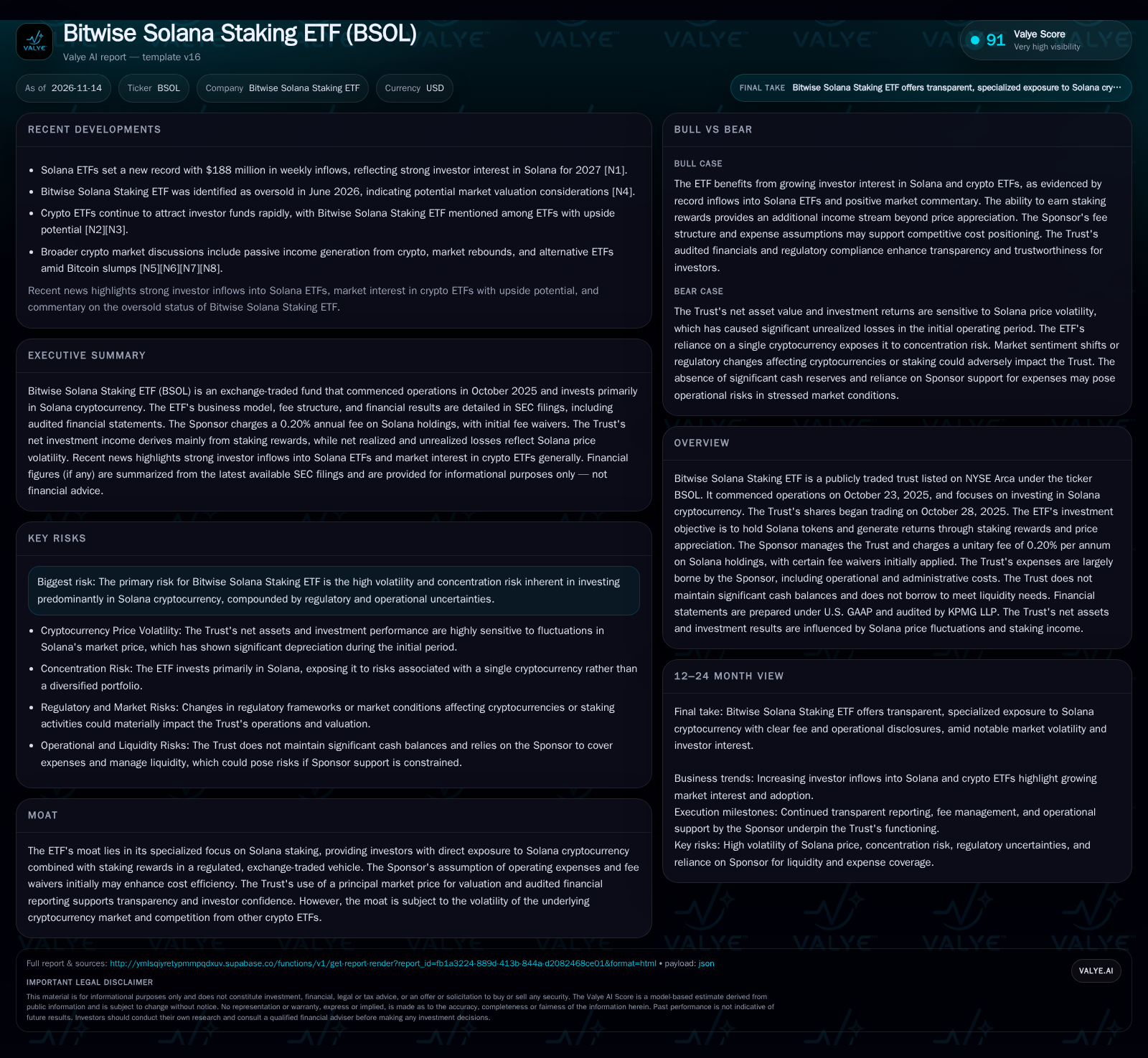
The Bitwise Solana Staking ETF offers investors regulated, exchange-traded access to Solana with added staking yield, drawing record inflows in late 2026. While its low-cost structure and sponsor-supported expenses improve near-term economics, the ETF remains highly sensitive to Solana price volatility, regulatory developments, and operational reliance on sponsor commitments.
Bitwise Solana Staking ETF (BSOL) has emerged as a high-profile entry point for investors seeking both direct Solana exposure and the incremental yield of staking rewards within a regulated ETF wrapper. With over $1 billion in proceeds from share sales and record-breaking inflows reported in late 2026, BSOL rides a wave of crypto ETF enthusiasm. However, the product’s fortunes are tightly bound to Solana’s price volatility, staking economics, and the durability of sponsor-backed cost structures. The coming quarters will test whether investor appetite and operational resilience can weather the inherent risks of single-asset crypto funds.
Surging Inflows and Early Performance: The Snapshot for BSOL
Bitwise Solana Staking ETF (BSOL) commenced operations in October 2025, quickly raising approximately $1.04 billion through the sale of 53.25 million shares by March 2026 [S1]. As of December 31, 2025, the Trust held 5.15 million Solana tokens valued at about $638,000, with net investment income of $6,009 primarily from staking rewards [S1]. However, the ETF also experienced a net realized loss of $2,803 and an unrealized depreciation of $209,749 due to Solana’s price decline from $191.41 to $123.86 per token in the initial period [S1]. By October 2026, Solana ETFs set a record for weekly inflows, drawing $188 million in a single week, underscoring robust investor demand for Solana-linked products [N1]. These facts highlight both the ETF’s rapid asset accumulation and the volatility-driven swings in its early results.
How BSOL’s Economics Are Shaped by Fees, Staking, and Crypto Volatility
BSOL’s revenue streams are fundamentally tied to two levers: the appreciation (or depreciation) of Solana tokens and the accrual of staking rewards. Staking provides an ongoing, though variable, yield that can help offset price declines and add to total returns—an important differentiator compared to traditional spot crypto ETFs. However, the ETF’s net asset value will still primarily track Solana’s market price, making returns highly sensitive to token volatility.
The ETF’s cost structure is anchored by a 0.20% annual unitary fee on Solana holdings, but the sponsor has waived this fee on the first $1 billion of assets through January 27, 2026 [S1]. Additionally, the sponsor covers normal operating expenses up to $500,000 annually, including custody, administration, and regulatory costs [S1]. This arrangement supports early cost competitiveness and could attract assets during the initial ramp, but exposes the fund to a step-function increase in expenses as waivers expire or if sponsor support wanes.
Given that the Trust does not borrow or maintain significant cash balances, liquidity is managed through creation/redemption activities and sponsor expense coverage [S1] [S2]. The company reported cash and liquidity metrics for the period; these figures do not by themselves establish operating runway, investment capacity, financial flexibility, or financing capacity. The ETF’s operating leverage is low; most expenses are fixed or sponsor-covered, so scale primarily affects sponsor economics rather than the ETF’s own cost base.
Evaluating BSOL’s Place in the Crypto ETF Landscape
BSOL’s core competitive proposition is regulated, exchange-traded access to Solana with embedded staking yield. This appeals to investors seeking exposure to Solana without the operational complexity of direct custody or staking management. Fee waivers and sponsor-covered expenses make BSOL cost-competitive versus both other Solana-linked vehicles and broader crypto ETFs in the near term.
However, the ETF faces several counterforces. Other single-asset crypto ETFs (e.g., those tracking Bitcoin or Ethereum) offer greater liquidity and brand recognition, while multi-asset or index-based crypto ETFs can provide diversification benefits that BSOL lacks. Direct ownership and staking through retail platforms also remain substitutes, especially if staking yields or custody solutions improve over time.
Barriers to entry for new crypto ETFs are declining as regulatory clarity improves, raising the risk of fee compression and product proliferation. The ETF’s moat rests on early scale, operational transparency, and the sponsor’s ability to maintain low costs and secure robust staking infrastructure. However, all of these advantages are contingent on the ongoing health and regulatory status of both Solana and the broader crypto ETF market.
What a Virtuous Cycle of Flows, Staking Rewards, and Price Appreciation Could Unlock
A favorable scenario for BSOL would see continued strong inflows—consistent with the $188 million weekly record in October 2026 [N1]—driven by rising investor demand for Solana exposure and staking yield. If Solana’s price rebounds or enters a sustained bull phase, the ETF’s net asset value could increase materially, magnifying both mark-to-market gains and the dollar value of staking rewards. Persistently high staking yields would further enhance total returns, potentially attracting even more inflows as the ETF’s performance stands out against both spot crypto and traditional asset classes.
This scenario would be confirmed by: (1) ongoing acceleration in net share creations and AUM growth, (2) a recovery or surge in Solana prices, (3) stable or rising staking yields, and (4) the extension or expansion of sponsor fee waivers. Evidence of the ETF gaining market share among crypto products, or being cited in additional bullish news coverage, would further support this thesis.
Single-Asset Volatility Balanced by Staking Yield and Cost Efficiencies
The most likely outcome is that BSOL delivers returns roughly in line with Solana’s price trajectory, with staking rewards providing a modest buffer against negative price movements. Investor inflows may remain solid but could moderate after the initial fee waiver period ends, especially if new competing products or changes in staking economics emerge. The ETF’s cost advantage may erode if sponsor support diminishes or as assets grow beyond the initial $1 billion threshold.
A base case would be confirmed by: (1) AUM stabilizing or growing at a slower pace post-fee-waiver, (2) staking yields remaining a small but steady portion of total returns, (3) Solana price volatility driving short-term swings in NAV, and (4) the ETF retaining a stable market share among Solana or single-asset crypto ETFs. Evidence that the sponsor continues to cover core expenses and maintain operational transparency would also support this scenario.
How Solana Price Shocks or Regulatory Actions Could Cascade Through BSOL
A negative scenario could unfold if Solana experiences a sharp or prolonged price decline, similar to the depreciation seen in late 2025 [S1], or if staking yields fall due to protocol changes or broader crypto market stress. In this context, the ETF’s net asset value would erode, potentially triggering outflows as investors seek to cut losses or rotate into diversified products. Regulatory interventions—such as restrictions on staking, ETF structures, or crypto custody—could further undermine BSOL’s economics or operational viability.
This scenario would be confirmed by: (1) a marked drop in Solana’s price and NAV per share, (2) declining staking rewards, (3) net redemptions and shrinking AUM, (4) negative or cautionary regulatory headlines, and (5) any curtailment of sponsor expense coverage or fee waivers. Increased tracking error, operational disruptions, or adverse audit findings would also reinforce downside risks.
Testing the Durability of the BSOL Thesis: What Investors Should Track
Net share creations/redemptions: Persistent inflows or sudden outflows would indicate shifts in investor sentiment and test the ETF’s resilience during market volatility.
Solana price movements: Since NAV tracks Solana directly, any major price swings will immediately impact returns and capital flows.
Staking yield rates: Monitoring the percentage yield from staking (if disclosed) would help assess the incremental income buffer against price declines.
Sponsor fee policy: Whether the 0.20% fee waiver is extended, modified, or allowed to expire will affect BSOL’s cost competitiveness.
Sponsor expense coverage: Continued assumption of operational expenses up to $500,000 annually is crucial; any change could alter the fund’s economics.
Regulatory developments: New SEC or CFTC guidance regarding crypto ETFs, staking, or custody arrangements could materially impact the business model.
Market share versus other Solana/crypto ETFs: Tracking AUM and trading volume relative to peers would indicate the ETF’s competitive position.
Audit and operational disclosures: Any changes in audit opinion, operational controls, or risk disclosures (if reported) would inform confidence in the ETF’s governance.
Disclaimer: This is research-only, informational analysis and not investment advice. It may include AI-generated interpretation and general industry context. Always verify important details using primary sources.

Comments