
Nektar Therapeutics: High-Stakes Pipeline Progress Amid Self-Funded Development and Industry Competition
Nektar Therapeutics now fully funds rezpegaldesleukin’s development after regaining rights from Eli Lilly, with multiple Phase 3 trials underway.
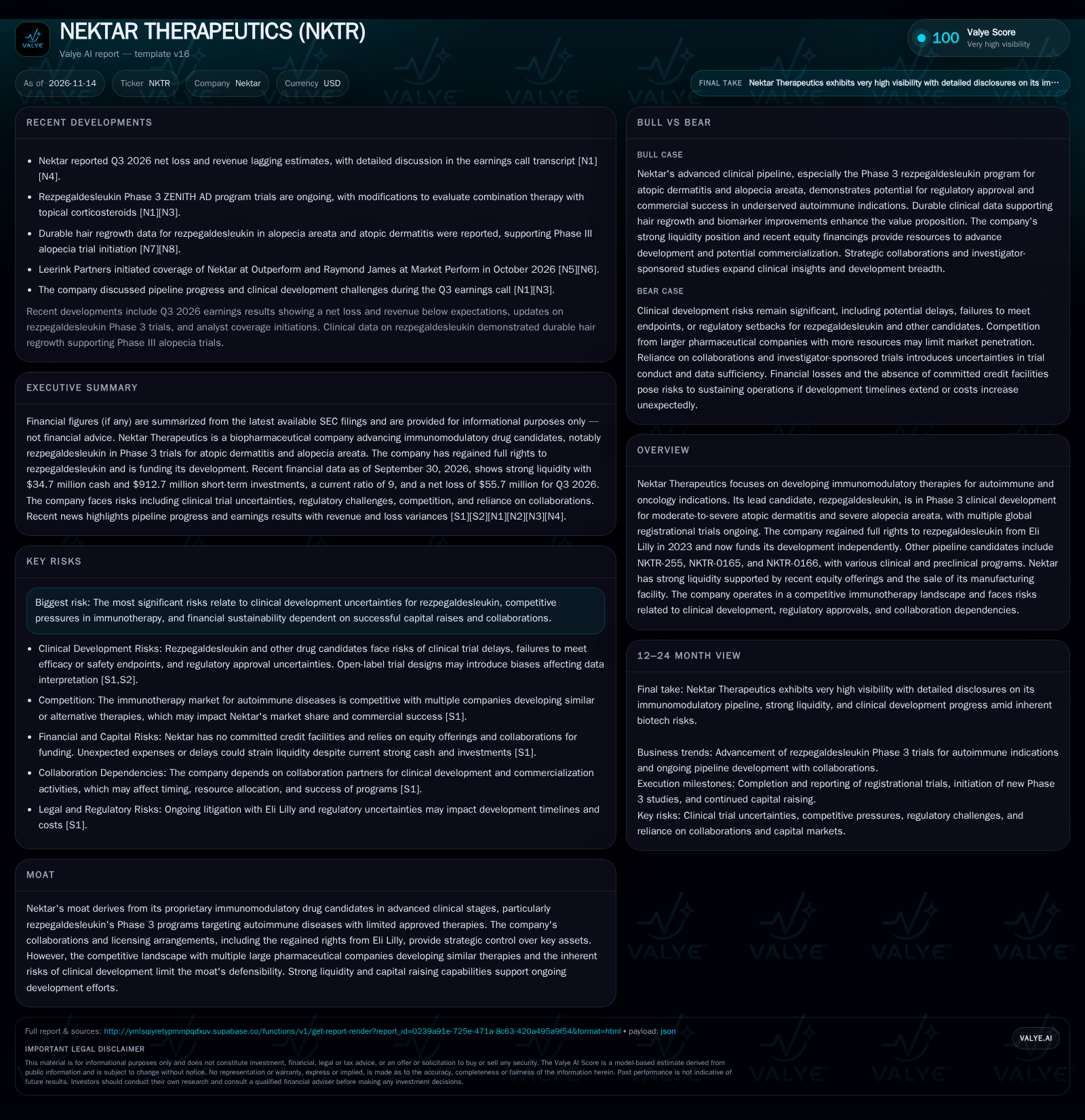
Nektar Therapeutics now fully funds rezpegaldesleukin’s development after regaining rights from Eli Lilly, with multiple Phase 3 trials underway. The company reports reported liquidity position—$34.7M in cash and $912.7M in short-term investments—but faces a Q3 2026 net loss of $55.7M and rising R&D expenses. Durable clinical data in alopecia and atopic dermatitis underpin pipeline value, but Nektar must manage trial, regulatory, and competitive risks as it relies on equity financing and collaborations for future funding. [S1] [S2] [N1] [N7] [N8]
Nektar Therapeutics is entering a decisive phase as it transitions from partnered to fully independent development of its lead immunomodulatory asset, rezpegaldesleukin, with multiple Phase 3 trials underway in atopic dermatitis and alopecia areata. As Nektar seeks to validate durable clinical benefits and carve out commercial opportunity in a highly competitive immunotherapy field, the next 12–24 months will test whether its pipeline and funding strategy can deliver sustainable value. [S1] [S2] [N1] [N7] [N8]
Major Pipeline Milestones, Liquidity, and Strategic Shifts Shape Nektar’s 2026 Position
As of November 2026, Nektar Therapeutics is advancing rezpegaldesleukin through multiple global Phase 3 trials for atopic dermatitis and alopecia areata, following the 2023 reacquisition of full development and commercialization rights from Eli Lilly. This strategic shift commits Nektar to self-fund all late-stage development, substantially increasing both its financial risk and potential reward. The company reported cash and liquidity metrics for the period; these figures do not by themselves establish operating runway, investment capacity, financial flexibility, or financing capacity. Durable clinical data in alopecia and atopic dermatitis, highlighted in 2026, are pivotal for underpinning the commercial potential of rezpegaldesleukin. Meanwhile, Nektar has no committed credit facility and must rely on equity offerings and collaborations to fund ongoing and future development. [S1] [S2] [N1] [N7] [N8]
The strategic decision to self-fund rezpegaldesleukin’s late-stage development places a premium on Nektar’s capital allocation efficiency and risk management capabilities. In a landscape where clinical trial costs can escalate unpredictably, the company’s ability to optimize trial design, patient recruitment, and operational execution will directly impact its financial runway. This dynamic underscores the importance of adaptive financial planning and the potential value of staged milestone-based collaborations to mitigate funding volatility.
How Self-Funded Late-Stage Drug Development Reshapes Nektar’s Economic Profile
Nektar’s business model is now highly leveraged to the clinical and commercial success of rezpegaldesleukin. With the loss of Eli Lilly as a partner, Nektar retains full economics—meaning all future sales (if approved) would accrue to Nektar, but so do all development costs and risks. The company’s cost structure is characterized by high fixed R&D expenses, especially during global Phase 3 trials, and relatively modest variable costs until commercialization. Operating leverage is substantial: if rezpegaldesleukin gains approval, Nektar could see a sharp inflection in margins as revenues scale with a relatively fixed cost base. However, until then, negative operating leverage dominates, as R&D and regulatory costs are incurred without offsetting commercial revenue.
Funding needs are substantial and ongoing. Revenue is contingent on successful regulatory approvals and market uptake, with pricing power and formulary access likely to depend on demonstrating meaningful clinical differentiation in crowded autoimmune and immuno-oncology segments.
The shift to a fully self-funded model also alters Nektar’s risk-return profile by concentrating financial exposure on a narrower set of clinical assets. While retaining full economic rights maximizes upside potential, it simultaneously increases vulnerability to clinical or regulatory failures. The company’s cost structure, heavily weighted toward fixed R&D expenses during pivotal trials, creates a scenario where incremental delays or additional trial requirements can disproportionately erode potential financial flexibility. Consequently, the timing of regulatory milestones and the ability to demonstrate clear clinical differentiation become critical inflection points that could either unlock scalable revenue streams or exacerbate cash burn without offsetting income.
Additionally, Nektar’s reliance on equity financing introduces dilution risk that must be managed against the backdrop of market conditions and investor sentiment toward immunotherapy developers. The company’s strategic choices around capital raises—such as timing, size, and pricing—will influence its cost of capital and shareholder value. If clinical data support a compelling value proposition, Nektar may secure more favorable financing terms or partnerships; conversely, ambiguous or delayed results could increase funding costs and pressure governance decisions. This interplay highlights the inherent tension in balancing aggressive development timelines with prudent financial stewardship.
Immunotherapy Market Competition and the Limits of Strategic Control
Nektar operates in a fiercely competitive field, with multiple large pharmaceutical companies and emerging biotechs developing immunomodulatory therapies for atopic dermatitis, alopecia areata, and related indications. While regaining full rights to rezpegaldesleukin gives Nektar greater strategic control and full downstream economics, it also removes the insulation and resources that a large partner provides. The company's ability to compete will rest on the clinical profile of rezpegaldesleukin (efficacy, safety, durability), speed to market, and commercial execution.
Potential substitutes include other biologics, JAK inhibitors, and emerging modalities targeting similar pathways. Larger competitors may have advantages in trial recruitment, regulatory navigation, and commercial reach. However, Nektar could carve out a defensible niche if rezpegaldesleukin demonstrates superior or differentiated outcomes—especially in patient subgroups underserved by existing therapies. Clinical data durability, real-world effectiveness, and the breadth of indications will be key to establishing and sustaining market share.
Competitive dynamics in immunotherapy extend beyond clinical efficacy to encompass regulatory strategy, payer negotiations, and post-market evidence generation. Larger pharmaceutical companies often leverage extensive commercial infrastructures and established payer relationships to accelerate market penetration and reimbursement. In contrast, Nektar’s relative resource constraints necessitate a focused approach to identifying patient subpopulations where rezpegaldesleukin’s clinical profile offers meaningful advantages. This could include targeting patients with refractory disease or those experiencing adverse effects from existing therapies, thereby creating a differentiated value proposition that could support premium pricing and formulary inclusion.
Moreover, the evolving regulatory environment for immunomodulatory agents introduces both opportunities and challenges. Accelerated approval pathways, conditional on post-marketing commitments, could provide earlier market access if Nektar can demonstrate surrogate endpoint efficacy. However, such pathways also require robust long-term data collection and risk management plans, which may strain resources. The company’s ability to anticipate and adapt to regulatory expectations, including real-world evidence requirements, will be instrumental in sustaining competitive positioning and avoiding costly delays or label restrictions.
Successful Phase 3 Outcomes Could Unlock a High-Value Immunomodulatory Franchise
If rezpegaldesleukin delivers positive Phase 3 outcomes in both atopic dermatitis and alopecia areata—replicating the durability and efficacy seen in recent clinical data—Nektar could rapidly transition from a development-stage to a revenue-generating company. This would enable the company to leverage its existing liquidity, reduce future dilution from equity raises, and potentially attract new strategic collaborators or acquirers. The upside scenario also includes the possibility of label expansion into additional autoimmune indications, leveraging platform synergies across the pipeline.
Evidence that would confirm this scenario includes consistent, statistically significant primary endpoint achievement in Phase 3 trials, robust safety/tolerability data, and early signs of commercial traction or partnership interest. Conversely, equivocal or negative trial results, or regulatory delays, would quickly falsify this upside.
Incremental Progress, Ongoing Losses, and the Need for Further Capital Define the Most Likely Trajectory
The most plausible path for Nektar over the next 12–24 months is one of incremental clinical progress, continued net losses, and ongoing reliance on capital markets. The company is likely to advance rezpegaldesleukin through at least one pivotal trial readout, with additional pipeline candidates (NKTR-255, NKTR-0165) providing optionality but not near-term revenue. R&D expenses will remain elevated, and the absence of a credit facility means that Nektar will probably need further equity offerings or new collaborations to maintain its development pace.
Confirmation of this scenario would include steady trial enrollment, continued liquidity above critical thresholds, and measured pipeline updates. Falsification would occur if major clinical setbacks or funding shortfalls force retrenchment, asset sales, or significant operational restructuring.
Clinical Setbacks or Financing Gaps Could Trigger Strategic Contraction or Asset Sales
The primary downside risk is a failure to achieve positive clinical outcomes in Phase 3 trials for rezpegaldesleukin, which would undermine the lead asset’s value and leave Nektar with a capital-intensive pipeline and limited near-term revenue prospects. Given the company’s lack of a committed credit facility, an unexpected increase in trial costs, regulatory delays, or inability to raise additional equity could precipitate a liquidity crunch.
Indicators confirming this scenario would include negative or inconclusive trial data, sharp increases in cash burn, unsuccessful capital raises, or announcements of asset divestitures/restructuring. Delays in pipeline progress or adverse regulatory developments would further compound downside risks.
Milestones and Metrics That Will Determine Whether Nektar Can Deliver on Its Immunotherapy Ambitions
Enrollment progress and primary endpoint results for the ZENITH AD-1, AD-2, AD-3, and AA-1 Phase 3 trials of rezpegaldesleukin. Timely, positive data would be the single most important catalyst. [S1]
Updates on the durability, safety, and real-world effectiveness of rezpegaldesleukin in both atopic dermatitis and alopecia areata, including long-term extension data if disclosed.
Level and trend of quarterly R&D expenses relative to cash and short-term investments—especially as Phase 3 trials progress and new programs advance. [S2]
Announcements of new strategic collaborations, partnerships, or licensing deals, which could provide non-dilutive funding or commercial leverage.
Evidence of additional equity offerings or other financing events, as further capital raises may be needed to sustain late-stage development. [S1]
Regulatory developments, including feedback from the FDA or EMA on trial design, endpoints, or data sufficiency for approval.
Progress on pipeline candidates NKTR-255, NKTR-0165, and NKTR-0166, including advancement to later-stage trials or new indications.
Disclaimer: This is research-only, informational analysis and not investment advice. It may include AI-generated interpretation and general industry context. Always verify important details using primary sources.

Comments