
THEGLOBE.COM, INC.: Shell Status, Funding Reliance, and the Reality of Reverse Merger Optionality
With no active operations, minimal liquidity, and ongoing dependence on Delfin Midstream for survival, THEGLOBE.COM, INC. embodies the risks and potential optionality of a public shell. The company’s future hinges entirely on external funding and the plausibility of serving as a vehicle for a future business combination.
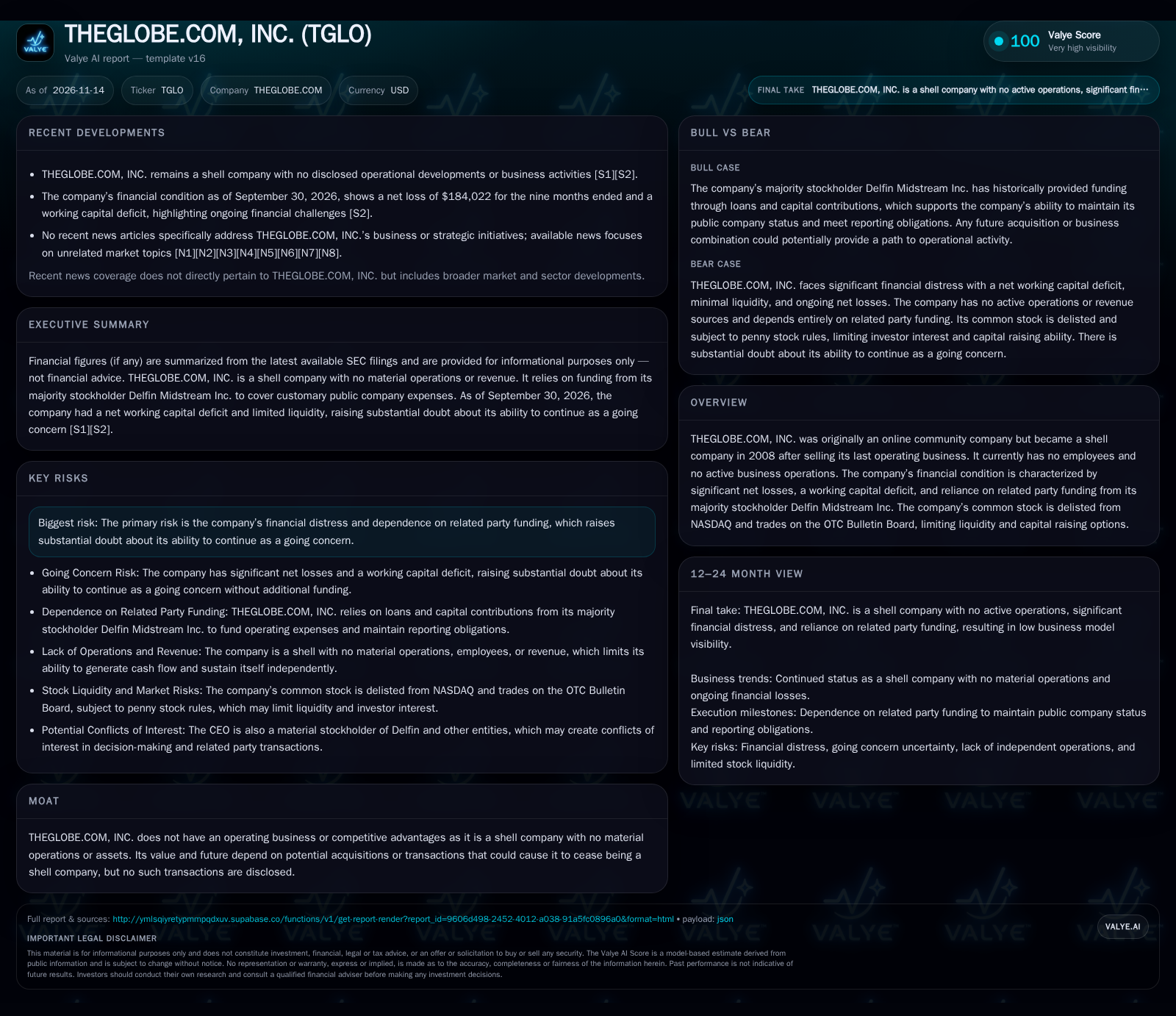
THEGLOBE.COM, INC. is a longstanding public shell with no operations, employees, or revenue, and a severe working capital deficit. Its survival depends solely on funding from majority owner Delfin Midstream, with substantial going concern risk. The only path to value creation is a prospective acquisition or business combination, but no such transaction is currently disclosed or underway. [S1] [S2]
THEGLOBE.COM, INC. With delisted shares now trading on the OTC Bulletin Board and subject to the strictures of penny stock regulation, the company’s capital-raising and operational flexibility are deeply compromised. Its only potential for future value lies in acting as a reverse merger vehicle or acquisition target, but no such process is currently underway. The present reality is one of persistent losses, reliance on related-party funding, and substantial going concern risk—a situation that will persist absent a transformative transaction. [S1] [S2]
No Operations, No Revenue: The Present Shell State of THEGLOBE.COM, INC.
THEGLOBE.COM, INC. has had no material operations since 2008, following the sale of its last business line. As of September 30, 2026, the company reported no employees, meaning even routine public company functions are managed on a minimal, part-time basis by its executive officer, who receives no compensation. The company reported a net loss of $184,022 for the first nine months of 2026 and ended the quarter with a working capital deficit of $1.7 million and only $21,664 in cash. Its current and cash ratios are both 0.01, reflecting a severe shortfall in liquidity. With its shares delisted from NASDAQ and now trading OTC under penny stock rules, the company’s access to outside capital is severely constrained. [S1] [S2]
Public Shell Economics: Survival Mechanics and the Cost of Inactivity
THEGLOBE.COM, INC.'s economics are defined not by revenue generation or margin expansion, but by the minimal costs required to maintain public company status. Recurring expenses are limited to legal, audit, and administrative fees, with no investment in growth or operations. There is no customer base, product, or service—thus, no pricing or volume levers to pull. Instead, the company’s only inflows are loans or capital contributions from its majority stockholder, Delfin Midstream. This creates a recurring cycle: funding received covers expenses, but the absence of any revenue or asset base means net losses accumulate and the working capital deficit grows. Any attempt to revive operations or pursue a business combination would likely require significant external capital, and could result in substantial dilution to existing shareholders. The company has no access to credit facilities, so its funding needs are met solely at the discretion of Delfin or affiliates. [S1] [S2]
No Moat, No Market: The Structural Limitations of a Public Shell
As a shell company with no operations, THEGLOBE.COM, INC. has no competitive advantages or defensible market position. It does not compete for customers, revenue, or market share in any industry. The only 'asset' is its public company status, which could have value to a private business seeking a reverse merger or public listing without the expense and regulatory scrutiny of an IPO. However, numerous other public shells exist, and regulatory scrutiny of reverse mergers has increased in recent years, making this path less attractive. Additionally, the company’s working capital deficit, penny stock status, and dependence on a single funder could deter potential partners or acquirers. The CEO’s overlapping interests with Delfin and other entities may further complicate any transaction, creating potential conflicts of interest. [S1] [S2]
Acquisition Event or Reverse Merger: The Only Plausible Path to Value Creation
The most optimistic scenario for THEGLOBE.COM, INC. is that it becomes the vehicle for a reverse merger or acquisition, allowing a private company to gain a public listing. In such a transaction, the shell could be recapitalized, and the surviving entity could inject new assets, operations, and management. For existing shareholders, this could result in a significant—if highly speculative—appreciation in share value, especially if the incoming business has credible growth prospects. Confirmation of this scenario would require concrete public disclosures: a letter of intent, term sheet, or definitive agreement with an acquisition target; regulatory filings outlining the terms of the transaction; and evidence that Delfin is willing to fund the transition or facilitate new capital raising. The absence of any such disclosures as of November 2026 means this remains a theoretical possibility, not an imminent outcome. [S1] [S2]
Continued Inactivity and Funding Reliance Define the Most Likely Outcome
Absent a merger or acquisition, the most probable scenario is indefinite continuation as a dormant public shell, funded at the bare minimum by Delfin Midstream. The company will likely continue to incur routine public company expenses, covered by related-party loans or contributions, with net losses accumulating and the working capital deficit worsening over time. No revenue-generating activities are expected, and the stock will remain illiquid and subject to penny stock rules. Any change in the willingness or ability of Delfin to provide ongoing support would immediately threaten the company’s ability to meet reporting requirements and could precipitate a voluntary or involuntary liquidation. Evidence confirming this scenario includes continued absence of operational announcements, no new business combinations or capital-raising events, and ongoing reliance on Delfin for funding. [S1] [S2]
Funding Withdrawal or Regulatory Action Could Force Liquidation
The primary downside risk is that Delfin Midstream ceases to provide financial support, whether due to its own capital constraints, strategic priorities, or a breakdown in the relationship. Without access to credit or other funding sources, THEGLOBE.COM, INC. would be unable to pay legal, audit, or administrative costs, likely resulting in missed SEC filings and loss of public company status. This could force a wind-down or receivership, with little or no recovery for shareholders given the absence of assets. Alternatively, regulatory scrutiny or enforcement action could arise if the company fails to meet periodic reporting or disclosure obligations. Confirmation of this scenario would include public disclosure of Delfin’s intent to withdraw support, missed regulatory filings, or initiation of bankruptcy or liquidation proceedings. [S1] [S2]
Testing the Shell Thesis: What Would Signal Change or Imminent Risk for THEGLOBE.COM, INC.?
Disclosure of any letter of intent, term sheet, or agreement for a merger, acquisition, or business combination would be a pivotal indicator for potential value realization.
Updates on the willingness and ability of Delfin Midstream to continue providing funding or capital contributions—especially if disclosed in filings—would clarify the company’s immediate survival prospects.
Evidence of new capital-raising initiatives or access to third-party funding would suggest a possible shift in strategy or renewed business activity.
Material changes to the company’s board or management structure, particularly appointments of executives with operational backgrounds, could signal preparatory steps toward a transaction.
Any new or increased regulatory scrutiny, missed SEC filing deadlines, or going concern audit opinions would be early warning signs of heightened risk.
Disclosure of negotiations with creditors or initiation of restructuring or liquidation processes would confirm downside scenarios.
A useful metric would be any disclosure of negotiations with potential acquisition or merger partners, even if preliminary.
Announcements regarding changes to the company’s share structure, such as reverse splits or recapitalizations, could indicate preparation for a business combination or capital raise.
Disclaimer: This is research-only, informational analysis and not investment advice. It may include AI-generated interpretation and general industry context. Always verify important details using primary sources.

Comments