
Bolt Biotherapeutics: Pipeline Expansion, Funding Infusion, and the Stakes of Oncology Development
Bolt Biotherapeutics has reshaped its risk/reward profile through a major acquisition, a substantial $120 million capital raise, and a sharpened focus on advancing its oncology pipeline. The company's future now hinges on clinical milestones, disciplined expense management, and the ability to translate scientific progress into sustainable value amid the perennial uncertainties of early-stage biopharma.
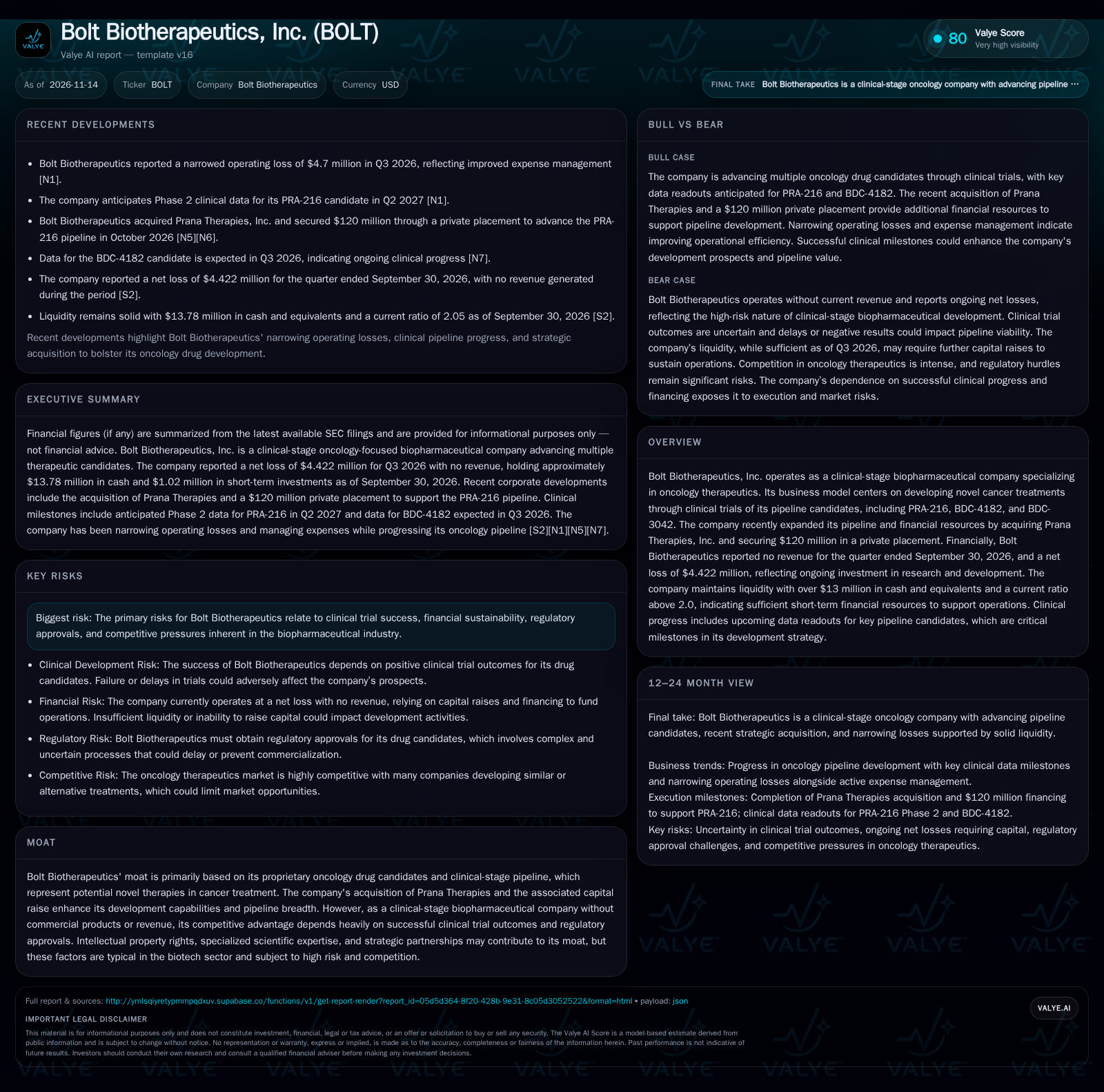
Bolt Biotherapeutics operates as a clinical-stage oncology company with no current revenue, a narrowing net loss, and a $120 million private placement supporting its expanded pipeline following the Prana Therapies acquisition. Upcoming clinical readouts for PRA-216 and BDC-4182 are critical to validating its development strategy and determining future capital needs. The company's fate is tightly linked to clinical success and its ability to manage cash burn in a competitive, high-risk sector. [S2] [N1] [N5] [N6] [N7]
Bolt Biotherapeutics stands at a strategic inflection point after acquiring Prana Therapies and securing a $120 million private placement to accelerate its oncology pipeline. With zero revenue and ongoing net losses, the company’s immediate future is defined by its ability to deliver on key clinical milestones for PRA-216 and BDC-4182, manage cash burn, and ultimately demonstrate that its scientific advances can be translated into marketable therapies. The next twelve to twenty-four months are likely to be dominated by data readouts, capital discipline, and the ongoing quest for validation in a crowded and high-stakes oncology landscape. [S2] [N1] [N5] [N6] [N7]
Recent Acquisition, Capital Raise, and Narrowing Losses Define Bolt’s 2026 Position
Bolt Biotherapeutics recently acquired Prana Therapies, Inc. and secured $120 million in a private placement to advance its lead pipeline asset, PRA-216. These transactions materially expand the company’s pipeline and provide a near-term funding cushion. As of September 30, 2026, Bolt reported no revenue, a net loss of $4.422 million, and a narrowing operating loss of $4.7 million for Q3, reflecting improved expense management. The company held $13.78 million in cash and $1.02 million in short-term investments, with a current ratio of 2.05. Upcoming clinical milestones include Phase 2 data for PRA-216 expected in Q2 2027 and BDC-4182 data in Q3 2026. These developments collectively shift the company’s risk profile and set the stage for the next phase of value creation or risk crystallization. [S2] [N1] [N5] [N6] [N7]
Clinical-Stage Economics: Cash Burn, Milestones, and the Path to Value
Bolt’s business model is typical of clinical-stage biotech: heavy upfront investment in R&D with no commercial revenue until successful clinical and regulatory milestones are met. The company’s cash burn is driven by trial costs, personnel, and pipeline expansion, partially offset by recent expense management. Fixed costs include core scientific staff and infrastructure, while variable expenses rise with trial activity and pipeline breadth. The $120 million private placement provides a temporary buffer, but future funding needs will be dictated by trial outcomes and the pace of development. If clinical data are positive, Bolt could seek non-dilutive funding through partnerships or out-licensing; negative or delayed results would likely force further capital raises or pipeline reprioritization. Operating leverage is inherently limited until commercialization, with value inflection points tied to clinical readouts and, ultimately, the ability to attract partners or acquirers.
The interplay between clinical milestones and capital availability is a critical determinant of Bolt’s strategic flexibility. Given the high fixed costs associated with maintaining specialized scientific teams and regulatory compliance infrastructure, any delays in trial progression can disproportionately increase cash burn relative to operational output. Conversely, accelerated enrollment or positive interim data could justify incremental investment to expand patient cohorts or explore combination therapies, potentially increasing near-term expenses but enhancing long-term value. This dynamic underscores the importance of adaptive budgeting and scenario planning, where management must balance aggressive development with prudent capital stewardship to avoid overextension or premature dilution.
Assessing Bolt’s Prospects in an Intensely Competitive Oncology Landscape
Bolt’s core differentiation hinges on the novelty and efficacy of its pipeline assets, particularly PRA-216 and BDC-4182. The oncology therapeutics sector is crowded with both large pharmaceutical incumbents and other innovative biotechs pursuing similar mechanisms or alternative modalities. Intellectual property and first-mover advantage matter, but the ultimate competitive moat depends on clinical differentiation—improved efficacy, safety, or targeting in comparison to standard of care and competing experimental agents. Switching frictions are low at the pre-commercial stage, but could rise if Bolt’s candidates show compelling clinical benefit in defined patient populations. Competitive pressure is further heightened by the ongoing pace of innovation, regulatory hurdles, and the likelihood that any scientific advance will quickly attract both partnership interest and rival development efforts.
In addition to clinical differentiation, Bolt’s competitive positioning will depend on its ability to navigate regulatory complexities and reimbursement landscapes. Oncology therapeutics face stringent approval criteria, and demonstrating a favorable risk-benefit profile is necessary but insufficient without considering payer acceptance. The development of companion diagnostics or biomarker-driven patient selection strategies could enhance Bolt’s value proposition by targeting therapies to populations most likely to benefit, thereby improving trial outcomes and market uptake. However, such strategies require additional investment and regulatory coordination, introducing further operational complexity and execution risk.
Furthermore, the speed of innovation in oncology necessitates continuous pipeline evolution. Bolt must monitor emerging science and competitor pipelines to anticipate potential obsolescence or the need for combination approaches. Strategic agility—manifested through selective in-licensing, collaborations, or internal research—can mitigate risks associated with single-asset dependency. Yet, expanding the pipeline also escalates resource demands and may dilute management focus. Thus, the company’s ability to prioritize assets based on rigorous scientific and commercial criteria will be a key determinant of sustained competitiveness in a rapidly evolving therapeutic area.
Breakthrough Clinical Data Catalyzes Partnering and Pipeline Monetization
The most favorable scenario for Bolt is that PRA-216 and/or BDC-4182 deliver strong, differentiated efficacy and safety data in their upcoming clinical readouts. This would validate the scientific platform, increase the probability of regulatory advancement, and potentially attract licensing or co-development partnerships with larger pharmaceutical companies—unlocking non-dilutive funding and accelerating commercialization. Confirmation of this scenario would require not only positive headline results but also evidence of clear clinical benefit in patient subgroups, manageable toxicity, and regulatory dialogue progressing as planned. Early partnering discussions, milestone payments, or upfront licensing deals would further support the upside case. Falsification would come from disappointing efficacy, safety signals, or muted external interest even after data release.
Clinical Progress with Cautious Capital Management, but Uncertainty Remains
The most plausible outcome is that Bolt achieves some degree of clinical progress—such as meeting safety endpoints or demonstrating preliminary efficacy in at least one lead candidate—while continuing to manage expenses and cash burn. In this scenario, the company maintains reported liquidity position through 2027, but faces ongoing uncertainty regarding the ultimate commercial potential of its assets. Validation would come from successful completion of Phase 2 for PRA-216 and positive BDC-4182 data, accompanied by further narrowing of operating losses. However, the lack of near-term revenue and the possibility of only incremental clinical progress mean that Bolt may need to pursue additional funding before reaching commercial inflection points. Falsification would be indicated by trial delays, ambiguous data, or a rapid re-acceleration of cash burn.
Negative or Delayed Clinical Outcomes Force Strategic Retrenchment
In the adverse scenario, one or both of Bolt’s lead candidates fail to meet key clinical endpoints, encounter unexpected safety issues, or experience significant development delays. The absence of positive data would undermine the company’s ability to attract partners or additional capital on favorable terms, increasing the risk of dilution or pipeline downsizing. In this outcome, Bolt could be forced to halt or reprioritize programs, reduce headcount, or seek strategic alternatives under duress. Confirmation of this scenario would include negative or ambiguous clinical results, missed data readout timelines, accelerated cash burn, and difficulty raising new funds. Falsification would require clear evidence of clinical success or a meaningful partnership despite setbacks.
Milestones and Metrics That Will Define Bolt Biotherapeutics’ Trajectory
Actual clinical trial results for PRA-216 (Phase 2, expected Q2 2027) and BDC-4182 (expected Q3 2026), including efficacy, safety, and regulatory feedback.
Cash burn rate in subsequent quarters, with particular attention to whether expense management continues to narrow operating losses or if trial costs accelerate.
Updates on partnering activity, licensing discussions, or strategic collaborations, especially following major data readouts.
Changes in the reported pipeline—additions, discontinuations, or reprioritizations—that might signal shifts in development strategy.
Quarterly liquidity updates, including cash, short-term investments, and current ratio—especially if disclosed runway or funding needs are updated by management.
Any announced or rumored equity/debt financings, especially if occurring before the next major clinical milestone.
Management commentary on regulatory interactions, trial enrollment rates, and timeline guidance for current and new pipeline assets.
A useful metric would be detailed breakdowns of R&D versus G&A spend to assess discipline and allocation of the recent $120 million capital infusion.
Disclaimer: This is research-only, informational analysis and not investment advice. It may include AI-generated interpretation and general industry context. Always verify important details using primary sources.

Comments