
Liftoff Mobile: Profitable Execution Despite Sector Uncertainties and Limited Disclosure
Liftoff Mobile, Inc. demonstrates quarterly profitability and maintains a reported liquidity position, drawing fresh analyst coverage and investor attention. Yet, the absence of clear sector and business model disclosures constrains assessment of its competitive positioning, scalability, and durable growth drivers.
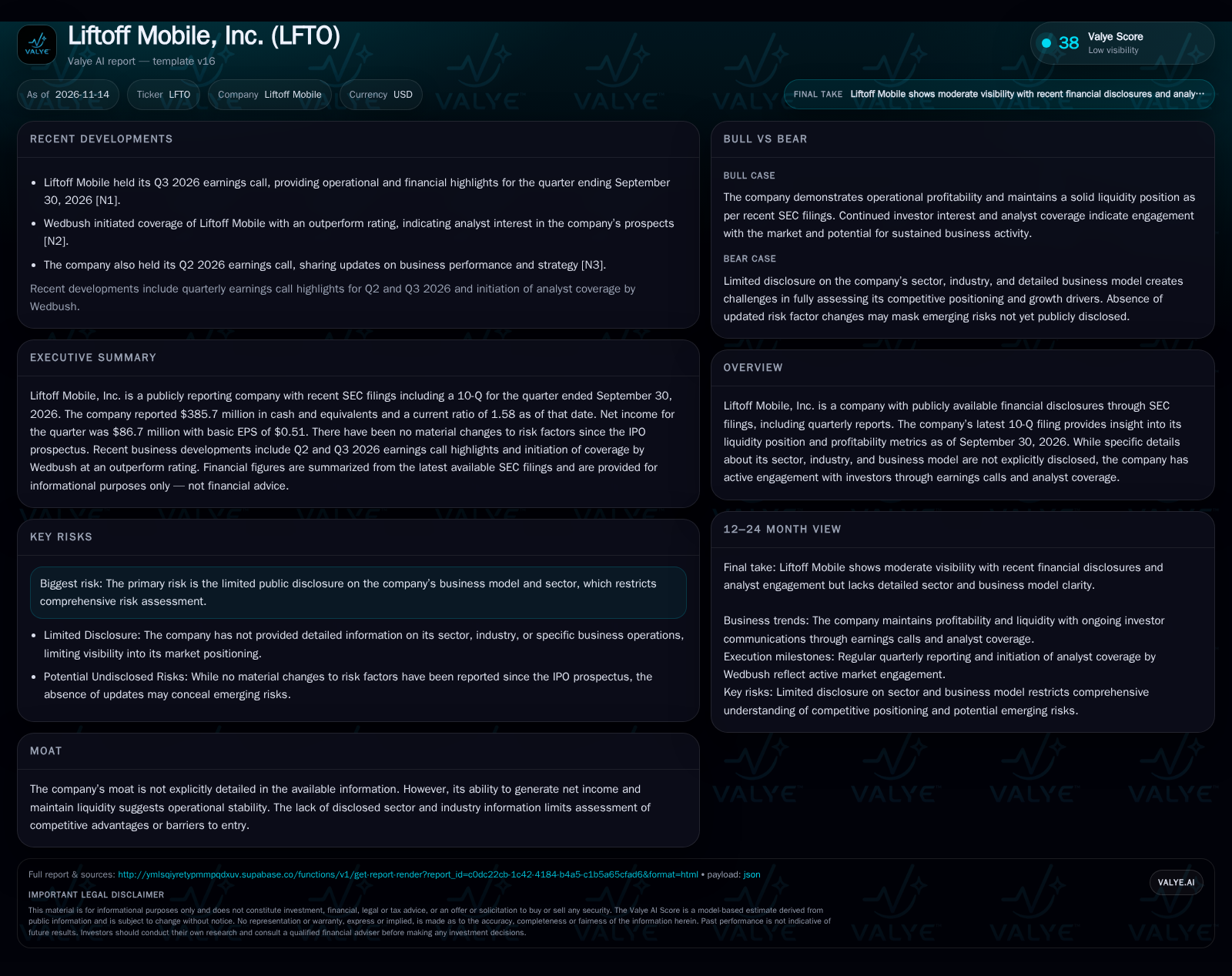
Liftoff Mobile’s recent quarter shows $86.7 million net income and a reported current ratio of 1.58, with $385.7 million in cash and equivalents as of September 30, 2026. The company is attracting analyst interest, but limited public details on its sector and business mechanics impede a full evaluation of its long-term trajectory or competitive moat. Future performance will hinge on operational transparency, sector clarity, and evidence of repeatable, scalable unit economics. [S1] [N1] [N2]
Liftoff Mobile, Inc. is operating from a position of apparent financial strength, posting robust profitability and maintaining significant cash reserves as of Q3 2026. Recent analyst coverage and active investor communications suggest market engagement and operational momentum. However, the company’s public disclosures omit sector and business model details, leaving investors without clarity on the structural drivers of profitability, the nature of its revenue streams, or the durability of its current results. This information gap is central to understanding whether Liftoff Mobile’s recent success is repeatable and scalable, or merely transient.
Profitability and Analyst Coverage Enhance Market Awareness Despite Sector Opacity
As of September 30, 2026, Liftoff Mobile reported net income of $86.7 million, translating to $0.51 in basic earnings per share for the quarter. The company’s cash and cash equivalents totaled $385.7 million, with current assets at $785.3 million against current liabilities of $496.0 million, resulting in a current ratio of 1.58 and a cash ratio of 0.78. There have been no material changes to risk factors since the IPO prospectus, and the company has recently attracted Wedbush analyst coverage at an outperform rating. While these facts signal operational performance and market engagement, the absence of explicit sector, industry, or business model details in public disclosures remains a significant limitation for evaluating future prospects. [S1] [N1] [N2]
Decoding Liftoff Mobile’s Earnings Amid Limited Transparency
Liftoff Mobile’s ability to deliver a quarterly net income figure of $86.7 million indicates that its core operations are currently profitable. The company reported cash and liquidity metrics for the period; these figures do not by themselves establish operating runway, investment capacity, financial flexibility, or financing capacity. However, without disclosure of its sector or business model, it is unclear whether these earnings reflect high-margin, recurring revenue streams (e.g., SaaS, digital advertising, or fintech), or more transactional, lower-margin models (e.g., hardware, commerce, or project-based services).
If Liftoff Mobile operates in a software-driven or platform-based business, it could benefit from significant operating leverage—where incremental revenue flows disproportionately to the bottom line once fixed costs are covered. Conversely, if the business is capital-intensive or relies on high customer acquisition costs, current profitability may prove less durable.
Ultimately, the sustainability and scalability of Liftoff Mobile’s economics depend on the repeatability of its revenue model, the stickiness of its customer relationships, and its ability to maintain or expand margins as it grows—none of which can be confirmed with present disclosures.
Beyond the fundamental question of revenue model type, understanding Liftoff Mobile’s cost structure would significantly enhance evaluation of its financial resilience. For instance, if the company’s operating expenses are predominantly fixed—such as technology infrastructure, R&D, or salaried personnel—then scaling revenue could lead to disproportionate profit growth. Conversely, a variable cost base tied closely to sales or customer acquisition expenses could imply tighter margin control and sensitivity to market fluctuations. Additionally, the extent to which Liftoff Mobile invests in customer support, marketing, and product development would influence its capacity to sustain competitive differentiation and adapt to evolving market demands.
Evaluating Competitive Advantages in an Undisclosed Sector
The absence of sector and industry disclosure for Liftoff Mobile prevents direct peer benchmarking or assessment of market share. If the company operates in a digital-first category such as mobile marketing, app monetization, or fintech, it may face a competitive set that includes established incumbents, high-growth disruptors, and well-capitalized technology platforms. In such markets, scale, proprietary data, network effects, and integration depth are typical sources of durable advantage.
Alternatively, if Liftoff Mobile’s business is more transactional or hardware-driven, differentiation might hinge on cost structure, channel access, or product innovation. Given the reported profitability and analyst interest, it is plausible Liftoff Mobile has succeeded in carving out a defensible niche or executing with operational efficiency. However, without understanding the basis of its customer value proposition or switching frictions, it is impossible to assess the durability of its moat or the risk of margin compression from new entrants or substitutes.
Clear Business Model Could Drive Scalable Growth and Margin Expansion
The most favorable outcome for Liftoff Mobile would arise if future disclosures reveal a highly scalable, recurring-revenue business—such as a leading SaaS platform, mobile ad network, or fintech infrastructure provider—with demonstrable customer retention and pricing power. In this scenario, the company’s current profitability would be underpinned by operating leverage, low incremental costs, and the ability to reinvest cash flows into growth or shareholder returns.
Confirmation would come from detailed segment reporting, disclosure of customer concentration and retention rates, and evidence of expanding gross or operating margins over multiple quarters. Additional analyst upgrades, successful capital deployment initiatives, or entry into adjacent markets could further validate the upside case.
Should Liftoff Mobile’s disclosures eventually confirm a scalable platform with network effects or proprietary data assets, the company could benefit from structural barriers to entry that enhance long-term profitability. For example, network effects—where the value of the platform increases as more users or partners join—can create a virtuous cycle of customer acquisition and retention. Proprietary data could enable superior targeting, personalization, or operational efficiencies, further differentiating the business. In such a scenario, Liftoff Mobile might also achieve pricing power, allowing margin expansion even in competitive environments. These dynamics would support a valuation premium relative to peers lacking similar structural advantages.
Moreover, the ability to cross-sell or upsell within an existing customer base would be a critical growth lever in a recurring-revenue model. If Liftoff Mobile can demonstrate increasing average revenue per user or contract through product innovation or expanded service offerings, it would signal robust demand and customer satisfaction. This would also mitigate risks associated with new customer acquisition costs by maximizing lifetime value. The presence of multi-year contracts or high switching costs would further solidify revenue visibility and reduce churn risk, reinforcing confidence in sustainable cash flow generation.
Ongoing Earnings Stability Despite Disclosure Limitations
A plausible middle-ground scenario is that Liftoff Mobile continues to report consistent profitability and maintains a reported balance sheet position, but the lack of sector and business model transparency persists. The company could remain a ‘black box’ for many investors, leading to a persistent valuation discount relative to more transparent peers. Operational performance could remain stable, but the absence of visibility into growth levers, customer stickiness, or margin structure would limit broader institutional adoption and constrain the equity’s re-rating potential.
Evidence for this scenario would be continued quarterly profitability and cash generation, but without incremental disclosures on business mechanics or strategic direction. Analyst coverage may expand, but persistent calls for greater transparency would signal the market’s ongoing information gap.
Profit Volatility and Sustainability Concerns Hidden by Model Ambiguity
The principal risk is that Liftoff Mobile’s current profitability is driven by non-repeatable events, low-quality earnings, or financial engineering—such as one-off transactions, aggressive revenue recognition, or cost deferrals. If the company operates in a volatile or hyper-competitive market, margin compression, customer churn, or regulatory changes could quickly erode earnings.
This scenario would be confirmed by abrupt declines in revenue, net income, or cash flow; restatements or revisions to financials; or negative surprises in future risk disclosures. A lack of progress on transparency, coupled with increased analyst skepticism or a widening valuation gap, would further support the bear case.
Disclosure Developments and Milestones That May Refine Investment Outlook
Disclosure of sector, industry, and primary business model in future filings or investor communications would clarify peer set and revenue mechanics.
Segmentation of revenue by product line, geography, or customer type—if disclosed—would allow assessment of concentration risk and growth drivers.
Trends in gross margin and operating margin across successive quarters would help establish the durability and scalability of current profitability.
Cash flow from operations and capital expenditure disclosures would provide insight into the underlying quality of earnings and reinvestment needs.
Customer retention, renewal rates, or average contract value—if disclosed—would indicate the presence or absence of recurring revenue and switching costs.
Any updates to risk factors or emergence of new regulatory or competitive disclosures would help assess latent risks not currently visible to investors.
Expansion or reduction in analyst coverage, as well as changes in consensus estimates, would signal shifts in market perception and information flow.
Evidence of capital allocation decisions—such as share repurchases, dividends, or M&A—would clarify management’s priorities and confidence in underlying cash flows.
Disclaimer: This is research-only, informational analysis and not investment advice. It may include AI-generated interpretation and general industry context. Always verify important details using primary sources.

Comments