
SeaStar Medical: Commercial Launch, Clinical Milestones, and the Stakes of Scaling Immunomodulation in Critical Illness
SeaStar Medical’s Selective Cytopheretic Device (SCD) has reached initial commercialization in pediatric acute kidney injury (AKI) with promising survival data and FDA support, while pivotal adult trials and a broad platform strategy test the company’s ability to translate clinical innovation into durable revenue and market adoption amid tight financial constraints.
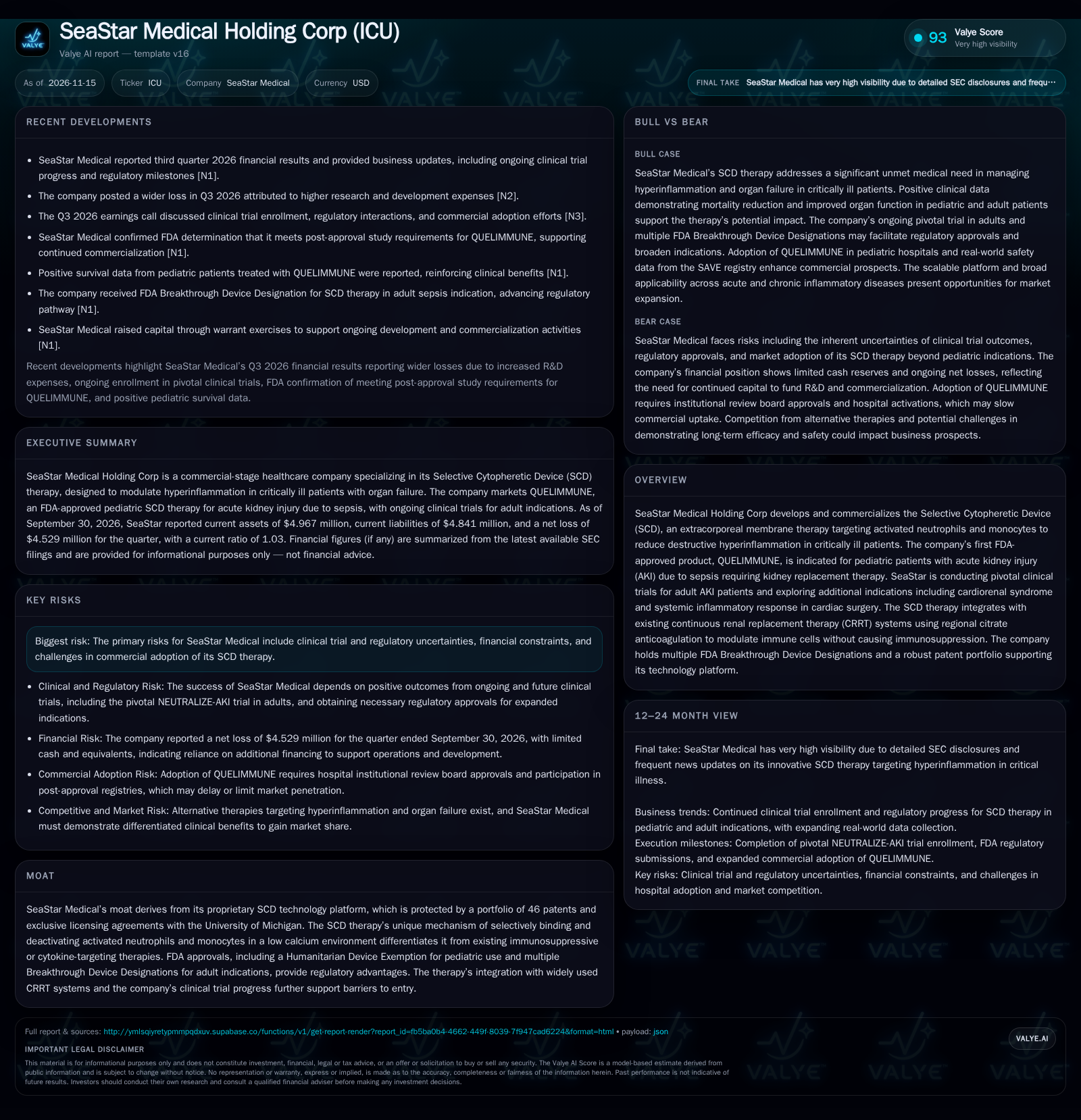
SeaStar Medical is commercializing its SCD immunomodulation therapy, showing early real-world survival benefits in pediatric AKI and progressing a pivotal adult trial. While the technology addresses a major unmet need and holds multiple FDA Breakthrough Device Designations, commercial uptake, further clinical validation, and capital adequacy remain decisive for value creation and long-term viability. [S1] [S2] [N1] [N2]
SeaStar Medical Holding Corp has crossed a critical threshold with the launch of its SCD-based QUELIMMUNE therapy for pediatric sepsis-induced AKI, reporting real-world data that suggest a substantial reduction in mortality compared to historical controls. With FDA regulatory flexibility, a growing commercial hospital base, and a pivotal adult trial underway, SeaStar now faces the dual challenge of scaling its technology platform and managing acute financial pressures. The coming quarters will test whether SeaStar can convert clinical promise and regulatory goodwill into sustainable adoption and a viable business model in the highly competitive and capital-intensive market for critical care therapeutics.
Commercial Launch and Clinical Progress Define the Current Moment
SeaStar Medical’s most material recent development is the commercial launch of QUELIMMUNE—its SCD therapy—for pediatric patients with sepsis-induced acute kidney injury (AKI), initiated in July 2024. As of the close of 2025, 10 hospitals had completed onboarding and registry processes, marking a tangible shift from development to revenue-generating activity. Early real-world registry data from 21 patients show a 76% 60-day survival rate and no device-related safety events, suggesting a potential 50% reduction in mortality versus historical norms and supporting the therapy’s clinical value proposition. Concurrently, the FDA has reduced post-approval registry requirements based on safety data, lowering the SAVE registry enrollment target from 300 to 50. On the adult side, the pivotal NEUTRALIZE-AKI trial is over halfway enrolled (178 of 339 patients), with an interim analysis pending. These milestones collectively test both the clinical impact and the commercial viability of SeaStar’s immunomodulation platform. [S1] [N1] [S2]
From Device Innovation to Revenue: The Economics of SCD Commercialization
SeaStar’s business model centers on selling its SCD therapy as an adjunct to existing continuous renal replacement therapy (CRRT) systems in critical care. The economics depend on uptake by intensive care units (ICUs), reimbursement dynamics, and the ability to scale manufacturing and distribution efficiently. SCD is a single-use, extracorporeal membrane device, implying a per-patient or per-treatment revenue model. If the device is reimbursed as a distinct therapy or as an add-on to existing DRG (diagnosis-related group) codes for AKI or sepsis, pricing could support premium positioning given the claimed mortality benefit. However, the device’s integration into hospital protocols and the requirement for specialized procedures (regional citrate anticoagulation) could limit adoption speed and require significant clinical education and support.
The company reported cash and liquidity metrics for the period; these figures do not by themselves establish operating runway, investment capacity, financial flexibility, or financing capacity. The capital intensity of clinical trials, market development, and regulatory compliance is high—especially as SeaStar pursues new indications. Without robust recurring revenue from a growing hospital base, the economics remain fragile in the near term. [S2] [N2]
Differentiation in a Crowded Critical Care Landscape
SeaStar’s competitive position rests on its proprietary immunomodulation approach, which targets activated neutrophils and monocytes without inducing broad immunosuppression. This contrasts with existing therapies for hyperinflammation—such as corticosteroids, cytokine inhibitors, or conventional extracorporeal therapies—which may blunt immune response or lack selectivity. The SCD’s catch-and-release mechanism in a low-calcium environment is unique and protected by a portfolio of 46 patents and exclusive licenses from the University of Michigan, potentially providing a defensible technological moat.
However, the company faces competition from large device manufacturers, pharmaceutical companies developing targeted biologics, and emerging extracorporeal platforms. Adoption barriers include entrenched hospital protocols, the need for institutional review board (IRB) approvals, and competition for ICU resources. Demonstrating clear, replicable survival and functional benefits—especially in adult populations—will be critical to differentiate SCD therapy from both established and next-generation alternatives.
Clinical Validation Spurs Hospital Uptake and Platform Expansion
The most favorable scenario for SeaStar involves strong, durable real-world outcomes with QUELIMMUNE in pediatric AKI, leading to rapid adoption by additional hospitals and favorable reimbursement decisions. If the NEUTRALIZE-AKI adult trial demonstrates statistically significant reductions in mortality and dialysis dependency, SCD therapy could secure broader FDA approval and establish itself as a new standard of care in critical care nephrology.
Such outcomes would enable SeaStar to leverage its Breakthrough Device Designations to accelerate expansion into other indications—such as cardiorenal or hepatorenal syndromes—using its existing platform and regulatory momentum. Evidence confirming this scenario would include: a growing customer and patient base, repeat hospital orders, positive coverage determinations by payors, and clear clinical guideline endorsements. A marked increase in device revenues and gross margins as fixed costs are leveraged would further validate the upside case.
Gradual Adoption Amid Clinical, Regulatory, and Financial Hurdles
The most plausible outcome is a gradual expansion of QUELIMMUNE use in pediatric centers, with incremental hospital activations as post-market data accumulate and IRB processes are navigated. The NEUTRALIZE-AKI trial continues toward completion, but adult approval is not guaranteed and may require additional studies or post-market commitments. Revenue growth is likely to be modest in the short term as the company builds clinical credibility and addresses logistical barriers to widespread SCD adoption.
SeaStar may need to secure additional capital through equity, debt, or partnerships to fund operations and further trials, especially given current net losses and limited cash. Confirmation would come from steady, albeit slow, increases in hospital customers, continued publication of supportive registry data, and at least neutral to positive interim results in the adult trial. Falsification would be signaled by stagnant adoption, negative safety or efficacy signals, or inability to raise needed capital.
Clinical or Financial Setbacks Derail Commercial Progress
A negative scenario arises if the NEUTRALIZE-AKI trial fails to demonstrate a meaningful mortality or functional benefit in adults, undermining confidence in the SCD’s mechanism and limiting expansion beyond the pediatric niche. Safety concerns in real-world use or registry data showing less robust outcomes than early reports could trigger regulatory scrutiny or hospital reticence.
Financially, persistent losses and a minimal reported cash balance could force SeaStar to curtail R&D or commercial activities, dilute shareholders through emergency capital raises, or explore strategic alternatives. Evidence confirming this downside would include trial discontinuations, withdrawal of hospital customers, adverse regulatory actions, or inability to fund operations through the next clinical milestone.
Milestones and Metrics That Will Shape SeaStar’s Trajectory
The pace of new hospital activations and repeat orders for QUELIMMUNE, especially as additional pediatric centers complete IRB and registry onboarding.
Interim and final results from the NEUTRALIZE-AKI pivotal trial in adults, including mortality, dialysis dependency, and safety endpoints.
Updates on SAVE registry outcomes, particularly any new safety signals or changes in observed survival rates versus historical controls.
Progress toward additional FDA approvals or expanded indications, especially leveraging Breakthrough Device Designations.
Reimbursement decisions by major public and private payors for SCD therapy in pediatric and (if approved) adult AKI.
Manufacturing and supply chain scalability, as measured by the ability to meet growing hospital demand without quality or cost issues.
Disclosure of device pricing, gross margin, and per-patient economics if available, to assess operating leverage and pathway to profitability.
Capital-raising events, partnership announcements, or other funding developments that address short-term liquidity and long-term investment needs.
Disclaimer: This is research-only, informational analysis and not investment advice. It may include AI-generated interpretation and general industry context. Always verify important details using primary sources.

Comments