
Lucid Diagnostics: Commercializing Non-Invasive Esophageal Cancer Screening Amid Payer, Evidence, and Adoption Hurdles
Lucid Diagnostics is leveraging proprietary, guideline-endorsed DNA methylation testing for early esophageal cancer detection, but faces significant challenges in reimbursement, clinical evidence generation, and scaling commercial adoption as it transitions from early-stage revenue to broader market penetration.
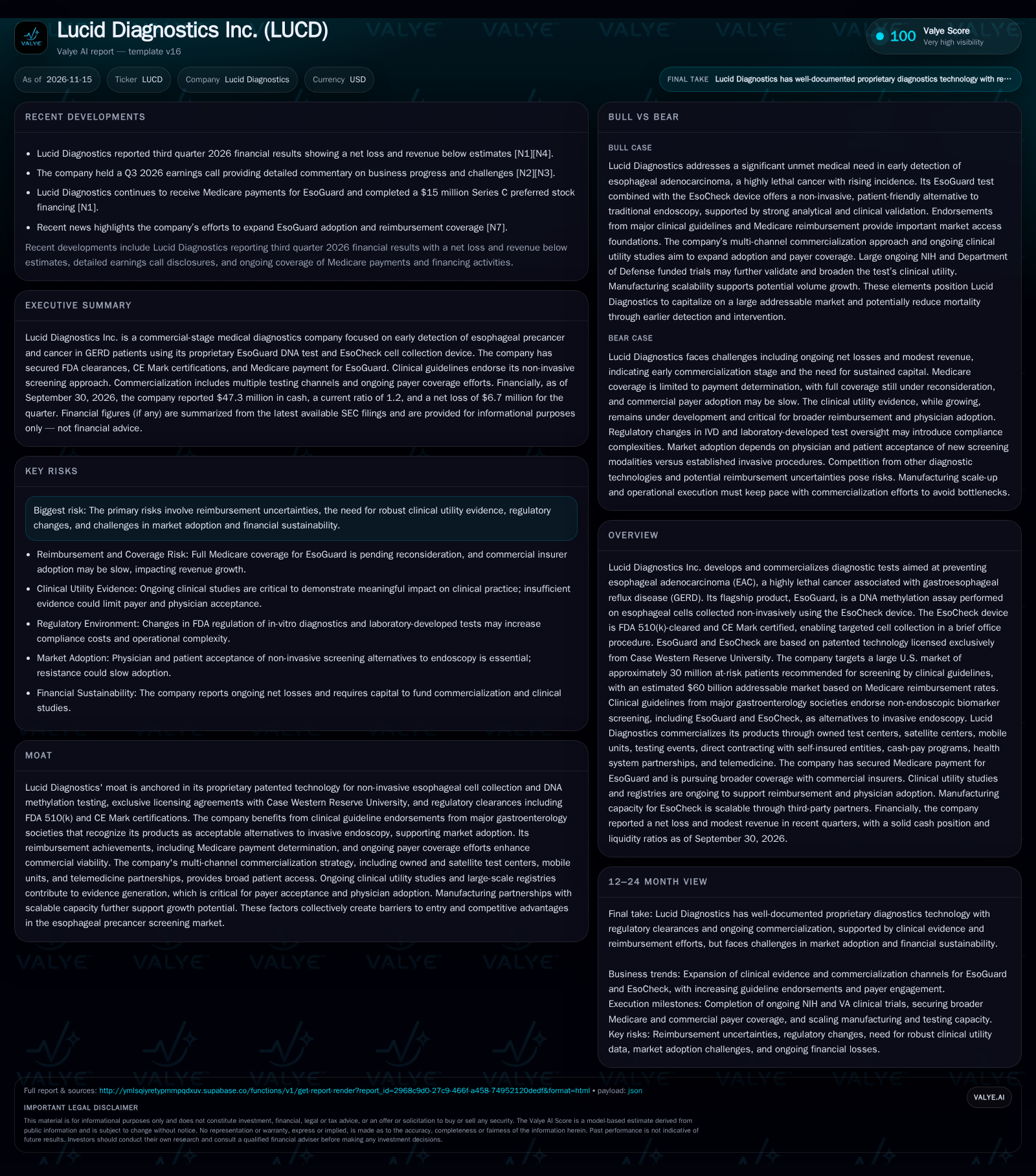
Lucid Diagnostics’ non-invasive EsoGuard test and EsoCheck device are positioned as alternatives to endoscopy for detecting esophageal precancer. Despite clinical endorsements, Medicare payment determination, and a $60B potential market, the company remains in early commercialization—reporting a net loss and modest revenue for Q3 2026. The road ahead hinges on expanding clinical evidence, unlocking broader payer coverage, and achieving physician and patient adoption, while navigating regulatory and financial uncertainties. [S1] [S2]
Lucid Diagnostics stands at a pivotal inflection point in the commercialization of non-invasive esophageal cancer screening. Its flagship EsoGuard test, performed on samples collected with the EsoCheck device, offers a less invasive, guideline-endorsed alternative to traditional endoscopy for detecting Barrett’s Esophagus and esophageal adenocarcinoma in at-risk GERD patients. Despite securing FDA clearance, Medicare payment determination, and prominent clinical guideline endorsements, the company remains in early stages of revenue generation and faces ongoing net losses. The next phase of Lucid’s journey will be determined by its ability to broaden payer coverage, generate real-world clinical utility data, and drive adoption within a large but historically slow-moving diagnostics market.
Recent Financials and Regulatory Milestones Shape Lucid’s Trajectory
Lucid Diagnostics reported a net loss of $6.7 million for Q3 2026, with basic EPS of -$0.03 and revenue of $1.21 million in its most recently reported quarter [S2]. The company held $47.3 million in cash and equivalents as of September 30, 2026, with a current ratio of 1.2 and cash ratio of 2.19 [S2]. EsoGuard, its flagship DNA methylation test, and the EsoCheck device are both FDA-cleared and CE Mark certified. Importantly, EsoGuard has Medicare payment determination ($1,938 per test) but not yet full Medicare coverage, and commercial insurer adoption remains limited [S1]. Clinical guidelines from major gastroenterological societies and the National Comprehensive Cancer Network now endorse non-endoscopic biomarker screening, including Lucid’s products, as alternatives to invasive endoscopy [S1]. These developments establish a regulatory and reimbursement foundation but underscore the gap between potential market access and realized commercial traction.
Revenue Model, Cost Structure, and the Economics of Early-Stage Diagnostics
Lucid Diagnostics’ business model relies on monetizing the EsoGuard test, performed on esophageal cells collected via the EsoCheck device, both of which are based on patented technology licensed from Case Western Reserve University with associated royalty and milestone obligations [S1]. The company’s revenue per test is anchored by Medicare’s payment determination of $1,938, and the commercial opportunity is theoretically vast—up to 30 million U.S. GERD patients recommended for screening, translating to a $60 billion addressable market if full uptake at Medicare rates were achieved [S1].
However, the realized revenue remains modest and reflects early-stage commercialization, with significant variable costs (including royalties, outsourced manufacturing, and lab processing) and fixed costs associated with clinical studies, regulatory compliance, and commercial infrastructure. Outsourced manufacturing of EsoCheck to Coastline International provides scalable capacity, suggesting that gross margins could improve with volume, though near-term profitability is hindered by the need to fund ongoing clinical utility studies, registry data generation, and market education.
Operating leverage could materialize if payer coverage and physician adoption accelerate, as incremental test volumes would likely outpace fixed cost growth. On the other hand, the economics are sensitive to payer mix, reimbursement rates, and test adoption velocity—if commercial payers or Medicare limit coverage or set lower rates, revenue per test could compress. Sustained net losses highlight the need for either rapid volume growth or careful cost containment to manage cash burn.
Clinical Validation, Intellectual Property, and the Battle for Diagnostic Adoption
Lucid Diagnostics’ competitive position is underpinned by a combination of proprietary technology, regulatory clearances, and strong clinical guideline endorsements. The patented EsoGuard/EsoCheck platform offers a non-invasive alternative to traditional endoscopy, with high reported analytical sensitivity and specificity [S1]. Exclusive licensing from Case Western Reserve University creates a legal barrier to direct replication, and FDA 510(k) clearance and CE Mark certification provide regulatory credibility.
However, real-world adoption in diagnostics is heavily influenced by physician trust, payer willingness to reimburse, and patient acceptance. While guidelines now reference Lucid’s products as alternatives, the market remains contested by other non-endoscopic screening technologies (such as alternative biomarker assays and imaging capsules), and by the inertia of established endoscopy procedures. The company’s multi-channel approach—including direct test centers, mobile units, cash-pay, and telemedicine—broadens access but also fragments operational focus.
Future competitive threats could emerge from larger diagnostics companies with broader distribution, deeper payer relationships, or next-generation molecular diagnostics. The moat is meaningful but not unassailable: continued evidence generation and payer engagement are required to maintain and deepen competitive advantages.
If Clinical Evidence and Payer Coverage Converge, a Step-Change in Adoption Is Plausible
The most favorable scenario for Lucid Diagnostics involves a reinforcing cycle: large-scale clinical utility studies (including NIH and DoD-funded trials) demonstrate that EsoGuard/EsoCheck screening materially improves patient outcomes and reduces esophageal cancer mortality in real-world practice. This evidence persuades Medicare to grant broad coverage (not just payment determination) and compels commercial insurers to follow suit, unlocking access to millions of eligible patients [S1].
Physician adoption accelerates as non-invasive screening becomes standard of care and is integrated into primary care and gastroenterology workflows. As test volumes rise, manufacturing scale and fixed-cost leverage drive margin expansion, and Lucid transitions from net losses to operating profitability. Confirmation of this scenario would include: publication of positive real-world clinical utility outcomes, major payers issuing positive coverage decisions, rapid sequential revenue acceleration, and sustained improvements in gross margin.
Incremental Progress: Gradual Evidence Accumulation and Selective Adoption
The most plausible near-term outcome is steady but uneven progress. Lucid continues to generate supportive clinical evidence and expands its registry data, leading to incremental increases in physician adoption and slow but steady payer coverage gains. Medicare’s reconsideration process may extend for several quarters, and commercial insurer uptake remains patchy, with some regional or employer-specific contracts but no national inflection.
Revenue grows in the low- to mid-single digit millions per quarter, and net losses persist but are managed through cost controls and disciplined cash burn. Manufacturing partnerships support moderate volume increases without major bottlenecks. Evidence supporting this scenario would be modest sequential revenue growth, additional positive coverage decisions (albeit limited), and ongoing publication of clinical evidence without a dramatic usage spike.
Clinical or Reimbursement Setbacks Could Stall Commercial Momentum
In an adverse scenario, clinical utility studies or real-world evidence fail to demonstrate a clear benefit from EsoGuard/EsoCheck screening, or results are ambiguous. This could lead Medicare and commercial payers to delay or deny broader coverage, limiting test reimbursement to a small subset of patients. Physician inertia or skepticism about new screening modalities may persist, especially if workflow integration proves difficult or if alternative technologies gain traction.
Revenue stagnates at low levels, and persistent net losses erode the company’s reported cash balance, eventually forcing Lucid to curtail commercialization activities, seek dilutive capital, or pursue strategic alternatives. Downside signals would include negative or inconclusive clinical utility publications, explicit payer denials, declining sequential revenue, or cost-cutting measures such as layoffs or R&D reductions.
Milestones That Will Shape Lucid Diagnostics’ Value Creation Thesis
Updates on Medicare’s full coverage determination for EsoGuard, including any formal expansion or limitation of covered indications.
New commercial payer coverage decisions and the proportion of test volumes reimbursed versus cash-pay or other channels.
Results from ongoing NIH and Department of Defense-funded clinical utility studies—especially real-world outcome data and publication in peer-reviewed journals.
Quarterly revenue growth rate and the number of tests performed, if disclosed, as a direct measure of adoption.
Gross margin trends, including the impact of manufacturing scale and cost structure evolution, if disclosed.
Physician adoption metrics such as the number of active prescribing physicians or test centers, if reported.
Updates on the regulatory environment for IVDs and laboratory-developed tests, including any new FDA rules impacting compliance costs or go-to-market strategy.
Cash burn rate and any announced capital raises, strategic partnerships, or cost containment measures.
Disclaimer: This is research-only, informational analysis and not investment advice. It may include AI-generated interpretation and general industry context. Always verify important details using primary sources.

Comments