
Aktis Oncology: Clinical Milestones and Liquidity Shape the Stakes for a High-Risk, High-Reward Oncology Pipeline
Aktis Oncology’s reported cash position and upcoming clinical data for its lead candidates position the company at a pivotal moment. Success in trials could unlock significant value, but the path is defined by high clinical, regulatory, and financial risk.
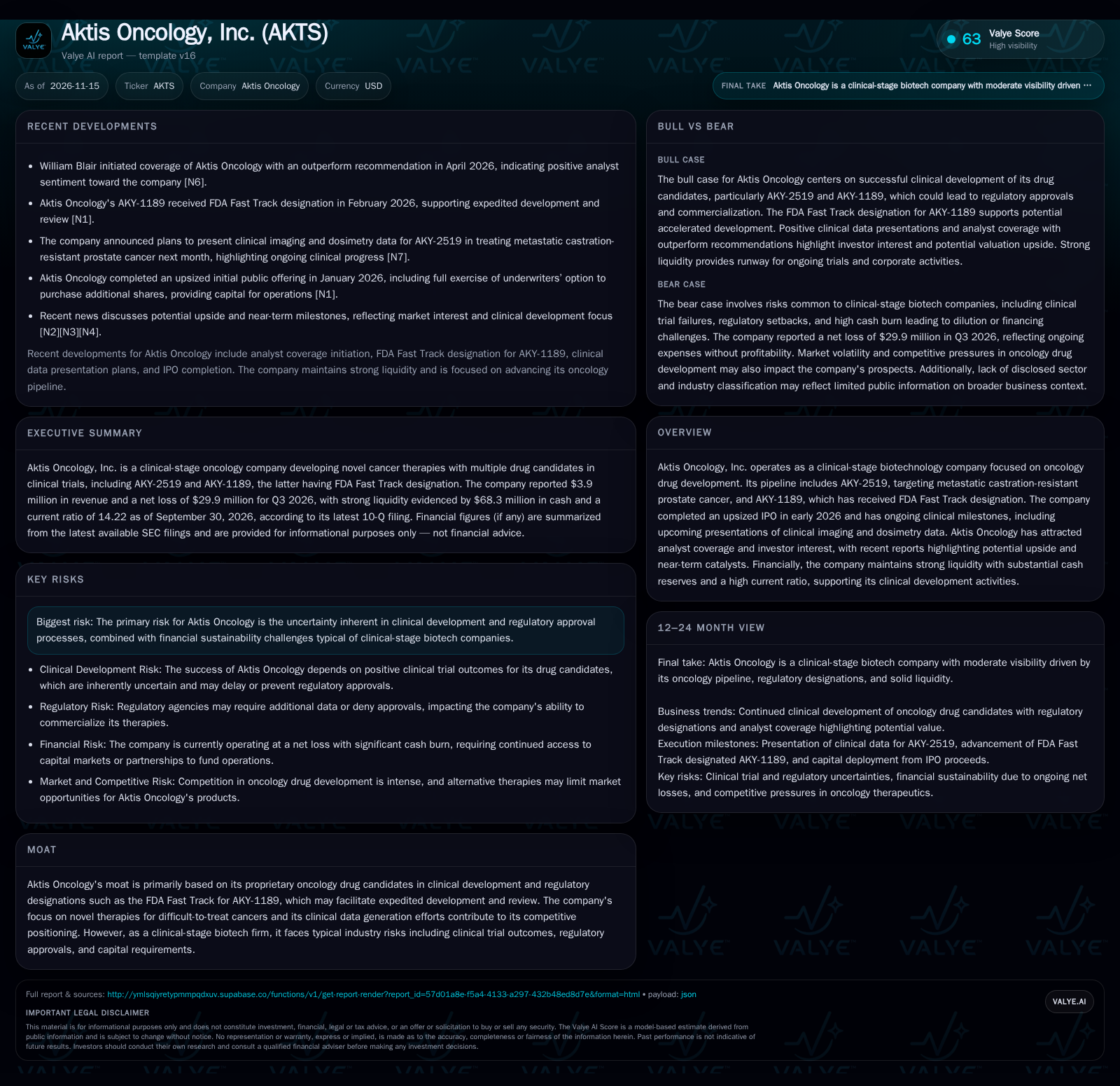
Aktis Oncology’s near-term outlook revolves around two lead drug candidates, AKY-2519 and FDA Fast Track-designated AKY-1189, with key clinical data presentations imminent. The company maintains reported liquidity position following an upsized IPO, but continues to operate at a significant net loss. The next phase hinges on clinical results, regulatory progress, and disciplined capital deployment amid intense competition in oncology drug development. [S1] [N6] [N7]
Aktis Oncology stands at a crossroads typical for clinical-stage biotech: significant scientific promise paired with substantial execution risk. With two lead programs—AKY-2519 targeting metastatic prostate cancer and AKY-1189 carrying FDA Fast Track status—the company is approaching key clinical milestones that could reshape its valuation and strategic options. The next 12 months will likely determine whether Aktis becomes a breakout oncology innovator or faces the headwinds that have derailed many peers.
Clinical Progress, Financial Cushion, and Analyst Backing Define Aktis Oncology’s Present
Aktis Oncology’s most material current facts are its $3.905 million in revenue and a substantial net loss of $29.939 million for the quarter ending September 30, 2026, highlighting the classic clinical-stage biotech profile of high R&D spend with limited top-line contribution at this stage. Importantly, AKY-1189 has received FDA Fast Track designation, potentially accelerating its review, while AKY-2519 is nearing a key clinical milestone with upcoming imaging and dosimetry data presentations. The successful completion of an upsized IPO in January 2026, along with positive analyst coverage, suggests market confidence in the pipeline and management’s ability to execute. [S1] [N6] [N7]
The Economics of Clinical-Stage Oncology: High Burn, Binary Outcomes, and the Value of Optionality
Aktis Oncology’s business model is fundamentally shaped by the economics of drug development: significant upfront investment in R&D, with the prospect of outsized returns if a candidate achieves regulatory approval and commercial uptake. At present, revenue is minimal and likely reflects collaboration income or milestone payments rather than product sales. The company’s operating expenses are dominated by clinical trial costs, pre-commercial manufacturing, and regulatory activities, resulting in large net losses—a pattern typical for the sector.
Fixed costs are high due to the need for specialized talent and infrastructure, but variable costs rise sharply as trials progress to later stages. The ability to leverage operating expenses depends on advancing candidates through pivotal trials and, eventually, transitioning to commercial scale.
Margins, if and when products reach market, could be attractive given oncology’s pricing power—particularly for first-in-class or best-in-class therapies targeting unmet needs. However, pricing is subject to payer negotiations, competitive dynamics, and, increasingly, value-based reimbursement frameworks. Success for Aktis will hinge on translating clinical milestones into value inflection points that support additional funding or strategic partnerships.
Navigating the Oncology Innovation Arena: Differentiation and Vulnerability
Aktis Oncology operates in one of the most competitive segments of biopharma, where dozens of small and large companies pursue similar indications and mechanisms. Its potential advantages stem from proprietary candidates—AKY-2519 (targeting metastatic castration-resistant prostate cancer) and AKY-1189 (with FDA Fast Track status)—and the possibility of clinical differentiation through improved efficacy, safety, or dosing convenience.
However, the sector is crowded with both established pharma and emerging biotech players, many of whom possess greater resources, established commercial infrastructure, and extensive clinical pipelines. Substitutes include other targeted therapies, immuno-oncology agents, and radiopharmaceuticals. Barriers to entry are high due to regulatory complexity and the need for robust clinical evidence, but switching costs for prescribers and patients are typically low once competing products are available.
Aktis’s competitive moat could strengthen if its candidates demonstrate superior clinical outcomes or carve out niche indications with limited alternatives. The FDA Fast Track designation for AKY-1189 is a positive signal, but actual competitive advantage will depend on forthcoming clinical data and the company’s ability to navigate regulatory and payer environments.
Clinical Validation Unlocks Strategic and Financial Leverage
The most favorable scenario for Aktis Oncology is predicated on strong clinical data for AKY-2519 and AKY-1189, leading to regulatory momentum and heightened investor confidence. If the upcoming clinical imaging and dosimetry data for AKY-2519 demonstrate meaningful efficacy and safety improvements, it could accelerate partnerships, licensing deals, or even acquisition interest—common pathways for successful clinical-stage biotechs.
In this scenario, the FDA Fast Track designation for AKY-1189 expedites review, shortening time to market and potentially enabling earlier revenue generation from an underserved oncology indication. The company’s reported liquidity position allows for aggressive pursuit of pivotal trials without immediate dilutive financings. Confirmation would come from positive top-line clinical results, new collaboration announcements, or regulatory filings. Falsification would be signaled by negative or inconclusive data, clinical holds, or a lack of partnering activity despite milestone achievement.
Clinical Progress Amid Persistent Losses and Incremental De-Risking
The most plausible path for Aktis Oncology over the next 12-18 months is continued incremental progress in clinical development, punctuated by data updates and milestone events. The company likely continues to report net losses as R&D spend persists and no products are yet commercialized. Clinical milestones—such as the presentation of AKY-2519 data and advancement of AKY-1189—provide periodic value inflection points, but the timeline to regulatory approval remains extended.
Analyst and investor sentiment remains constructive but cautious, contingent on the cadence and quality of clinical updates. Falsification would be signaled by delayed or negative trial updates, faster-than-expected cash depletion, or deterioration in capital markets access.
Clinical Setbacks, Cash Burn, and Dilution Risk
The adverse scenario emerges if Aktis experiences negative or inconclusive clinical data for its lead programs, triggering loss of investor confidence and making future fundraising more challenging. Failure to achieve key endpoints for AKY-2519 or setbacks in the AKY-1189 program could lead to trial discontinuations, impairment charges, or the need to pivot pipeline strategy.
In this scenario, persistent net losses and high cash burn erode the current liquidity cushion, forcing the company to seek additional capital on unfavorable terms—potentially resulting in significant shareholder dilution or restrictive partnerships. Competitive advances by peers or changes in the regulatory landscape could further diminish the perceived value of Aktis’s assets. Confirmation would come from public disclosure of negative trial outcomes, guidance cuts, or urgent capital raises. Falsification would require evidence of successful trial readouts, new funding on favorable terms, or non-dilutive strategic transactions.
Milestones and Metrics That Will Shape Aktis Oncology’s Next Chapter
Clinical imaging and dosimetry data for AKY-2519: The quality, timing, and interpretation of these results will be pivotal for both regulatory and investor sentiment. [N7]
Progress updates on AKY-1189: Any new disclosures on trial enrollment, data readouts, or regulatory interactions—especially under the FDA Fast Track program—will help test the value-creation narrative. [S1]
R&D expense trends: Changes in R&D allocation may reflect shifting priorities, trial progress, or responses to clinical data (if disclosed).
New partnership or licensing deals: Announcements of collaborations, co-development, or out-licensing would validate the pipeline’s external appeal (if disclosed).
Analyst coverage and target price revisions: Shifts in sell-side views may signal changing market confidence, especially after major clinical updates. [N6] [N2] [N8]
Dilutive financing events: Additional equity or debt raises, and their terms, will directly impact shareholder value and the company’s strategic flexibility (if disclosed).
Disclaimer: This is research-only, informational analysis and not investment advice. It may include AI-generated interpretation and general industry context. Always verify important details using primary sources.

Comments