
Creatd’s Early-Stage Digital Content Ambitions: User Growth, Monetization, and the Long Road to Scale
With modest early revenue and persistent net losses, Creatd’s prospects hinge on its ability to scale user engagement and convert digital attention into sustainable advertising and affiliate sales—while navigating fierce competition and operational dependencies.
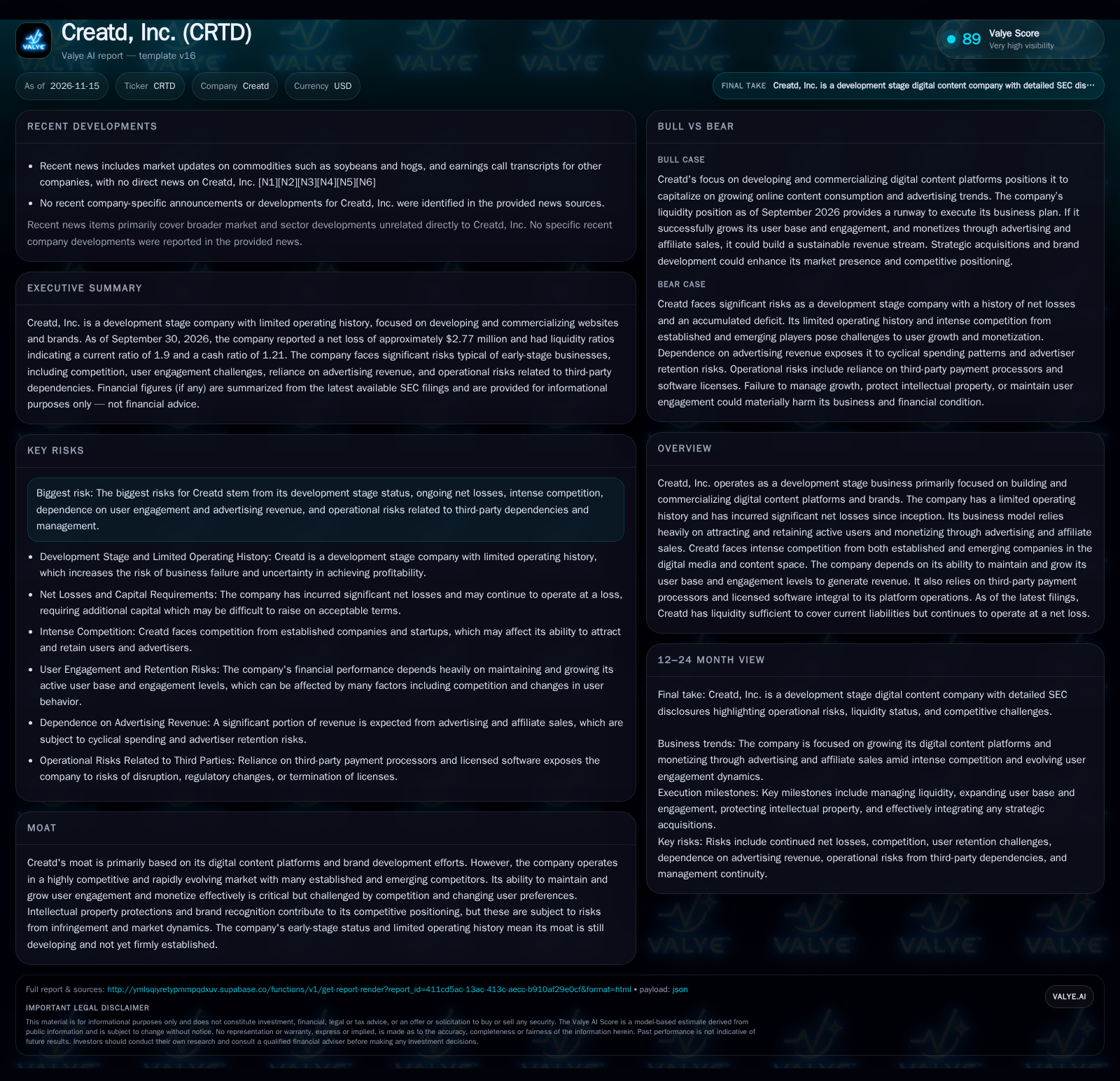
Creatd, Inc. remains deep in its development stage, posting limited revenue ($173,941 as of June 2026) and a net loss of $2.77 million for the first nine months of 2026. With a current ratio of 1.9 and a cash balance of $3.03 million, short-term reported liquidity position, but sustained losses underscore the urgency of accelerating user growth and monetization. The company’s reliance on advertising and affiliate sales exposes it to cyclical risks, while competition for users and advertisers remains intense. Creatd’s ability to execute on platform growth and protect its operational infrastructure will define whether it can transition from early-stage promise to a viable digital media business. [S1]
Creatd, Inc. sits at the crossroads of digital content ambition and the hard realities of early-stage execution. The next phase for Creatd will be defined not by balance sheet metrics, but by whether it can carve out meaningful user traction in a crowded landscape. [S1]
Where Creatd Stands Today: Early Revenue, Ongoing Losses, and Liquidity Snapshot
As of June 30, 2026, Creatd reported just $173,941 in revenue, underscoring its status as a development stage company still searching for product-market fit and scalable monetization. Net losses for the first nine months of 2026 reached approximately $2.77 million, with an accumulated deficit above $287 million, highlighting the persistence of operating deficits. On the balance sheet, Creatd held $3.03 million in cash and $0.59 million in short-term investments as of September 30, 2026, alongside total current assets of $5.66 million and current liabilities of $2.98 million—a current ratio of 1.9 and cash ratio of 1.21. While these metrics indicate coverage of near-term liabilities, they do not resolve the longer-term challenge of bridging ongoing losses to future growth. [S1]
Economics of Digital Content: Monetization Levers and Cost Structure Realities
Creatd’s business model is predicated on building digital platforms that attract and engage users, with monetization driven by advertising and affiliate sales. In theory, digital content platforms can benefit from high operating leverage: once a critical mass of users is reached, incremental revenue from advertising or affiliate deals can flow through at relatively high margins, given the fixed cost base of technology, content, and platform maintenance.
However, at Creatd’s current scale, fixed costs—development, content acquisition, platform infrastructure, and personnel—far outweigh revenue, resulting in persistent losses. Advertising and affiliate revenues are not only volume-dependent (requiring large, engaged audiences) but also sensitive to cyclical advertiser budgets and changes in user behavior. Additionally, the company’s reliance on third-party payment processors and licensed software introduces variable costs and potential contractual dependencies. The capital needs remain substantial: without a step-change in user monetization, further funding may be required to sustain operations or invest in growth initiatives.
A critical dimension in evaluating Creatd’s economics lies in the scalability of its cost structure relative to user growth. Digital content platforms often exhibit non-linear cost behavior, where initial user acquisition and content development costs are disproportionately high, but incremental costs per additional user decline over time. This dynamic creates a potential for operating leverage once a critical mass is achieved. However, if the platform fails to reach sufficient scale, fixed costs remain burdensome and variable costs tied to third-party services can erode margins. Understanding the tipping point at which revenue growth outpaces cost increases is essential for assessing the viability of Creatd’s business model.
Another important consideration is the sensitivity of advertising and affiliate revenue streams to external economic cycles and platform-specific engagement metrics. Advertising budgets tend to contract during economic downturns, which can disproportionately impact early-stage platforms lacking diversified revenue sources or long-term contracts. Similarly, affiliate sales depend on user purchasing behavior and conversion rates, which may fluctuate with consumer confidence and platform trust. Therefore, Creatd’s monetization levers are exposed to macroeconomic volatility and user behavior shifts, underscoring the need for flexible cost management and diversified revenue channels to mitigate cyclical risks.
Competitive Dynamics: Fighting for Users and Advertisers in a Saturated Market
Creatd competes in the crowded digital media and content platform arena, where user acquisition costs are high and consumer attention is fragmented across established giants and agile startups. Large incumbents benefit from entrenched network effects, brand recognition, and cross-platform data, making it difficult for new entrants to attract and retain a meaningful user base without substantial differentiation or marketing spend.
For advertising and affiliate revenue, Creatd must demonstrate both scale and engagement—metrics that directly influence advertiser interest and pricing power. The company’s early-stage status means it lacks the audience reach and data sophistication of larger platforms, limiting its ability to command premium ad rates or secure exclusive affiliate partnerships. Moreover, operational dependencies on third-party technology and payment infrastructure add layers of risk not faced by vertically integrated competitors.
What Success Looks Like: User Engagement Ignites a Monetization Flywheel
A favorable trajectory for Creatd involves achieving rapid growth in active users and engagement on its platforms, thereby unlocking the potential for scalable advertising and affiliate revenue streams. If Creatd can meaningfully differentiate its content or community experience—whether through unique creator incentives, vertical focus, or proprietary technology—it may be able to attract and retain a loyal audience that appeals to advertisers targeting niche or high-value segments.
Confirmation of this scenario would come from sustained double-digit user growth, rising engagement metrics (such as time-on-platform or repeat visits, if disclosed), and a marked increase in revenue per user. Additionally, evidence of major advertising partnerships, affiliate program expansion, or successful brand extensions would signal momentum toward operating leverage and eventual profitability. Falsification would be indicated by stagnant or declining user metrics, weak advertiser uptake, or continued revenue stagnation despite increased spend.
Plausible Trajectory: Incremental Progress, Persistent Losses, and Funding Needs
The most likely outcome is that Creatd experiences incremental but modest user and revenue growth, insufficient to offset its fixed cost base in the near term. The company may iterate on content and engagement strategies, experiment with new platform features, or pursue partnerships, but progress is likely to be gradual given resource constraints and competitive pressures.
Confirmation of this middle path would be slow but positive trends in user and revenue metrics, periodic capital raises, and ongoing net losses. Falsification would occur if user or revenue growth flatlines or reverses, or if the company is forced into significant cost-cutting that impairs platform development or user experience.
Adverse Outcomes: User Apathy, Monetization Shortfalls, and Operational Disruptions
In a negative scenario, Creatd fails to achieve meaningful user growth or engagement, leading to stagnant or declining revenue and increasing difficulty in attracting advertisers or affiliates. Without scale, advertising and affiliate sales are unlikely to generate enough margin to cover fixed costs, accelerating cash burn and raising the risk of financial distress.
Operational risks compound the downside: disruptions from third-party payment processors or software vendors, security breaches, or loss of key management could further erode user trust and platform stability. Evidence for this scenario would include declining user metrics (if disclosed), deteriorating revenue, rapid cash depletion, and an inability to raise additional capital on acceptable terms. Bankruptcy or forced asset sales would represent worst-case outcomes.
Milestones That Will Define Creatd’s Transition from Development to Viability
Sustained growth in active users and engagement on Creatd’s platforms—user count, retention, and time-on-platform (if disclosed) would help test whether the company is gaining traction.
Revenue per user and aggregate monetization metrics—upward trends would indicate improving platform economics and advertiser appeal.
Gross margin progression—if disclosed, would reveal whether monetization gains are translating into better operating leverage.
Major advertising or affiliate partnership announcements—would suggest growing market credibility and the ability to attract external commercial interest.
Cash burn rate and runway—updates on quarterly cash flow would clarify when additional funding might be required.
Churn or retention rates for both users and advertisers—declines in these metrics would signal platform or commercial weakness.
Operational incidents—any disruptions involving payment processors, software vendors, or security breaches would test the resilience and reliability of Creatd’s infrastructure.
Changes in management or board composition—loss of key personnel could disrupt strategy execution or signal deeper organizational challenges.
Disclaimer: This is research-only, informational analysis and not investment advice. It may include AI-generated interpretation and general industry context. Always verify important details using primary sources.

Comments