
Patriot National Bancorp’s Strategic Reset: Regulatory Pressures, Capital Actions, and the Pursuit of Relationship Banking Value
After a sweeping 2025 transformation, Patriot National Bancorp faces the dual challenge of regulatory remediation and business model execution. With recent capital infusions, insider buying, and a new leadership team, the bank’s future hinges on risk management, client focus, and its ability to restore sustainable growth while navigating OCC oversight and Nasdaq compliance deadlines.
Patriot National Bancorp is in the midst of a high-stakes turnaround, marked by major capital raises, a new strategic focus on relationship-driven banking, and ongoing regulatory remediation under OCC oversight.Insider transaction activity was reported in the cited source; this activity does not by itself establish insider confidence. The next 12-18 months will test whether this repositioning can deliver risk-adjusted returns and durable value.
Patriot National Bancorp, Inc. sits at a critical crossroads following a sweeping overhaul in 2025 that reshaped its capital structure, management, and business focus. With a new leadership team, major insider investment, and a sharpened strategy centered on relationship-driven and specialized banking services, the company is now tasked with meeting the stringent requirements of an OCC Formal Agreement while also addressing Nasdaq listing compliance. The next phase will be defined by the bank’s ability to execute on its targeted client strategy, remediate regulatory concerns, and demonstrate operational resilience amid competitive and capital market pressures.
Recent Capital Raises and Regulatory Oversight Define the Operating Environment
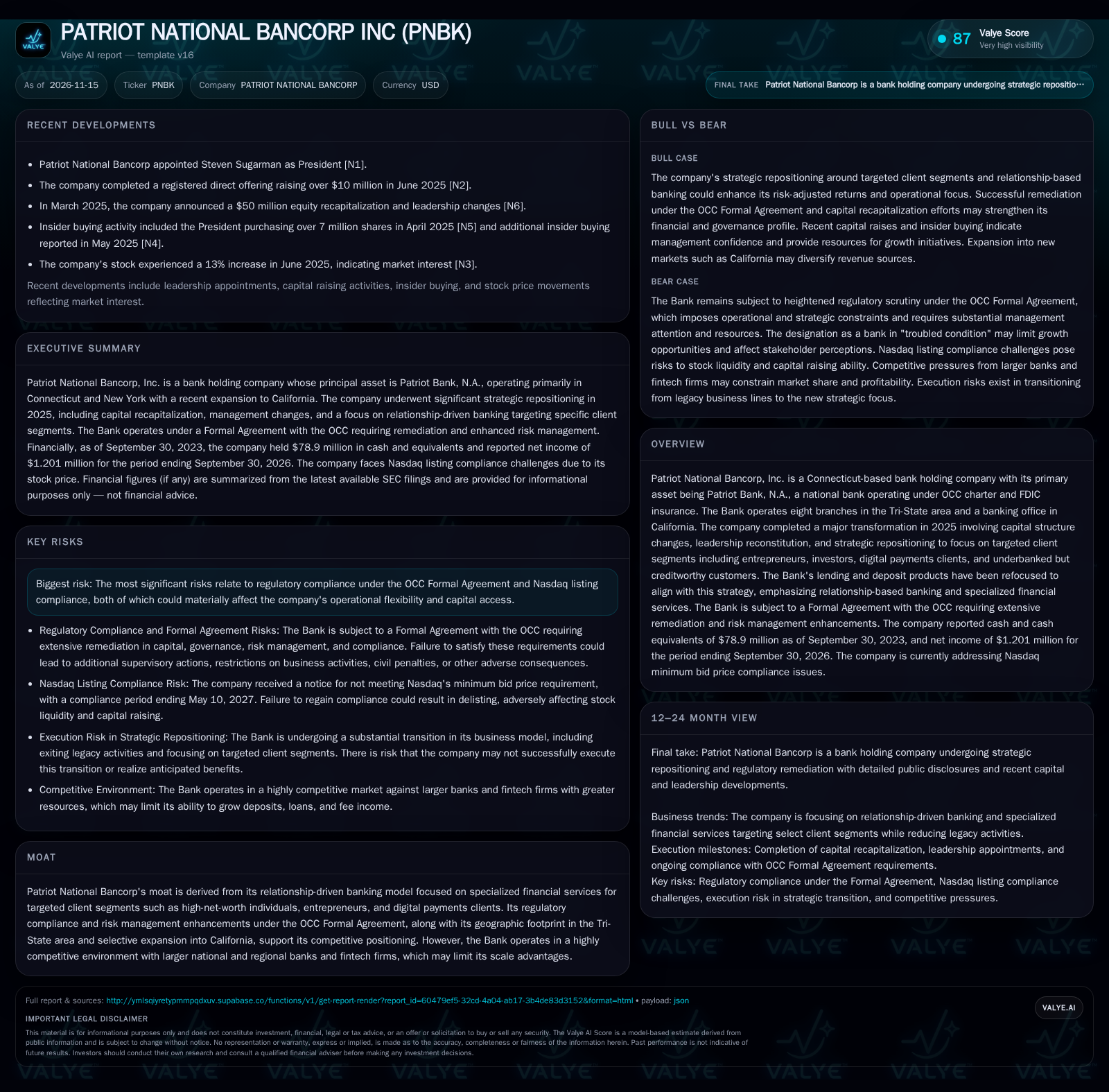
Patriot National Bancorp’s current reality is shaped by three primary developments: its status under a Formal Agreement with the OCC, a series of substantial capital raises, and visible leadership changes. The OCC agreement, entered into in January 2025, mandates corrective action in capital, governance, risk management, and compliance—placing the bank under enhanced regulatory scrutiny and limiting its operational discretion [S1]. To support remediation and strategic realignment, the company completed a $50 million equity recapitalization in March 2025 and a $10 million registered direct offering in June 2025 [N6] [N2]. Leadership changes include the appointment of Steven Sugarman as President, alongside insider purchases of over 7 million shares by management in April and May 2025 [N1] [N5] [N4]. These actions demonstrate management’s commitment and provide a financial buffer, but also highlight the urgency of delivering a credible turnaround under regulatory constraints.
How Relationship Banking and Specialized Services Could Drive Risk-Adjusted Returns
Patriot’s business model pivots on relationship-driven banking, targeting entrepreneurs, high-net-worth individuals, business leaders, and digital payments clients. The lending book is now concentrated in commercial real estate, asset-secured rediscount lending, and business lines of credit to relationship borrowers—segments that may command higher yields but also require disciplined risk management. On the funding side, the bank emphasizes relationship-based deposits from affluent households, private businesses, and institutional clients, potentially reducing reliance on volatile rate-sensitive deposits and supporting net interest margin stability if retention is high [S1].
Fee-generating activities include ACH, card program sponsorship, and settlement services. These could offer higher-margin, recurring revenue streams if the bank can scale its digital payments and institutional banking offerings—though the compliance and operational risks in these segments are non-trivial and require robust controls. The cost structure is likely to be weighted toward fixed personnel and compliance costs in the near term, reflecting both the regulatory remediation efforts and the need to support relationship management. Operating leverage could materialize if asset growth resumes and deposit costs remain contained. However, the capital-intensive nature of banking means that sustainable profitability will depend on prudent loan growth, credit quality, and the ability to maintain a healthy risk-adjusted spread.
Navigating a Crowded Field: Niche Focus Versus Scale Disadvantages
Patriot faces entrenched competition from large national and regional banks, as well as nimble fintechs, all vying for similar client segments within the Tri-State and, now, Los Angeles markets. Larger banks possess balance-sheet scale, technology investment capacity, and broader product suites, which can pressure Patriot on pricing and client acquisition. Fintech entrants may erode fee income potential in payments and digital banking, especially if Patriot’s compliance-driven operational changes slow product rollout or dampen customer experience.
However, the company’s focus on underbanked but creditworthy clients, entrepreneurs, and relationship-driven lending could carve out defensible niches—particularly if competitors overlook these segments or apply rigid underwriting models. Enhanced risk management and local market knowledge may enable Patriot to offer customized solutions, though this advantage is only durable if the bank can consistently deliver superior service and maintain credit discipline. The extension into California provides geographic diversification but also exposes the company to new competitive dynamics and regulatory environments, increasing execution demands.
Turnaround Success: Regulatory Remediation Unlocks Profitable Growth
In the upside scenario, Patriot successfully fulfills the requirements of the OCC Formal Agreement, restoring regulatory confidence and operational flexibility. Capital raised in 2025 enables the bank to selectively grow its lending book in commercial real estate and high-net-worth segments, capturing attractive spreads while maintaining credit quality. Relationship-based deposit growth outpaces rate-sensitive deposit runoff, supporting net interest margins and reducing funding costs.
The institutional banking and digital payments businesses achieve scale, generating recurring fee income and diversifying revenue beyond traditional lending. Management’s insider buying and new leadership drive a cultural reset, improving execution and attracting new client relationships. The company regains Nasdaq compliance, boosting investor confidence and broadening capital access. Evidence for this scenario would include measurable progress in OCC remediation milestones, sustained net income growth, expanding fee income, stable or improving asset quality, and a restored share price above the Nasdaq minimum bid threshold.
Gradual Remediation and Modest Growth Amid Ongoing Constraints
The most plausible near-term outcome is a measured recovery, with Patriot making incremental progress on OCC remediation but remaining under supervisory oversight through much of 2026. Loan and deposit growth are modest, reflecting conservative risk appetite and selective client onboarding. Net interest margin stabilizes but does not expand meaningfully due to competitive pricing and elevated funding costs.
Fee income from payments and institutional services contributes but does not offset the drag from ongoing compliance and remediation costs. The company avoids major credit losses but remains operationally constrained, limiting its ability to fully exploit new market opportunities such as the California expansion. Nasdaq compliance remains at risk, subject to share price volatility and investor sentiment. Confirmation of this scenario would involve regular OCC progress updates, stable but unspectacular earnings, and continued cautious capital deployment.
Regulatory Setbacks or Execution Failures Trigger Capital and Listing Risks
In a downside scenario, Patriot fails to demonstrate sufficient remediation progress to the OCC, resulting in prolonged or escalated regulatory restrictions—potentially limiting growth, imposing new capital requirements, or restricting dividend and expansion activities. Execution missteps, such as poor loan underwriting or inability to attract and retain core deposits, could erode asset quality or compress margins further.
Competitive pressures from larger banks or fintechs may accelerate deposit outflows or force additional concessions on lending rates. If earnings deteriorate or the compliance window closes without sufficient share price recovery, the company could face Nasdaq delisting, further constraining capital access and undermining investor confidence. Evidence confirming this scenario would include negative OCC communications, deteriorating credit or deposit metrics, unsuccessful equity raises, or a persistent stock price below the Nasdaq threshold.
Testing the Repositioning: Concrete Evidence to Track Execution and Risk
Progress against OCC Formal Agreement milestones, including specific remediation deliverables and any transition from 'troubled condition' status.
Sustained growth or retention in relationship-based deposit balances, especially from high-net-worth and business clients, if disclosed.
Changes in net interest margin and loan book composition, particularly the growth of commercial real estate and asset-secured lending.
Trends in non-interest income from digital payments and institutional banking services—scaling and client adoption would help test fee income potential.
Asset quality metrics such as non-performing loan ratios and charge-offs, which would signal credit discipline and underwriting effectiveness.
Updates on Nasdaq compliance status, including any share price recovery events or communication from the exchange.
Management and board actions—further insider buying, executive turnover, or new strategic hires that could impact execution.
Disclaimer: This is research-only, informational analysis and not investment advice. It may include AI-generated interpretation and general industry context. Always verify important details using primary sources.

Comments