
Kyverna Therapeutics: CAR T Ambitions Confront Regulatory, Funding, and Commercialization Hurdles
Kyverna Therapeutics moves toward a first-in-class CAR T approval for Stiff Person Syndrome with positive clinical data and a completed BLA, but faces the classic biotech gauntlet: regulatory scrutiny, capital intensity, complex commercialization, and entrenched competition in autoimmune therapeutics.
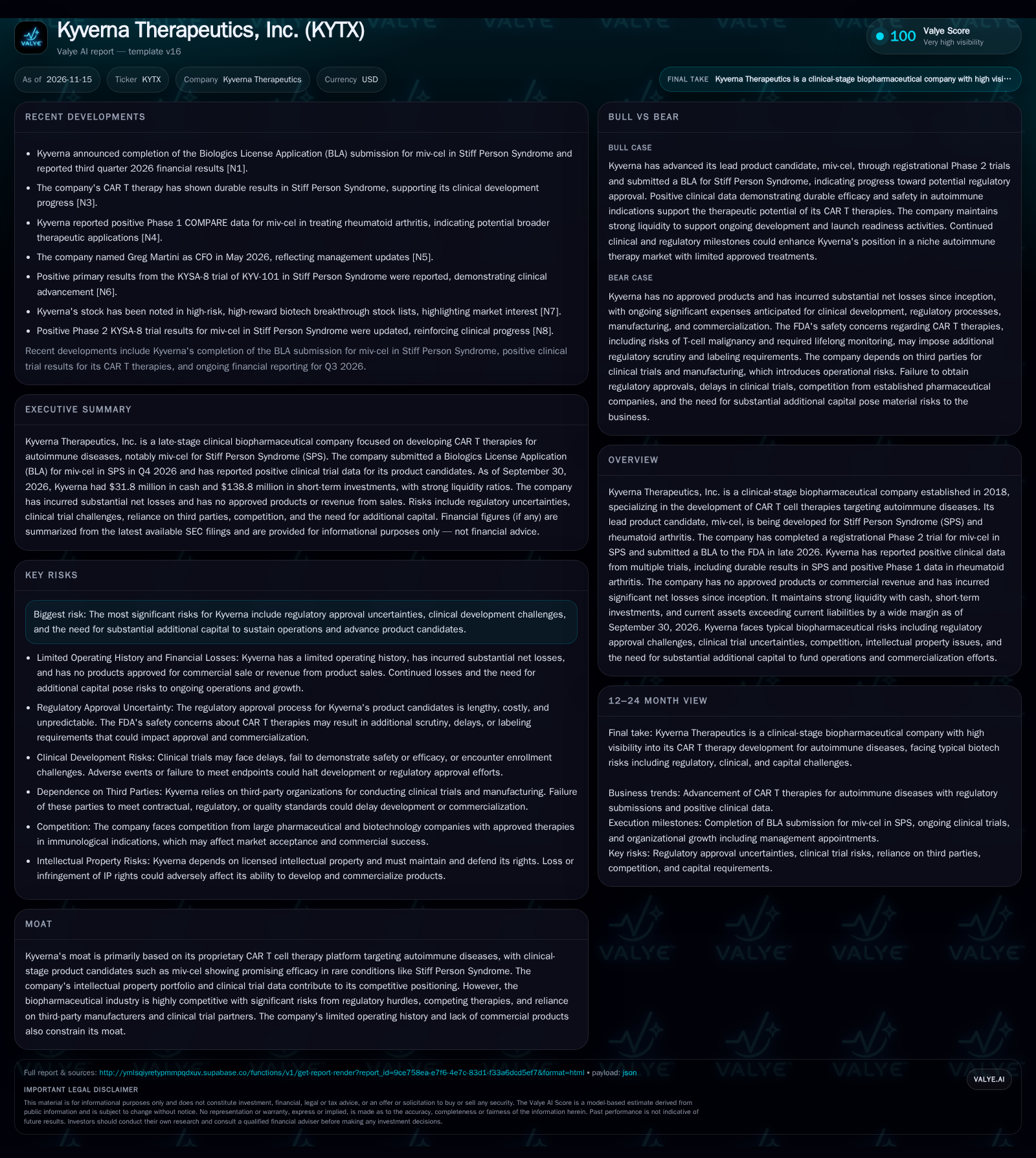
Kyverna Therapeutics has completed a BLA submission for its lead CAR T candidate, miv-cel, in Stiff Person Syndrome, supported by positive clinical results and substantial liquidity. Success depends on regulatory approval, funding continuity, and the ability to scale manufacturing and commercialization against large, established competitors in the autoimmune space. The path forward offers high-reward potential but remains fraught with execution, regulatory, and financial risks. [N1] [N3] [S2]
Kyverna Therapeutics stands at a classic inflection point for clinical-stage biotech: its lead CAR T cell program, miv-cel, has advanced through a successful registrational Phase 2 trial for Stiff Person Syndrome (SPS) and is now under FDA review following a completed Biologics License Application. Positive efficacy signals and a sizable liquidity buffer position the company for potential first-mover advantage in a rare autoimmune indication. Yet, the journey from regulatory submission to commercial viability is fraught with obstacles: regulatory scrutiny—especially regarding CAR T safety—substantial ongoing losses, future capital needs, and the daunting challenge of launching a cell therapy in a market dominated by established autoimmune players. The next 12-24 months will reveal whether Kyverna can parlay its early clinical wins into durable commercial value or succumb to the pitfalls that have felled many late-stage biotechs before it. [N1] [N3] [S2]
From BLA Submission to Regulatory Crossroads: Kyverna’s 2026 Milestones
Kyverna Therapeutics recently completed submission of a Biologics License Application (BLA) for miv-cel in Stiff Person Syndrome, a rare and debilitating autoimmune disorder. This follows positive Phase 2 clinical results demonstrating durable efficacy in SPS and supportive data from Phase 1 studies in rheumatoid arthritis. As of September 30, 2026, Kyverna reported $31.8 million in cash and $138.8 million in short-term investments, with a current ratio of 7.01 and a cash ratio of 6.79, indicating a reported liquidity position. However, the company has no approved products, no commercial revenue, and continues to report substantial net losses ($41.9 million for the first nine months of 2026; accumulated deficit of $544.8 million). The FDA has flagged safety concerns for CAR T therapies, requiring lifelong monitoring for secondary malignancies, which could complicate both the regulatory review and eventual product labeling. [N1] [N3] [N4] [N8] [S2]
Commercialization Economics: High Stakes, High Costs, and Uncertain Pathways
Kyverna’s business model is predicated on moving from a high-burn, pre-revenue R&D stage to generating revenue through the commercialization of miv-cel and potentially other CAR T therapies. The economics of autologous CAR T cell therapies are fundamentally different from oral or small-molecule autoimmune drugs: manufacturing is complex, individualized, and capital intensive, with high fixed costs for production facilities, quality assurance, and logistics. If approved, initial pricing for miv-cel in SPS could command a premium due to the lack of approved alternatives and the severity of the disease, but payer scrutiny and real-world efficacy will be decisive in securing reimbursement. Operating leverage is possible if Kyverna can expand miv-cel’s use to broader autoimmune indications, but each new indication requires fresh clinical investment and regulatory risk. The company’s reliance on third-party manufacturers and clinical trial partners may limit margin expansion and expose it to supply chain disruptions. With no current product revenue, Kyverna’s near-term economics remain dominated by R&D, regulatory, and pre-commercialization expenses, requiring ongoing capital infusions.
Defining Differentiation in a Crowded Autoimmune Therapeutics Landscape
Kyverna faces entrenched competition from large pharmaceutical and biotechnology companies with established franchises in autoimmune and inflammatory disorders. These competitors offer approved therapies—ranging from biologics (e.g., anti-TNF agents) to emerging cell therapies—for indications like rheumatoid arthritis, with wide physician adoption and payer contracts. Kyverna’s primary differentiation lies in the potential for durable, possibly curative, responses in severe autoimmune diseases where existing therapies often require lifelong administration and may be only partially effective. However, the regulatory and safety profile of CAR T therapies—particularly the risk of T-cell malignancy—could limit adoption or relegate the therapy to later lines of treatment. Intellectual property around the CAR T platform and clinical data exclusivity offer some protection, but the rapid pace of innovation in immunology and cell therapy means the moat is likely to be narrow and time-limited unless Kyverna can build a broader portfolio or establish clear real-world superiority.
First-Mover Advantage and Pipeline Expansion: What Success Could Look Like
In a favorable scenario, Kyverna’s BLA for miv-cel is approved on schedule with a manageable safety profile, allowing rapid launch in Stiff Person Syndrome. Early commercial uptake is driven by high unmet need, premium pricing, and positive physician/payer response, while robust post-market data confirm durable efficacy and manageable risks. The company leverages this momentum to accelerate clinical development in broader indications such as rheumatoid arthritis, using positive Phase 1 COMPARE data as a springboard. Manufacturing and logistics scale up without major bottlenecks or cost overruns, and Kyverna raises additional capital at attractive terms, reducing dilution. Evidence to confirm this scenario would include timely FDA approval, favorable reimbursement decisions, robust initial sales (if disclosed), and expansion of the clinical pipeline with new indications advancing efficiently.
Navigating the Regulatory Gauntlet: A Plausible Middle Course
The most likely course is that Kyverna faces moderate regulatory delays as the FDA scrutinizes long-term safety for CAR T in autoimmune disease, possibly requiring enhanced post-marketing surveillance or restrictive labeling. Approval for miv-cel in SPS is eventually granted, but initial uptake is slow as physicians and payers weigh the novelty and risks of CAR T in this population. Commercialization expenses remain high, and Kyverna must raise additional capital—potentially under less favorable terms—as the company ramps up manufacturing and sales infrastructure. Expansion into other indications proceeds cautiously, with additional trials needed to convince regulators and payers of the value proposition. Evidence for this scenario would include FDA requests for additional safety data, cautious or delayed reimbursement, slow initial sales (if disclosed), and continued negative operating cash flow despite regulatory progress.
Regulatory or Safety Setbacks Derail Commercialization Ambitions
In the adverse scenario, the FDA imposes significant restrictions on miv-cel—such as black box warnings, limited patient eligibility, or post-marketing requirements so onerous that commercial uptake is severely constrained. Alternatively, new safety signals emerge (e.g., T-cell malignancy) in ongoing or post-approval studies, leading to trial halts, label revisions, or even withdrawal. Kyverna struggles to secure reimbursement or faces payer pushback on pricing, while manufacturing or supply chain issues delay launch. With no product revenue and ongoing high burn, the company is forced to seek dilutive financing, scale back pipeline investments, or pursue strategic alternatives. Evidence for this scenario would include FDA complete response letters, new adverse safety findings, reimbursement denials, or significant delays in trial enrollment or manufacturing readiness.
Milestones and Metrics to Test Kyverna’s Transition from Clinic to Market
FDA decision timeline and any associated label restrictions or post-marketing requirements for miv-cel in SPS.
Disclosure of initial commercial sales, reimbursement wins, or payer coverage decisions for miv-cel (if approved).
Updates on additional capital raises, runway guidance, or changes in cash burn rate as commercialization efforts expand.
Progress in expanding miv-cel or other CAR T candidates into broader autoimmune indications, especially rheumatoid arthritis trial milestones.
Manufacturing and supply chain readiness, including any reported disruptions or scale-up challenges (if disclosed).
Real-world safety data, including any new reports of T-cell malignancy or other serious adverse events after approval.
Retention or expansion of key clinical and operational personnel as the company scales toward commercialization.
Disclaimer: This is research-only, informational analysis and not investment advice. It may include AI-generated interpretation and general industry context. Always verify important details using primary sources.

Comments