
Leatt Corp: Innovation in Protective Gear Meets the Realities of Global Supply Chains and Diversified Growth
Leatt Corp’s patented neck brace technology and helmet safety innovations anchor its position in the global personal protective equipment market. As the company expands into adventure motorcycle apparel and manages a diverse product portfolio, sustaining growth will depend on manufacturing agility, regulatory vigilance, and execution in new market segments.
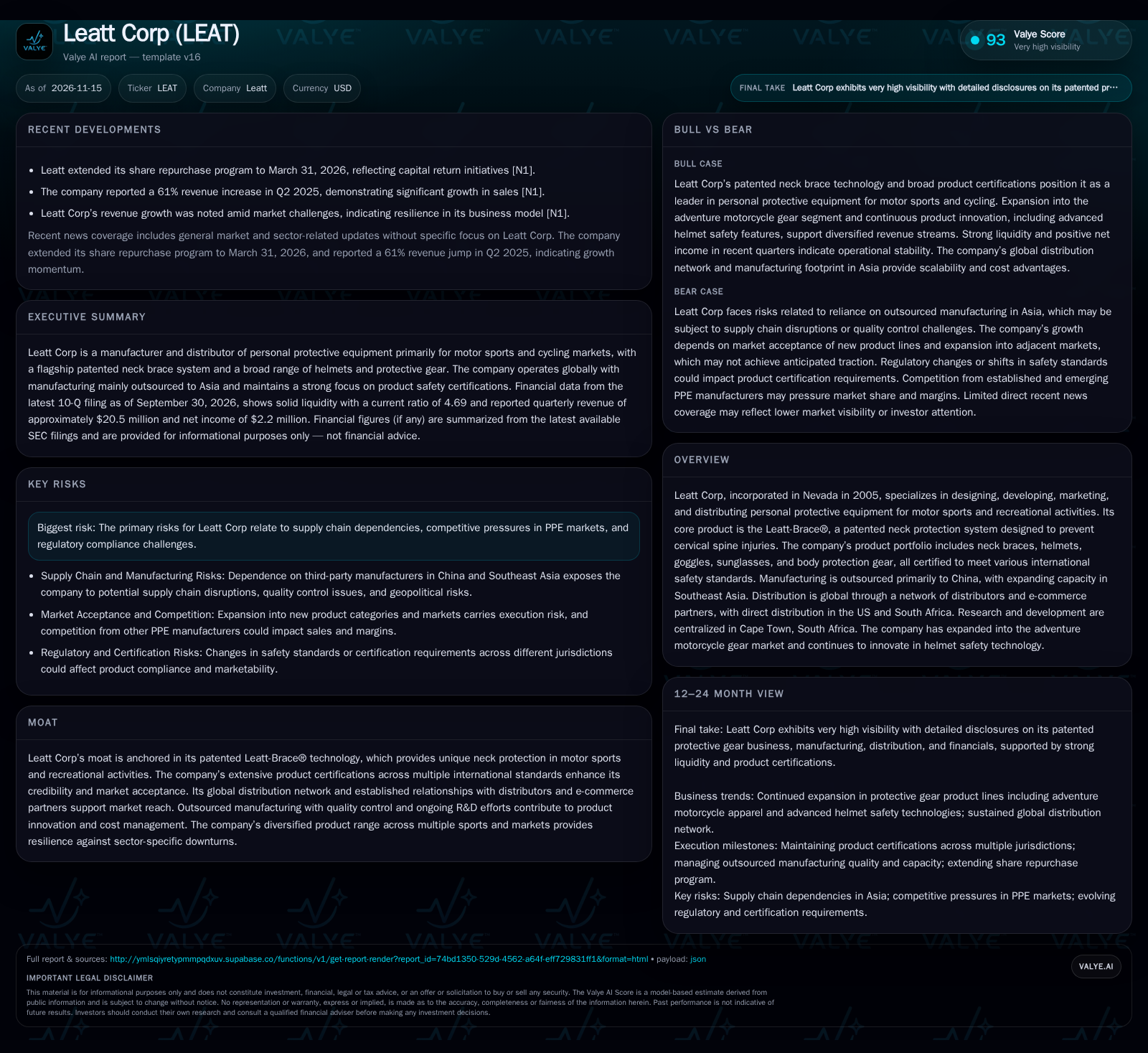
Leatt Corp reported Q3 2026 revenue of $20.5 million and net income of $2.2 million, supported by reported liquidity position and an expanding product line that now includes adventure motorcycle gear. The company’s patented Leatt-Brace® technology and adherence to global safety standards underpin its reputation in the motorsports and cycling PPE market. However, reliance on outsourced manufacturing in Asia and the need to maintain product certifications across jurisdictions present ongoing execution and compliance challenges. Sustaining growth will hinge on successful product innovation, manufacturing resilience, and effective navigation of competitive and regulatory pressures. [S2]
Leatt Corp occupies a distinctive niche in the global personal protective equipment market, leveraging patented technologies like the Leatt-Brace® to address the safety needs of motorsports and cycling enthusiasts. Recent financial results show healthy profitability and liquidity, while ongoing product innovation—such as the expansion into adventure motorcycle apparel—suggests a company intent on broadening its revenue base. Yet, Leatt’s heavy reliance on outsourced Asian manufacturing introduces operational risks, and its future growth will be shaped by its ability to maintain rigorous product standards, adapt to shifting regulatory landscapes, and compete in a crowded market.
Recent Performance and Strategic Moves Shape Leatt’s Outlook
Leatt Corp reported revenue of $20.5 million and net income of $2.2 million for the quarter ending September 30, 2026. The company’s balance sheet showed cash and equivalents of $15.4 million, current assets of $54.6 million, and current liabilities of $11.6 million, yielding a current ratio of 4.69 and a cash ratio of 1.33. The company reported cash and liquidity metrics for the period; these figures do not by themselves establish operating runway, investment capacity, financial flexibility, or financing capacity. Notably, the company’s Adventure gear line, launched in 2023, is cited as a growing revenue source and reflects product innovation beyond its flagship Leatt-Brace®. The extension of the share repurchase program through March 2026 points to continued shareholder return efforts. No material changes in risk factors were reported in the latest 10-Q filing. [S2]
How Leatt’s Product Mix and Cost Structure Influence Profitability
Leatt’s economics are defined by a mix of patented, high-value PPE (notably the Leatt-Brace®), a broad range of helmets and protective apparel, and a distribution model spanning global wholesale and direct-to-consumer channels. The flagship neck brace commands premium pricing due to its patented status and safety certifications, likely supporting above-average gross margins relative to generic PPE. Helmets and body protection products, incorporating proprietary technologies like 360-degree Turbine concussion mitigation, further reinforce pricing power where safety differentiation is valued.
The company outsources manufacturing to third-party partners in China, with additional capacity in Thailand, Cambodia, and Bangladesh. This strategy enables variable cost scaling and minimizes fixed capital investment, but exposes Leatt to input cost volatility, geopolitical risk, and quality control demands. Manufacturing cost flexibility can support margin preservation if demand fluctuates, but quality lapses or supply chain shocks could erode profitability.
Leatt’s distribution through 61 global distributors and 6 e-commerce partners, alongside direct sales in the US and South Africa, suggests a hybrid channel approach. Direct sales may yield higher margins, while distributor relationships drive broader market access but at a cost of channel discounts. R&D, centralized in Cape Town, is modest in scale but crucial for product refresh cycles and regulatory compliance. The extension into adventure motorcycle gear introduces a new product mix—likely at lower initial margins but with potential for operating leverage as volumes grow.
Patents, Certifications, and Brand Reputation: Sources and Limits of Leatt’s Market Edge
Leatt’s competitive position is anchored by its patented Leatt-Brace® technology, which serves as a recognized standard in motorsports neck protection. This patent protection, combined with a portfolio of international safety certifications (CE, DOT, ECE, ASTM, CPSC, and others), builds trust with both end-users and distribution partners. The company’s helmet line, incorporating proprietary concussion and brain rotation safety features, further differentiates the brand in a market often dominated by legacy PPE manufacturers and lower-cost entrants.
However, the competitive landscape is dynamic. Global PPE players—ranging from established brands with deep distribution to specialized innovators—compete on safety, price, and brand loyalty. Leatt’s ability to maintain its edge depends on the continued relevance of its IP, the pace of product innovation, and sustained investment in certification and compliance. New entrants, particularly those leveraging direct-to-consumer digital channels or global manufacturing scale, could pressure margins and erode share. The expansion into adventure motorcycle apparel pits Leatt against both traditional powersports brands and nimble lifestyle companies, raising the execution stakes.
Innovation and Brand Loyalty Drive Market Share Gains
A favorable outcome for Leatt would be driven by several reinforcing factors: successful scaling of the Adventure gear line, continued innovation in helmet and body protection technologies, and deepening brand loyalty among motorsports and cycling communities. If the company capitalizes on its reputation for safety and leverages its global distribution network, it could capture share in both core and adjacent markets. Operating leverage may emerge if new product categories reach scale, allowing fixed R&D and overhead investments to support a larger revenue base.
Evidence supporting this scenario would include accelerating growth in new product revenue (such as Adventure gear), consistently high gross margins driven by premium pricing, and expansion of direct-to-consumer sales channels. Additional confirmation would come from new or renewed large distributor agreements, increased adoption of Leatt products in professional sports, and ongoing patent filings or regulatory certifications that reinforce the brand’s technical edge. Share repurchases funded by growing free cash flow would further indicate robust underlying economics.
Sustained Growth Amid Execution and Compliance Challenges
The most plausible trajectory for Leatt is steady, incremental growth driven by its established product lines, periodic product refreshes, and measured expansion into adjacent segments like adventure apparel. The company’s broad certification base and distribution partnerships should underpin stable demand in core markets, while the Adventure line provides modest incremental revenue as it gains traction.
However, this scenario assumes Leatt can manage supply chain volatility, maintain quality standards across an increasingly complex manufacturing footprint, and stay ahead of evolving regulatory requirements. Revenue growth would likely be moderate, with profitability supported by disciplined cost control but limited by initial ramp-up costs in new product areas. Confirmation would come from stable or gradually improving gross margins, a consistent cadence of product launches meeting certification standards, and absence of major supply chain disruptions or product recalls.
Supply Chain Disruptions and Regulatory Hurdles Undercut Momentum
Adverse outcomes for Leatt could stem from several sources: a major supply chain disruption (e.g., geopolitical tensions, labor issues, or quality failures in Asia), regulatory shifts that impose new certification barriers or require costly redesigns, or execution missteps in launching new product lines. Should manufacturing partners fail to deliver consistent quality, or if logistics bottlenecks delay product availability, the company could see both lost sales and margin compression from expedited shipping or remediation costs.
Increased competition—especially from larger PPE brands with greater resources or digital-first disruptors—could force Leatt into price competition, eroding margins. Regulatory changes that invalidate existing certifications or require expensive compliance upgrades would further weigh on profitability. Evidence for this scenario would include gross margin declines, inventory write-downs, delayed or failed product launches, increased warranty or recall costs, and negative revisions to financial guidance.
Milestones and Metrics That Will Shape Leatt’s Competitive Trajectory
Quarterly breakdown of revenue by product category, particularly the contribution from new lines like Adventure gear (if disclosed), would help gauge the pace of diversification.
Gross margin trends, both consolidated and by product segment, would indicate the company’s ability to maintain pricing power and manage input costs.
Frequency and scope of new or renewed distributor/e-commerce partnerships, especially in key growth markets, would test the reach and resilience of the distribution network.
Updates on supply chain stability—including any commentary on manufacturing transitions or sourcing diversification—would help assess operational risk.
Product recall rates or quality-related customer feedback, if disclosed, would serve as early warning signs for manufacturing or design issues.
New patent filings, regulatory approvals, or product certifications would support innovation claims and market access.
Inventory turnover and working capital trends could signal either healthy demand or potential channel stuffing/overproduction risks.
Progress or changes in the share repurchase program could reflect management’s view on capital allocation and confidence in future cash flows.
Disclaimer: This is research-only, informational analysis and not investment advice. It may include AI-generated interpretation and general industry context. Always verify important details using primary sources.

Comments