
Avalyn Pharma: Inhaled Fibrosis Ambitions, Clinical Inflection Points, and the Realities of Pre-Revenue Biotech
Avalyn Pharma is advancing inhaled therapies for lung fibrosis with AP01 and AP02 in clinical development, a reported liquidity position buffer, and deepening regulatory expertise, but faces the classic hurdles of clinical-stage biotech: zero revenue, ongoing losses, and high dependency on pivotal trial outcomes.
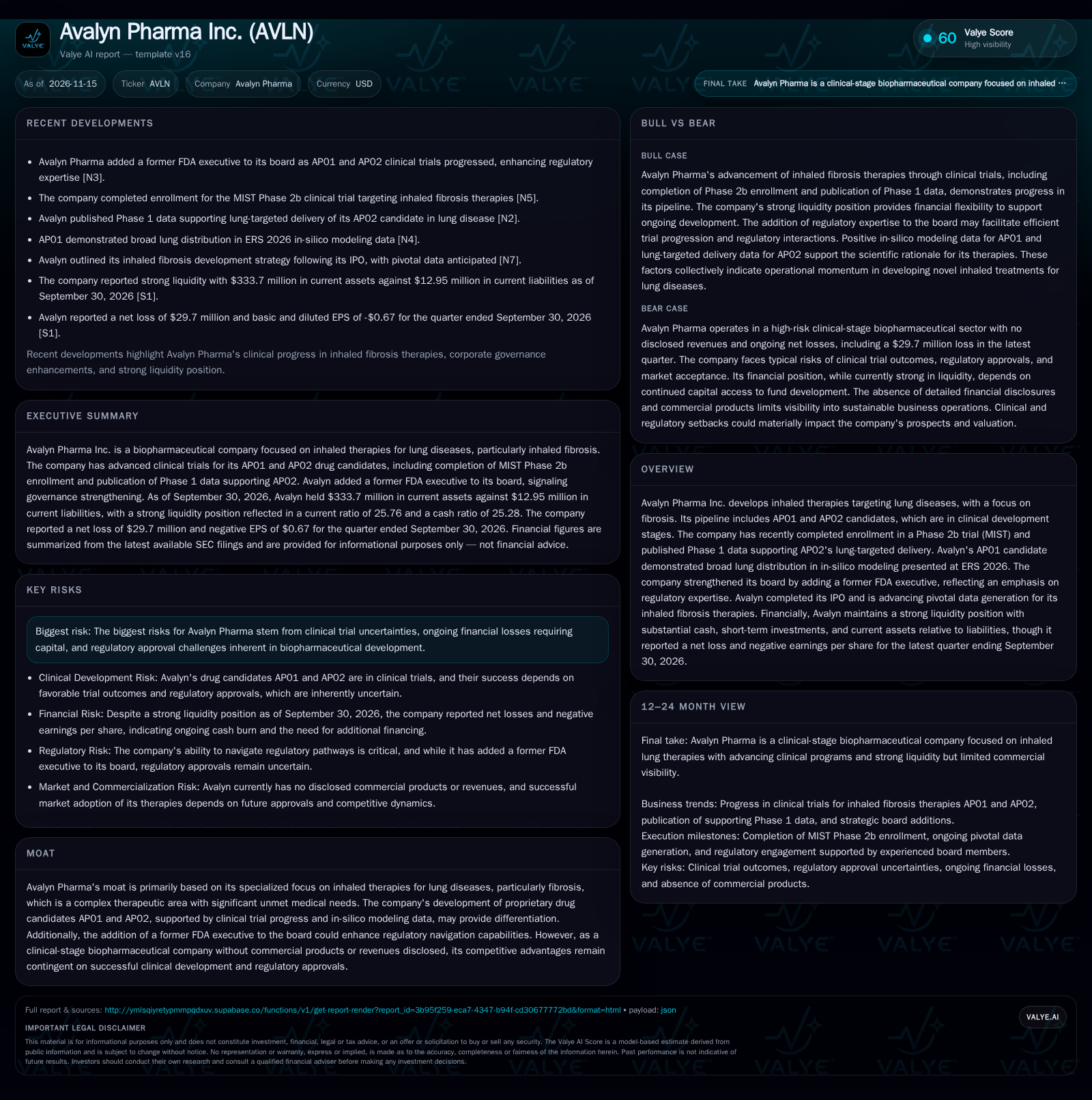
Avalyn Pharma is a clinical-stage biopharma pushing inhaled fibrosis therapies (AP01, AP02), now bolstered by substantial liquidity ($333.7M in current assets vs. $12.95M liabilities), recent IPO proceeds, and new regulatory expertise on its board. Early data (in-silico and Phase 1) show scientific promise, but the company remains pre-revenue, reporting a $29.7M net loss for the latest quarter. The next 12–24 months hinge on pivotal trial results and regulatory clarity, with no commercial products yet.
Avalyn Pharma sits at a strategic crossroads typical of clinical-stage biotech: armed with a large post-IPO cash reserve and promising inhaled fibrosis assets, but still pre-revenue and burning capital. The company’s AP01 and AP02 programs are progressing through trials, with recent in-silico and Phase 1 data supporting their mechanistic rationale. The addition of a former FDA executive to its board underscores Avalyn’s focus on regulatory success—a key determinant of value for novel therapies targeting underserved lung diseases. The next phase will test whether scientific promise and potential financial flexibility can translate into regulatory wins, commercial traction, and ultimately, sustainable economics.
Clinical Progress, Board Strengthening, and a Reported Liquidity Position Cushion Define Today’s Snapshot
As of September 30, 2026, Avalyn Pharma reported $145.4 million in cash and equivalents and $182.0 million in short-term investments, resulting in $333.7 million in current assets versus $12.95 million in current liabilities—a current ratio of 25.76 and a cash ratio of 25.28 [S1]. This reflects a reported liquidity position, likely influenced by recent IPO proceeds.
The company's pipeline is anchored by AP01 and AP02, both inhaled fibrosis drug candidates advancing through mid-to-late-stage clinical testing. AP01 demonstrated broad lung distribution in in-silico modeling presented at ERS 2026, while AP02 is supported by Phase 1 data for targeted lung delivery [N2] [N4].
Avalyn has also added a former FDA executive to its board as clinical trials progressed, signaling a strategic emphasis on regulatory expertise at a critical juncture for pivotal trial data and potential regulatory filings [N3].
Despite these advances, Avalyn remains pre-revenue and reported a net loss of $29.7 million and basic/diluted EPS of -$0.67 for the quarter ended September 30, 2026 [S1].
How Inhaled Fibrosis Therapies Might Translate to Future Revenue and Margin Structure
Avalyn’s business model is typical of clinical-stage biotech: significant upfront investment in R&D, clinical trials, and regulatory preparation, with no current revenue streams. The company reported cash and liquidity metrics for the period; these figures do not by themselves establish operating runway, investment capacity, financial flexibility, or financing capacity. [S1]
If AP01 or AP02 reach market, potential economics could include high per-patient pricing, reflecting the unmet need and chronic nature of fibrotic lung diseases. Inhaled delivery may offer differentiated value over systemic competitors by improving lung-specific drug exposure and potentially reducing systemic side effects—if these advantages are validated in pivotal trials.
Commercialization would likely require significant investment in specialty sales infrastructure, payer engagement, and post-market studies, especially given the rare-disease focus. Fixed costs for R&D and regulatory activities dominate in the near term, but the model could offer operating leverage if a product achieves scale.
Avalyn’s capital needs remain high, and despite its current liquidity, further dilution or partnership may be required in the absence of near-term revenue, particularly if development timelines extend or additional programs are advanced.
Specialization in Inhaled Delivery: Potential Differentiators and Looming Competitive Pressures
Avalyn’s main source of potential differentiation lies in its inhaled approach to treating fibrotic lung diseases, an area where most competitors focus on oral or systemic therapies. If the company’s clinical data can demonstrate superior efficacy or safety, inhaled AP01 and AP02 could carve out a distinct position in a market with significant unmet needs.
However, Avalyn faces competition from larger, well-capitalized pharmaceutical companies with approved treatments for idiopathic pulmonary fibrosis and related diseases. These incumbents benefit from commercial scale, established payer relationships, and broad clinical development platforms.
The addition of a former FDA executive to Avalyn’s board may help navigate regulatory complexities, but the moat remains contingent on clinical outcomes and eventual intellectual property protection. Barriers to entry are moderate, as inhaled delivery systems require specialized development but are not insurmountable for larger competitors if the market opportunity proves attractive.
Generic substitution is less likely in the near term due to the complexity of inhaled biologics and device-drug combinations, but eventual competition from both branded and biosimilar entrants is plausible if Avalyn’s products achieve commercial success.
If Pivotal Data Validate Efficacy and Safety, Avalyn Could Become a Commercial Contender
The most favorable scenario is that pivotal trials for AP01 and/or AP02 demonstrate clear, clinically meaningful improvements in lung function or disease progression, with a safety profile that differentiates inhaled therapy from systemic competitors. This would support regulatory approval and rapid uptake in targeted patient populations.
Early signals—such as AP01’s broad lung distribution in in-silico modeling and AP02’s targeted lung delivery in Phase 1—suggest the scientific rationale is sound, but only pivotal data can confirm clinical benefit [N2] [N4].
Evidence for this scenario would include: positive top-line pivotal trial results, expedited regulatory review or breakthrough designation, and early strategic partnerships or licensing deals with large pharma.
Falsification would occur if pivotal data show marginal benefit, unexpected safety issues, or fail to meet primary endpoints—undermining the commercial thesis and likely leading to significant revaluation.
Clinical Progress Amid Uncertainty: The Most Likely Trajectory for the Next 12–24 Months
The plausible middle path is that Avalyn continues to advance AP01 and AP02 through pivotal trials, with incremental data releases but without immediate regulatory approval or commercialization. Cash burn persists as the company invests in trial execution, regulatory engagement, and pre-commercial planning.
The newly strengthened board may help preempt regulatory pitfalls, but the company remains exposed to development risks, capital market volatility, and the possibility of needing to raise additional funds before revenue inflection.
Evidence supporting this scenario would include steady progress on trial enrollment and milestones, continued cash runway, and no major clinical or regulatory setbacks. Downside would be signaled by delayed trials, greater-than-expected cash burn, or negative data readouts.
Adverse Clinical Outcomes or Regulatory Setbacks Could Force Strategic Retrenchment
In the negative scenario, one or both lead programs encounter safety signals, fail to meet efficacy endpoints in pivotal trials, or face regulatory delays. Given the absence of commercial revenue and ongoing losses, such outcomes would force Avalyn to cut costs, seek strategic alternatives, or raise capital on unfavorable terms.
Additional dilution or loss of investor confidence could follow if the company is forced to pivot or deprioritize its lead assets. The lack of diversification in the pipeline increases this vulnerability.
Confirmation of this scenario would come from negative pivotal data, clinical holds, or regulatory rejections, as well as abrupt changes in cash guidance, staff reductions, or partnership terminations.
Milestones and External Factors That Will Shape Avalyn’s Clinical and Commercial Trajectory
Top-line results from pivotal trials for AP01 and AP02—positive or negative—will determine the company’s future.
Updates on regulatory interactions, including breakthrough therapy designation, fast track status, or IND submissions, would clarify the speed to potential approval.
Disclosure of any strategic partnerships, licensing deals, or co-development agreements would signal external validation and possible non-dilutive funding.
Progress on MIST Phase 2b enrollment and data readouts for AP01 would provide insight into the clinical momentum and possible timing of pivotal data.
Any signs of adverse safety findings, trial discontinuations, or regulatory holds would be material red flags.
A useful metric would be the number of patients enrolled and retained in ongoing pivotal studies, as this affects statistical power and timeline certainty.
Emergence of new competitors or alternative therapies in the inhaled fibrosis space could alter the commercial opportunity and shape future strategy.
Disclaimer: This is research-only, informational analysis and not investment advice. It may include AI-generated interpretation and general industry context. Always verify important details using primary sources.

Comments