
Taysha Gene Therapies: Clinical Milestones, Cash Reserves, and the Stakes of Pre-Revenue Gene Therapy Development
Taysha Gene Therapies remains a pre-revenue biotech with a substantial cash position and an upcoming interim data readout for its lead Rett syndrome gene therapy. With widening losses and no commercialized products, the company’s near-term trajectory hinges on clinical progress, regulatory clarity, and the ability to translate pipeline advances into sustainable value.
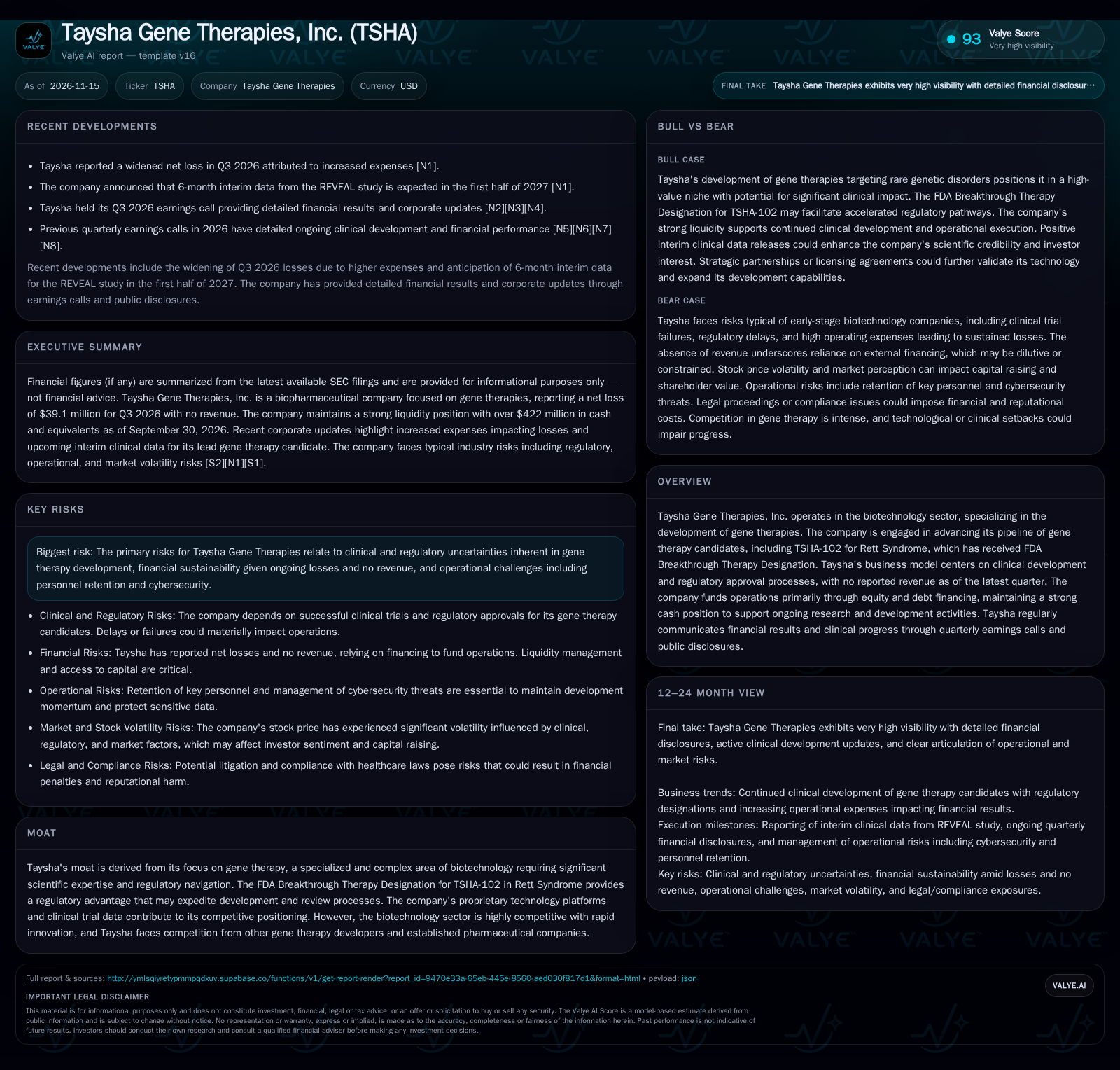
Taysha Gene Therapies reported a widened Q3 2026 net loss of $39.1 million and ended the quarter with $422.8 million in cash and equivalents, but has yet to generate revenue. The anticipated first-half 2027 REVEAL study interim data for TSHA-102 in Rett syndrome will be a critical inflection point. [S2] [N1]
Taysha Gene Therapies stands at a critical juncture as a pre-commercial gene therapy developer with a reported cash position but no product revenue. The company’s Q3 2026 results underscore widening losses driven by increased clinical investment, while the forthcoming interim results from its lead Rett syndrome program could reshape its prospects. With an industry landscape characterized by intense competition, regulatory hurdles, and high capital requirements, Taysha’s ability to convert scientific progress into commercial and shareholder value will hinge on near-term clinical outcomes and the company’s strategic choices over the next 12-24 months.
Pre-Revenue Status, Expanding Losses, and a Pivotal Data Readout on the Horizon
As of September 30, 2026, Taysha Gene Therapies reported a net loss of $39.1 million for the quarter, with no revenue generated, reflecting its ongoing investment in research and clinical development. These resources are earmarked for advancing the pipeline, including TSHA-102 for Rett syndrome, which has received FDA Breakthrough Therapy Designation. Critically, 6-month interim data from the REVEAL study of TSHA-102 is anticipated in the first half of 2027, representing a near-term inflection point that could determine the trajectory for both regulatory progress and future financing options. [S2] [N1]
The timing and quality of interim clinical data will not only influence regulatory engagement but also impact investor sentiment and the company’s ability to secure future financing on favorable terms. Given the high capital intensity of gene therapy development, the market often reacts sharply to clinical readouts, which can either validate the underlying science or raise concerns about efficacy and safety. Consequently, Taysha’s management must carefully balance transparency with strategic communication to maintain stakeholder confidence while navigating the inherent uncertainties of clinical research. Additionally, the evolving competitive landscape means that even positive data must be contextualized against peer progress and emerging scientific standards.
How Taysha’s Business Model Converts Science into Potential Value—If Clinical Success Arrives
Taysha’s business model is predicated on advancing gene therapy candidates through preclinical and clinical development, with the goal of eventual regulatory approval, commercialization, and out-licensing or partnership opportunities. The economics of gene therapy are characterized by high upfront R&D and operating costs, often resulting in years of losses before any potential revenue. Taysha currently reports zero revenue, so its burn rate is funded entirely by its cash reserves and external capital. If clinical trials succeed and lead to approval, gene therapies targeting rare diseases like Rett syndrome can command premium pricing due to high unmet need and orphan drug incentives, with relatively small patient populations but potentially high per-patient revenues. However, these economics are only realized after surmounting regulatory and commercialization hurdles, and the company must carefully manage its fixed cost base to preserve runway.
From a financial modeling perspective, the conversion of clinical success into commercial value depends heavily on the company’s ability to scale manufacturing efficiently and manage post-approval costs, which can be substantial in gene therapy due to complex production processes and patient monitoring requirements. If Taysha can leverage economies of scale or innovative manufacturing technologies, it could improve gross margins and enhance long-term profitability. Conversely, failure to control these costs or delays in scaling could compress margins and extend the timeline to profitability. Furthermore, the company’s capital structure and financing strategy will influence its flexibility to invest in commercialization or pipeline expansion, especially if initial revenues fall short of expectations.
Differentiation in a Crowded and Rapidly Advancing Gene Therapy Arena
Taysha operates in a highly competitive gene therapy sector, with both emerging biotechs and large pharmaceutical incumbents targeting monogenic neurological disorders. The FDA Breakthrough Therapy Designation for TSHA-102 in Rett syndrome provides some regulatory and signaling edge, potentially expediting review and heightening visibility. However, several peer companies are pursuing similar indications or modalities, and the field is marked by rapid innovation, evolving manufacturing standards, and the constant threat of clinical setbacks. Taysha’s ability to carve out a defensible niche will depend on demonstrating clear clinical differentiation, establishing intellectual property barriers, and efficiently executing on regulatory and commercial milestones. The company’s relative strength lies in its scientific focus and cash position, but the absence of commercial partnerships or revenue leaves it vulnerable to competitors with deeper pipelines or established market presence.
In addition to clinical and regulatory differentiation, Taysha’s competitive positioning will be influenced by its intellectual property portfolio and freedom to operate, which determine its ability to defend market share and negotiate partnerships. Strategic collaborations with contract manufacturing organizations or academic institutions could also provide advantages in cost control and access to specialized expertise. Moreover, the company’s geographic focus and ability to navigate reimbursement landscapes in key markets will be critical, as payer acceptance and pricing negotiations often dictate commercial success in rare disease therapies. Finally, the rapid pace of innovation in gene editing and delivery platforms means that Taysha must continuously evaluate its technology stack to avoid obsolescence and maintain relevance.
Breakthrough Clinical Data Catalyzes Regulatory Acceleration and Strategic Partnership Opportunities
A favorable scenario for Taysha would see the REVEAL study’s 6-month interim results for TSHA-102 in Rett syndrome demonstrate compelling efficacy and safety, exceeding expectations and addressing a significant unmet need. Such an outcome could accelerate regulatory discussions, potentially leading to expedited review or even early access programs. Positive data would also likely attract interest from larger biopharma partners seeking to enter or expand in gene therapy for neurodevelopmental disorders, opening doors to non-dilutive funding through licensing or co-development deals. Confirmation of this scenario would come from robust clinical endpoints, regulatory feedback indicating willingness to fast-track approval, and announcements of strategic collaborations or commercial partnerships. Conversely, equivocal or negative data would quickly undermine this upside thesis.
Clinical Progression Continues, but Commercialization and Revenue Remain Distant
The most plausible trajectory is that Taysha continues advancing TSHA-102 and other pipeline assets through clinical milestones, with incremental but not transformative data from the REVEAL study in the first half of 2027. Regulatory engagement may progress steadily but without breakthrough acceleration, and commercial partnerships or out-licensing remain on the horizon rather than imminent. Evidence for this scenario would include continued clinical updates, steady cash burn, and periodic fundraising or equity issuance announcements. A shift away from this path would require either unexpectedly strong clinical results (shifting to the upside) or material clinical, regulatory, or operational setbacks (moving toward the downside).
Clinical Setbacks Erode Investor Confidence and Trigger Funding Pressures
In the adverse scenario, interim or subsequent data from the REVEAL study fails to demonstrate sufficient efficacy or safety, delaying or derailing regulatory progress for TSHA-102. Such an outcome would likely be met with negative market reaction, making future capital raises more difficult and potentially forcing Taysha to reprioritize or scale back its pipeline. The lack of revenue and ongoing high cash burn would magnify these pressures, especially if combined with adverse external conditions such as tightening biotech funding or increased regulatory scrutiny. Evidence confirming this scenario would include negative clinical data releases, pipeline discontinuations, significant layoffs or restructuring, and/or announcements of dilutive financing under distressed terms.
Milestones and Metrics That Will Shape Taysha’s Value Proposition
6-month interim data from the REVEAL study of TSHA-102 in Rett syndrome (expected H1 2027): The most important near-term catalyst for both clinical and investor sentiment.
Quarterly cash burn and runway projections: Monitoring whether the company’s operating expenses accelerate or remain stable, and how long current reserves will last if no revenue is generated.
Regulatory feedback and interactions (if disclosed): Updates from the FDA or other agencies on the path to approval, including any signs of expedited review or requests for additional data.
Progress or setbacks in other pipeline assets: Any advancement, delay, or discontinuation of programs beyond TSHA-102 would impact long-term optionality.
Partnership or licensing announcements: Evidence of non-dilutive funding or strategic alliances would validate external interest in Taysha’s platform.
Workforce stability and retention of key scientific/clinical personnel: A useful metric would be voluntary turnover or disclosures of leadership changes, as talent loss could disrupt development.
Legal, cybersecurity, or compliance events: Any disclosed investigations, breaches, or litigation could introduce new risks or costs.
Disclaimer: This is research-only, informational analysis and not investment advice. It may include AI-generated interpretation and general industry context. Always verify important details using primary sources.

Comments