
Capstone Holding Corp.: Recurring Losses, Dilution Dynamics, and the Tenuous Path to Financial Stability
Capstone Holding Corp. contends with persistent net losses, aggressive dilution from convertible notes, and ongoing covenant compliance challenges.
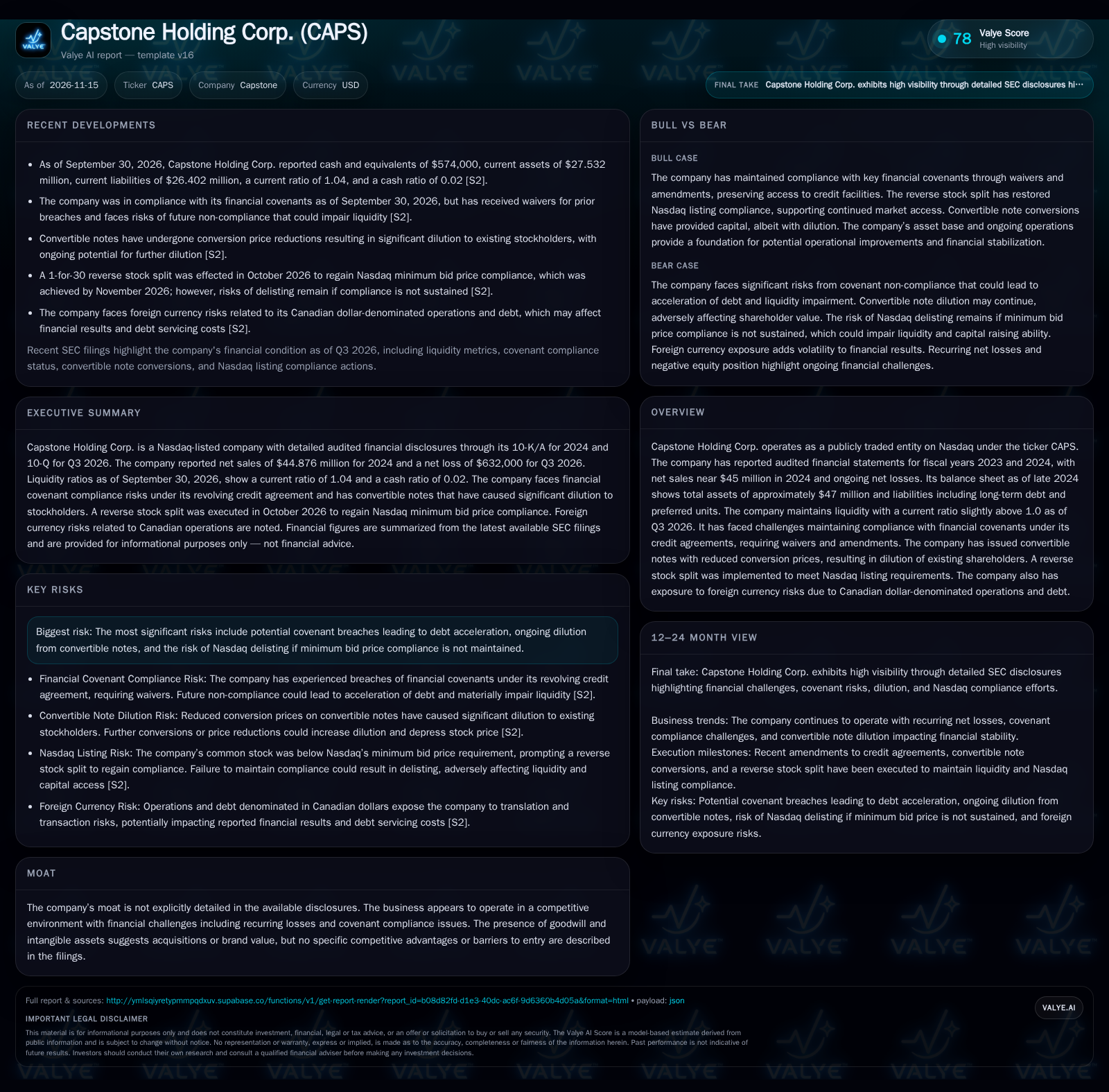
Capstone Holding Corp. remains operationally active with net sales near $45 million in 2024, but faces ongoing net losses, covenant compliance risks, and significant dilution from convertible notes. A recent reverse stock split restored Nasdaq listing compliance; however, risks of delisting, debt acceleration, and further dilution persist, leaving the company’s financial stability precarious. [S1] [S2]
Persistent net losses, aggressive dilution from convertible securities, and repeated covenant compliance issues cast doubt on its ability to achieve sustainable profitability or long-term shareholder value. Investors must weigh the short-term reprieve against the persistent structural risks that could resurface at any sign of operational or market weakness. [S1] [S2]
Recent Financial Maneuvers Define the Company’s Near-Term Survival
Capstone Holding Corp. reported net sales of $44.876 million for 2024 but continued to post net losses, with a $632,000 deficit in Q3 2026 and a basic EPS of -$1.28 for the quarter. The company reported cash and liquidity metrics for the period; these figures do not by themselves establish operating runway, investment capacity, financial flexibility, or financing capacity. Liquidity remains thin and highly sensitive to operational disruptions or credit events. The company has also faced multiple covenant breaches under its revolving credit agreement, relying on waivers to avoid acceleration of debt or immediate liquidity impairment. In October 2026, Capstone executed a 1-for-30 reverse stock split to regain compliance with Nasdaq’s minimum bid price requirement, but the risk of delisting persists if share prices slip again below the $1.00 threshold. Convertible notes with reduced conversion prices have introduced substantial dilution for existing shareholders, with the potential for further dilution if additional conversions occur. [S1] [S2]
Economic Realities: Thin Margins, High Fixed Costs, and Dilutive Financing
Capstone’s business model appears to generate moderate revenue but lacks sufficient margin or cost discipline to achieve profitability. With annual net sales approaching $45 million but recurring net losses, the company’s fixed cost base—likely including SG&A, interest expense, and potentially underutilized assets—appears to outpace its gross profit generation. Variable costs may be managed, but the persistent negative net income suggests operating leverage is not translating into earnings growth. The reliance on revolving credit facilities and convertible debt indicates limited access to non-dilutive capital. Convertible notes, in particular, have enabled short-term liquidity but at the cost of significant dilution, as lower conversion prices increase the share count and depress per-share value. The company’s ongoing covenant compliance issues highlight the fragility of its funding structure: should waivers cease or debt be accelerated, Capstone could face a liquidity crisis. Capital needs remain acute, and the company’s ability to self-fund growth or even maintain operations without further external capital appears questionable. [S1] [S2]
The company's elevated fixed cost structure inherently limits its operational flexibility, especially in volatile market conditions. Fixed expenses such as rent, salaries, and debt servicing must be met regardless of revenue fluctuations, which amplifies the impact of any downturns on net income. This dynamic creates a high operating leverage scenario where small declines in sales can disproportionately worsen losses. Moreover, the lack of access to non-dilutive capital sources constrains the company’s ability to invest in efficiency improvements or strategic initiatives that might otherwise enhance margins. Should interest rates rise or credit markets tighten, refinancing costs could increase, further pressuring profitability and liquidity.
Structural Disadvantages in a Crowded Market Landscape
The available disclosures do not detail Capstone’s specific industry or competitive advantages, but the company’s persistent losses and lack of described moat suggest it operates in a commoditized or highly contested space. The presence of goodwill and intangible assets implies past acquisitions or brand investments, yet no evidence of pricing power, sticky customer relationships, or proprietary technology is cited. Without clear barriers to entry or sustainable differentiation, Capstone is likely vulnerable to better-capitalized or more efficient peers. Its ongoing financial instability—visible through covenant breaches and dilutive financing—may further erode customer and supplier confidence, making it harder to secure favorable commercial terms or retain key relationships. Foreign currency exposure due to Canadian operations introduces additional volatility and risk, potentially putting Capstone at a disadvantage relative to competitors with more localized or hedged balance sheets. [S2]
In markets characterized by commoditization and intense competition, companies without clear differentiation often compete primarily on price, which compresses margins and limits profitability. Capstone's apparent lack of proprietary technology or strong brand loyalty suggests it may struggle to command premium pricing or customer stickiness. This competitive pressure not only affects revenue growth potential but also increases vulnerability to cost inflation, as the company may be unable to pass through higher input costs to customers. Additionally, suppliers and partners may be less willing to extend favorable terms to firms exhibiting financial distress, potentially increasing working capital requirements and operational risk.
Operational Turnaround and Debt Restructuring Could Restore Value
The most plausible bull case for Capstone involves a combination of operational improvements—such as cost rationalization, margin expansion, or revenue growth—and successful restructuring of its debt and equity capital base. If management can stabilize or grow revenues while reducing fixed costs and improving gross margins, the company could approach breakeven or positive cash flow. Concurrently, renegotiating debt terms, converting high-cost debt into equity at less dilutive terms, or securing new equity investment could alleviate short-term liquidity pressures and reduce the risk of covenant breaches. Progress would be confirmed by sustained positive operating cash flow, declining net losses, stabilization or improvement in per-share metrics, and evidence of less frequent reliance on waivers or amendments to credit agreements. Falsification would come from continued operating losses, persistent covenant breaches, or another wave of aggressive dilution. [S1] [S2]
Ongoing Dilution and Marginal Operations Sustain a Precarious Equilibrium
The most likely trajectory is a continuation of current trends: Capstone remains operational, but persistent net losses are offset by periodic waivers and dilutive financing events. Revenue may remain stable or grow modestly, but without a step-change in cost structure or margin profile, profitability remains elusive. Convertible note conversions continue to dilute existing shareholders, and the company periodically faces Nasdaq compliance risk, potentially requiring further corporate actions such as additional reverse splits or capital raises. The base case is confirmed by continued reliance on waivers, regular dilution events, and a share price hovering near the minimum listing threshold. Falsification would require a decisive break from these patterns—either a move to sustained profitability or, conversely, a liquidity crisis leading to delisting or restructuring. [S2]
Under the ongoing dilution and marginal operations scenario, the company’s capital structure could become increasingly complex and burdensome. Frequent conversions of convertible notes at depressed prices dilute existing equity holders and may deter new investors wary of further dilution. This cycle can depress share price and market capitalization, complicating efforts to raise fresh capital on reasonable terms. Without meaningful operational improvements, the company risks becoming locked in a low-growth, high-risk equilibrium where survival depends on continuous external support rather than internal value creation. This scenario also raises the possibility that management’s strategic options become constrained, limiting the ability to execute turnaround initiatives or pursue growth opportunities.
Debt Acceleration, Delisting, and Dilution Spiral Threaten Going-Concern Status
In a negative scenario, Capstone fails to secure further waivers or breaches new covenants, triggering acceleration of outstanding debt and a liquidity crisis. If the share price falls below the Nasdaq minimum and is not quickly remedied, delisting could occur, severely limiting access to capital markets and eroding stakeholder confidence. Concurrently, ongoing or emergency conversions of convertible notes at depressed prices could further dilute shareholders, compounding value destruction. This scenario would be confirmed by public notice of covenant default without waiver, delisting notifications, or material adverse changes in capital structure. Falsification would require evidence of renewed covenant compliance, emergency capital infusion, or a successful turnaround in operating results. [S2]
Milestones and Metrics That Will Define Capstone’s Financial Trajectory
Frequency and terms of future covenant waivers or amendments under the revolving credit agreement; increased reliance suggests rising financial stress.
Quarterly operating cash flow and net income trends; sustained improvement would support the case for stabilization.
Magnitude and price of future convertible note conversions; ongoing dilution at lower prices would threaten shareholder value.
Nasdaq listing compliance status and any further reverse split or corporate action announcements.
Disclosures regarding cost reduction initiatives or margin expansion, if any; evidence of structural cost improvement would be a positive inflection.
Reported changes in working capital and liquidity reserves each quarter, especially cash and equivalents.
Currency translation and transaction impacts from Canadian operations; increased volatility here could signal rising risk.
Any disclosure of new customer contracts, commercial wins, or asset sales that could alter revenue or capital needs.
Disclaimer: This is research-only, informational analysis and not investment advice. It may include AI-generated interpretation and general industry context. Always verify important details using primary sources.

Comments