
BTCS Inc.: Ethereum-Focused Infrastructure Ambitions, DeFi Expansion, and the Stakes of Operating Leverage in a Volatile Ecosystem
BTCS Inc. is executing a strategic bet on Ethereum-centric blockchain infrastructure and DeFi activities, posting record profitability while scaling its Imperium platform and Builder+ operations. The company’s integrated capital strategy and proprietary technology underpin its current gross margin achievements, but operational scale, competitive intensity, and the unpredictability of DeFi markets remain pivotal variables.
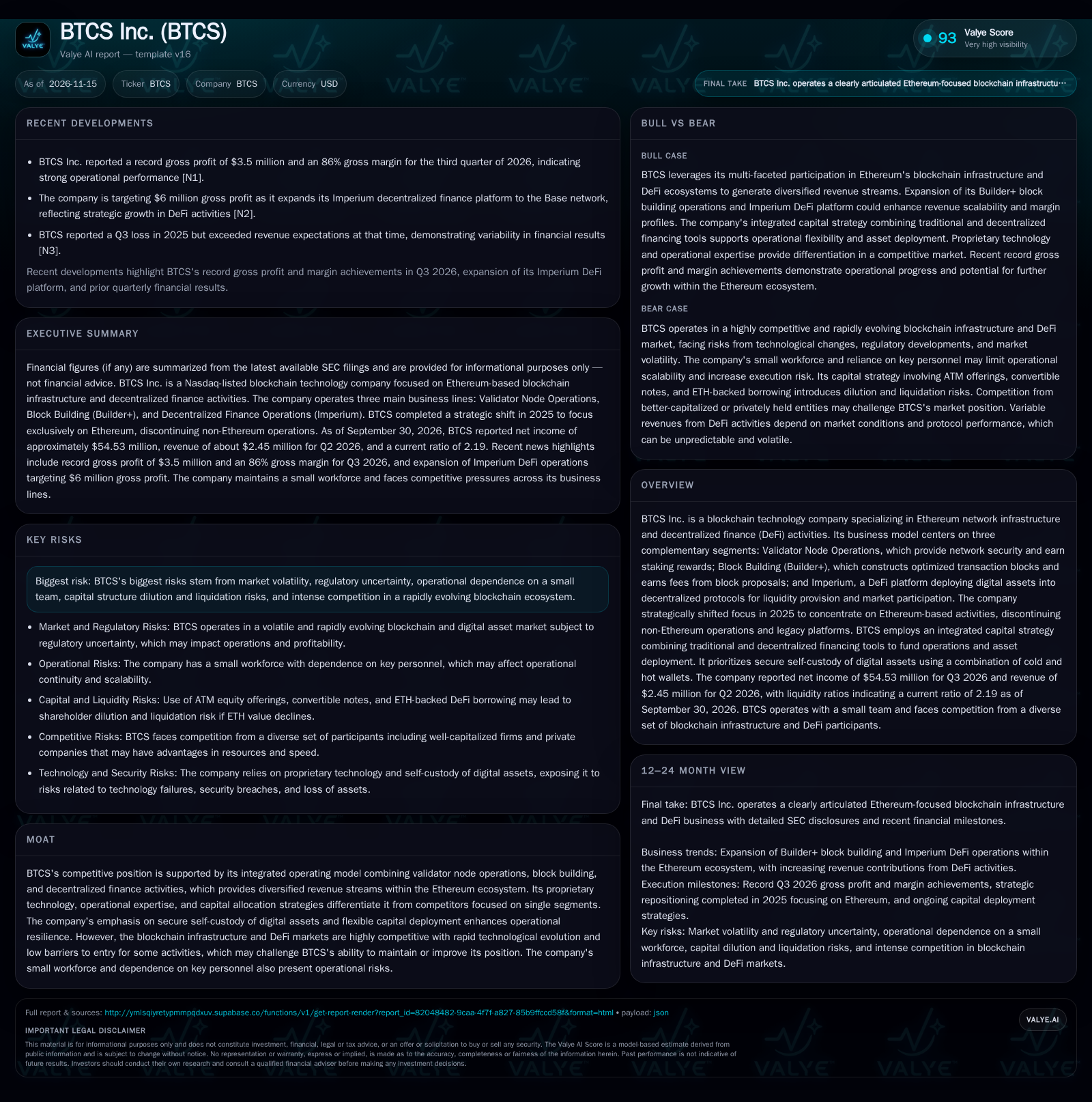
BTCS Inc. has repositioned itself as a focused Ethereum infrastructure and DeFi operator, achieving a record $3.5 million gross profit and 86% gross margin in Q3 2026, while targeting further growth from its Imperium DeFi platform’s expansion to new networks. The company’s small workforce and reliance on proprietary technology create both leverage and execution risks, especially given the volatility and competition inherent to blockchain and DeFi markets. Capital strategy and operational resilience will be critical as BTCS seeks to scale revenue and defend margins amid evolving competitive and regulatory pressures. [N1] [N2] [S2]
BTCS Inc. stands at a strategic crossroads: after a 2025 pivot to focus exclusively on Ethereum, the company has posted record Q3 2026 profitability while simultaneously expanding its DeFi platform and block building operations. With just nine full-time employees, BTCS is leveraging proprietary software and an integrated capital strategy in an effort to build a resilient, high-margin business within the volatile world of blockchain infrastructure and decentralized finance. The company’s future now rests on its ability to scale these operations, defend its margins, and navigate the risks of competition, personnel dependence, and market unpredictability.
Record Gross Profit and Strategic DeFi Expansion Define BTCS’s Recent Momentum
BTCS Inc. reported a record gross profit of $3.5 million and an 86% gross margin for the third quarter of 2026, a significant operational milestone that marks its best quarterly profitability to date. This outperformance is paired with a strategic push to expand its Imperium DeFi platform, now targeting $6 million in gross profit as the platform extends to the Base network. The company’s exclusive focus on Ethereum, formalized in 2025, has streamlined operations across three primary business lines: Validator Node Operations, Builder+ block building, and Imperium DeFi activities. However, with a workforce of just nine full-time employees, the company faces heightened operational execution risks as it scales. [N1] [N2] [S2]
How BTCS’s Revenue Model Converts Blockchain Participation into High Margins
BTCS’s business model is built around three revenue streams, all anchored to the Ethereum ecosystem. Validator Node Operations generate ETH-denominated staking rewards and transaction fees, a model that ties income directly to network participation, uptime, and the underlying value of ETH. Builder+ block building earns fees by constructing optimized transaction blocks for validators, with revenue dependent on block proposal success rates and transaction fee dynamics. The Imperium DeFi platform deploys ETH and stablecoins into decentralized protocols, earning variable yields as a liquidity provider and market participant—revenues here are highly sensitive to protocol utilization rates, DeFi market conditions, and smart contract performance.
The company’s Q3 2026 gross margin of 86% suggests high operating leverage, likely driven by the scalability of proprietary software and a lean cost structure. However, this margin profile may not be fully durable: DeFi yields fluctuate with market sentiment, and validator/block building economics are subject to Ethereum network changes (e.g., protocol upgrades, fee structures). BTCS’s capital strategy—combining equity offerings, convertible notes, and ETH-backed DeFi borrowing—can provide operational flexibility, but also introduces dilution and potential liquidation risks if ETH prices decline. The company’s small team amplifies both efficiency and vulnerability: fixed costs are low, but key-person risk is high, and the ability to scale operations without proportional increases in overhead remains untested. [S2]
Ethereum Infrastructure: Where Proprietary Tech and Scale Confront Low Barriers and Deep Pockets
BTCS operates in a crowded landscape, with competition from individual node operators, technology-focused crypto firms, and financial institutions expanding into blockchain infrastructure. Proprietary software, operational know-how, and secure self-custody of digital assets offer some defensibility—especially as security and reliability become more important to institutional and DeFi participants. However, barriers to entry for validator and DeFi activities are relatively low, and well-capitalized competitors can rapidly deploy capital and technology at scale.
The expansion of Imperium to new networks (e.g., Base) is an attempt to capture additional DeFi yield opportunities and diversify revenue sources, but it also brings BTCS into direct competition with specialized DeFi funds and protocol-native liquidity providers. The company’s ability to innovate, maintain uptime, optimize yield strategies, and deploy capital efficiently will be critical to sustaining any competitive edge. Importantly, BTCS’s small team could be a liability when it comes to responding to protocol changes, security incidents, or scaling demands—while larger competitors may have more robust risk management and development resources.
If DeFi Platform Growth and Builder+ Scale Sustain Margins, Profitable Expansion Could Accelerate
In a favorable scenario, BTCS successfully scales its Imperium DeFi platform across multiple Ethereum-compatible networks, capturing a significant share of DeFi protocol yield and transaction fees. Builder+ operations grow in parallel, benefiting from increased transaction volumes and steady block proposal success on Ethereum. The company’s proprietary technology and operational expertise enable it to maintain best-in-class uptime, security, and fee optimization—translating into sustained high gross margins and growing net income.
Evidence supporting this scenario would include continued quarter-over-quarter increases in gross profit and margin, successful launches and growing assets deployed on new networks (such as Base), and stable or increasing market share in validator and block building activities. The ability to grow revenue without a commensurate rise in operating expenses—leveraging software and automation—would further validate the thesis of scalable, high-margin blockchain infrastructure participation. Confirmation could also come from BTCS attracting institutional partnerships or capital inflows based on its track record of secure, reliable operations and DeFi performance. Any signs of increased workforce capacity without margin degradation would also support the upside case. [N1] [N2]
Operational Progress Continues, But Margin and Growth Volatility Persist as Scaling Is Tested
The most plausible near-term scenario is that BTCS continues to post solid, but potentially uneven, financial results as it pushes for growth in its core business lines. DeFi revenues and validator/block building fees remain variable, reflecting broader Ethereum network activity and market cycles. Gross margins may remain high, but could face periodic compression if DeFi yields fall, block competition intensifies, or security costs rise. The company’s integrated capital strategy allows it to opportunistically deploy assets and raise funds, but also exposes shareholders to dilution and volatility, particularly if ETH prices decline.
Evidence for this scenario would include quarter-to-quarter fluctuations in revenue and profit, periodic capital raises or convertible note issuances, and ongoing announcements of new DeFi deployments or network expansions. Operational bottlenecks—such as delays in scaling the team or responding to protocol changes—would signal the limits of the current model. Management’s ability to maintain operational uptime, security, and compliance amid these pressures will determine whether BTCS can defend its current margin profile as it grows. [S2] [N2]
Execution, Security, or Market Dislocation Exposes the Fragility of a Lean Crypto Operator
In a negative scenario, BTCS’s small workforce struggles to keep pace with operational demands, leading to security lapses, downtime, or missed opportunities as the Ethereum and DeFi landscapes evolve. A severe DeFi downturn, protocol exploit, or major Ethereum network change could sharply reduce yields, disrupt validator economics, or expose the company to asset losses. Capital strategy risks materialize if ETH prices fall, forcing asset liquidation or dilutive financings at unfavorable terms.
Confirmation of this scenario would come from a sudden drop in gross margin or profit, public disclosures of security incidents, or a need to rapidly scale headcount in response to operational failures. Regulatory changes or major competitive entries could also compress fees and erode market share. Evidence of forced asset sales, covenant breaches, or large convertible note conversions would signal capital structure stress. If the company’s proprietary technology fails to keep pace with network changes or security threats, the downside could be rapid and severe. [S2]
Measuring the Durability of BTCS’s Ethereum Bet: What Could Shift the Thesis Next
Quarterly gross profit and gross margin trends—sustained outperformance would support scalability, while compression would indicate margin vulnerability. [N1] [S2]
Assets deployed and yield metrics for the Imperium DeFi platform, especially as it expands to new networks such as Base—if disclosed.
Revenue and fee capture rates for Builder+ block building operations, and any changes in Ethereum protocol economics or competition.
Employee headcount and functional capacity—additions or turnover would illuminate scalability and key-person risk.
Frequency and terms of capital raises, ATM offerings, and convertible note issuances—dilution and capital access will impact shareholder value.
Incidence and disclosure of security events, downtime, or protocol exploits—would directly test operational resilience.
Material regulatory developments affecting Ethereum staking, DeFi participation, or digital asset custody.
Customer or partner concentration—dependency on a handful of protocols, liquidity sources, or validator partners would increase risk if disclosed.
Disclaimer: This is research-only, informational analysis and not investment advice. It may include AI-generated interpretation and general industry context. Always verify important details using primary sources.

Comments